EIC Pathfinder Open 2026: is a 2.6% success rate really enough?
The EIC Pathfinder Open May 2026 cut-off attracted 2,103 proposals from 12,399 participants across 76 countries. Even with an improved budget, the theoretical success rate remains around 2.6%, raising hard questions about competition, applicant effort and proposal quality.
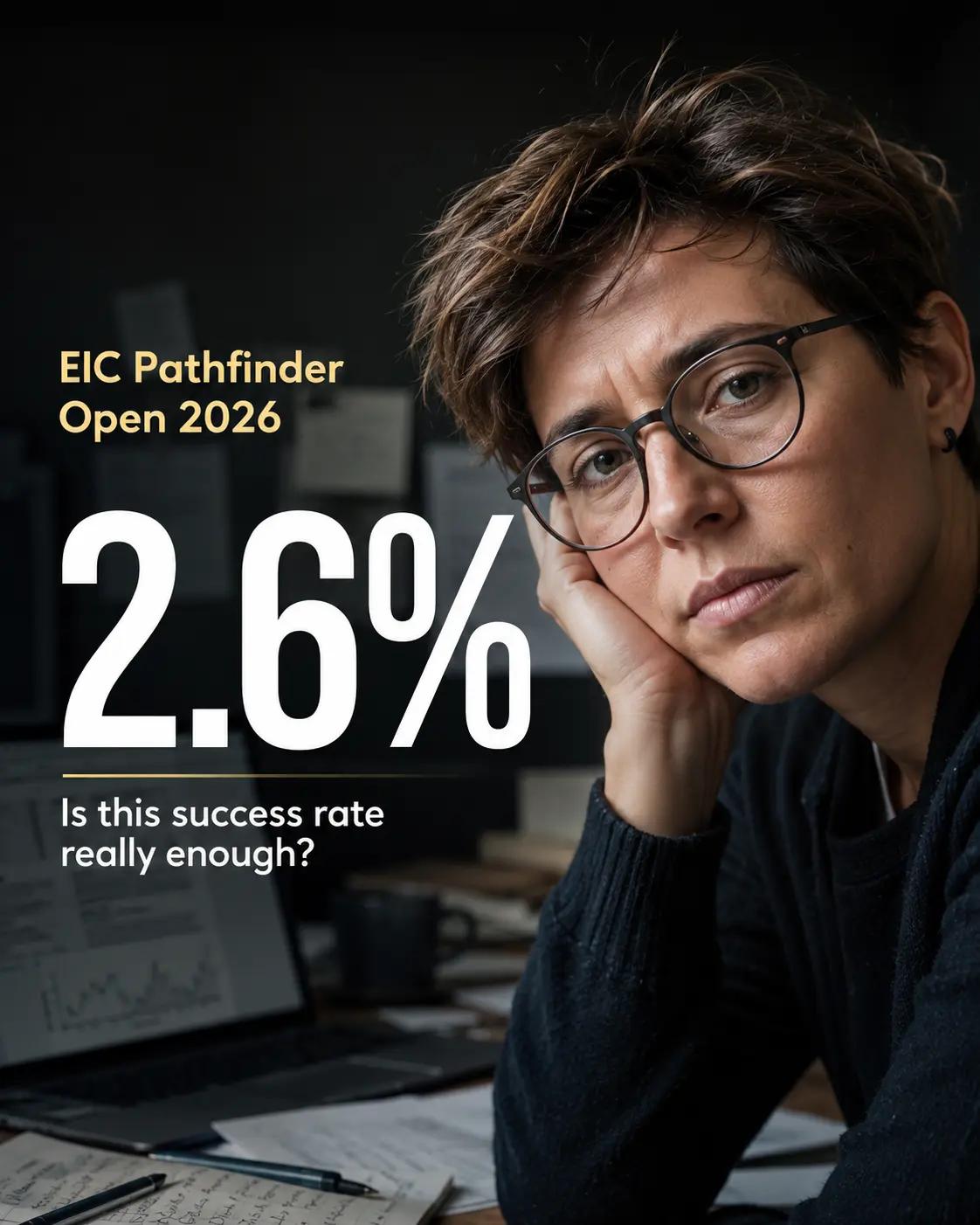
📊 The EIC Pathfinder Open 2026 May cut-off has a number everyone should look at carefully.
2.6%.
That is the approximate theoretical success rate if we divide the estimated available budget by the average EU grant.
According to the submission statistics published by the European Innovation Council and SMEs Executive Agency (EISMEA), the May 2026 cut-off received:
- 📥 2,103 proposals submitted
- 👥 12,399 participants
- 🌍 76 countries
- 💶 €166 million estimated budget
- 📊 €3 million average EU grant
- 🗓️ Results expected in autumn 2026
If the available budget is divided by the average grant, around 55 projects could be funded.
That would represent roughly 25% more funded projects than last year for the same scheme.
So yes, that is an improvement.
But it still means something uncomfortable.
The theoretical success rate would remain only around 2.6%.
Last year, it was around 2.1%.
Better? Yes.
Encouraging? Partly.
Enough? That is the real question.
When success rates become extreme
The EIC Pathfinder Open is designed to fund high-risk, high-gain research.
That naturally requires selectivity.
A programme like this should not fund everything.
It should support frontier ideas with the potential to create radically new technologies, scientific directions and innovation opportunities.
But when success rates remain close to 2-3%, we need to be honest about what that means.
At that level, many excellent proposals will inevitably fail.
Not because the science is weak.
Not because the teams are not capable.
Not because the ideas are irrelevant.
But because the selection pressure is extreme.
This is the point at which competition starts to behave less like normal selection and more like statistical elimination.
We explored this wider issue in When Competition Becomes Statistical Elimination, where extremely low EU funding success rates were discussed not only as a signal of excellence, but also as a potential source of ecosystem distortion.
The same question applies here.
How low can success rates go before strong applicants begin to question whether participation is worth the effort?
The improvement matters, but the pressure remains
Moving from around 2.1% to around 2.6% is not irrelevant.
If the estimate holds, more projects may be funded.
More teams may receive support.
More frontier research may move forward.
That matters.
But the improvement should not hide the scale of the challenge.
A 2.6% theoretical success rate still means that approximately 97 out of every 100 submitted proposals will not be funded.
That is an extraordinary level of competition.
It means that even a high-quality proposal may not be enough.
It means that even strong science may not be enough.
It means that even an experienced consortium may not be enough.
In this type of environment, the real question for applicants is not simply:
The better question is:
Those are not the same question.
What very low success rates do to applicants
Very low success rates create several effects that are often underestimated.
1. They increase sunk costs
Preparing an EIC Pathfinder Open proposal is not a light exercise.
It may require:
- scientific concept development
- consortium building
- work package design
- impact pathway definition
- risk analysis
- budget preparation
- partner alignment
- ethics and data considerations
- internal review
- proposal writing and rewriting
For many universities, research centres, startups and deep-tech teams, this is a significant investment of time and attention.
When the probability of funding is close to 2-3%, the opportunity cost becomes very real.
The question becomes not only whether the project deserves funding.
It becomes whether the team should invest months of work into a process where even excellent proposals may fall below the funding line.
2. They favour experienced applicants
Extreme competition can unintentionally favour applicants with stronger proposal-writing capacity.
Experienced coordinators know how to frame novelty.
They know how to structure consortium logic.
They know how to manage evaluator expectations.
They know how to avoid common weaknesses in Excellence, Impact and Implementation.
Newcomers may have outstanding ideas, but less experience translating them into evaluator-ready logic.
That matters.
Because when the success rate is extremely low, small differences in framing can become decisive.
3. They increase pressure on evaluators
The EIC Pathfinder Open May 2026 cut-off received 2,103 proposals.
That is a major evaluation workload.
Evaluators need to assess complex, interdisciplinary, high-risk research proposals under significant time pressure.
This has consequences.
The clearer the proposal, the easier it is to evaluate fairly.
The more ambiguous the proposal, the more it depends on interpretation.
And interpretation is risky when evaluators are reading many proposals under time constraints.
4. They make rejection feel almost random
This is perhaps the most uncomfortable consequence.
When success rates are extremely low, applicants may start to feel that the process is almost lottery-like.
That does not mean evaluation is random.
It means that from the applicant perspective, the difference between funded and unfunded may feel very narrow.
Especially when the proposal is strong.
Especially when the ESR contains positive comments.
Especially when the rejection comes from small weaknesses, missing justification or slightly lower confidence in feasibility.
This is why feedback quality, strategic fit and proposal clarity become so important.
Excellence is not enough
EIC Pathfinder Open proposals often involve excellent science.
That is the baseline.
But in a 2-3% success rate environment, excellence alone is not enough.
A proposal also needs to show:
- why the scientific ambition is credible
- why the methodology can deliver the expected breakthrough
- why the consortium is necessary and sufficient
- why the work plan is coherent
- why the risks are understood
- why the impact pathway is plausible
- why the project fits the call logic
- why the idea is not only interesting, but fundable
This is where many strong proposals become vulnerable.
They describe exciting science.
But they do not always make the evaluation case fully explicit.
They assume that scientific quality will carry the proposal.
It may not.
At this level of competition, evaluators are not only looking for brilliant ideas.
They are looking for brilliant ideas that are clearly justified, strategically framed and credibly implemented.
What is a healthy success rate for frontier research?
There is no simple answer.
A frontier research programme should be selective.
If the success rate is too high, the programme may lose focus and fund projects that are not sufficiently ambitious or differentiated.
But if the success rate is too low, the programme may discourage strong applicants and overload the evaluation system.
The balance matters.
Some hard questions should be asked:
- ❓ What is a healthy success rate for high-risk, high-gain research?
- ❓ When does competition stop being motivating and start becoming discouraging?
- ❓ How many excellent proposals are lost because the funnel is too narrow?
- ❓ Should applicants receive stronger signals before investing in full proposal preparation?
- ❓ Could feedback loops help rejected teams learn more from the process?
- ❓ Can resubmissions be guided more strategically?
- ❓ Are we making the best use of evaluator time when thousands of proposals compete for such a small number of awards?
These questions are not only administrative.
They affect the health of the European deep-tech and research ecosystem.
Funding programmes do not only allocate money.
They shape behaviour.
They influence which teams apply.
They determine how researchers spend time.
They affect whether newcomers feel the system is accessible.
They influence how much effort is spent writing proposals rather than developing science.
What applicants should take from the 2.6% figure
For applicants, the 2.6% figure should not create panic.
But it should create discipline.
In a programme this competitive, avoidable weaknesses become extremely expensive.
A vague claim is not a small issue.
An inconsistent work plan is not a minor formatting problem.
A weak link between science and impact is not harmless.
A misalignment with the call logic is not just a nuance.
An unsupported assumption is not something evaluators will simply forgive.
A consortium gap that should have been identified earlier can become decisive.
At a 2-3% success rate, these are not small imperfections.
They can be the difference between an outstanding project and an unfunded one.
This is not about making every proposal perfect.
That is impossible.
It is about removing avoidable reasons for doubt.
The most expensive weaknesses are often preventable
The frustrating part is that many proposal weaknesses are preventable.
They are visible before submission if the proposal is reviewed with enough distance and discipline.
Common examples include:
- A breakthrough claim that lacks a clear comparison with the state of the art
- A methodology that does not fully support the stated objectives
- A work package structure that looks busy but not strategically coherent
- A consortium where partner roles are described but not truly justified
- An impact section that describes potential benefits but not a credible pathway
- A risk table that lists generic risks instead of the real uncertainties
- A TRL progression that is asserted but not evidenced
- A budget that does not fully match the ambition or workload
- A proposal narrative that uses different terms for the same concept
- A call fit that is assumed rather than demonstrated
None of these weaknesses necessarily means the project is bad.
But under extreme competition, they reduce confidence.
And confidence is what evaluators need in order to defend a high score.
Lessons from recent EIC Pathfinder results
The EIC Pathfinder Open 2026 statistics also fit a wider pattern across EIC instruments.
Recent EIC calls have shown how narrow the selection funnel can be.
In our analysis of the 2025 EIC Pathfinder Challenges results, only 30 projects were funded out of 647 proposals, a success rate of 4.6%.
That was already extremely competitive.
The Pathfinder Open 2026 theoretical rate of around 2.6% would be even lower.
The lesson is clear.
Strong proposals are being rejected.
Not occasionally.
Systematically.
That does not mean the evaluation process is unfair.
It means the funding funnel is far narrower than the volume of high-quality applications.
For applicants, this changes the standard of preparation.
The question is not:
The question is:
Strategic fit matters more than ever
When success rates are extremely low, deciding whether to apply becomes part of the strategy.
Applicants should ask themselves:
- Does the project truly fit the EIC Pathfinder Open logic?
- Is the research sufficiently high-risk and high-gain?
- Is the breakthrough ambition clear enough?
- Is the methodology credible enough?
- Is the consortium strong enough for this specific challenge?
- Is the timing right?
- Is there enough preliminary evidence to support the concept?
- Is the proposal ready to withstand expert scrutiny?
- Are the expected outcomes differentiated from the state of the art?
- Can the team explain why this project deserves funding now?
A strong proposal starts before writing.
It starts with a hard decision about fit.
Not every good idea is a good EIC Pathfinder Open proposal.
Not every excellent scientific concept is mature enough for the call.
Not every consortium is ready.
Not every timing is right.
This is not discouragement.
It is strategic discipline.
At 2-3% success rates, strategic self-assessment is not optional.
The role of pre-submission pressure testing
In a selective programme, internal review should not only check whether the proposal is complete.
It should challenge whether the proposal is convincing.
There is a difference.
A complete proposal answers every section.
A competitive proposal makes a fundable argument.
A complete proposal includes a risk table.
A competitive proposal identifies the real uncertainties and explains how they will be managed.
A complete proposal describes partners.
A competitive proposal proves why each partner is necessary.
A complete proposal describes impact.
A competitive proposal shows a plausible pathway from research results to future use.
A complete proposal follows the template.
A competitive proposal follows the evaluation logic.
This is why pre-submission pressure testing matters.
Not to make the proposal longer.
Not to make the language more polished.
But to find the weaknesses that evaluators are likely to notice.
Before they appear in the Evaluation Summary Report.
Where Ruthless Evaluator fits
This is exactly why we built Ruthless Evaluator.
To help applicants, consultants, universities, research centres and innovation teams detect weaknesses before submission.
Not only spelling mistakes.
Not only formatting issues.
Not only missing sections.
But the problems that actually damage evaluation confidence:
- ⚠️ unsupported claims
- ⚠️ inconsistencies
- ⚠️ vague logic
- ⚠️ weak assumptions
- ⚠️ unclear impact pathways
- ⚠️ implementation gaps
- ⚠️ misalignment with the call logic
- ⚠️ consortium gaps
- ⚠️ unjustified risks
- ⚠️ weak evidence chains
Ruthless Evaluator cannot change the success rate of the EIC Pathfinder Open.
No tool can.
But when the success rate is around 2.6%, avoidable weaknesses become too expensive to ignore.
The goal is simple.
To help teams find the problems while there is still time to fix them.
Because in a programme this selective, you do not want to discover the weakness inside the ESR.
Better to be honest before submission
The EIC Pathfinder Open May 2026 statistics are impressive.
2,103 proposals.
12,399 participants.
76 countries.
€166 million estimated budget.
Around 55 possible funded projects.
A theoretical success rate around 2.6%.
This shows the strength of European frontier research.
It also shows the pressure applicants face.
The numbers are better than last year.
But they still raise a bigger question.
What should a reasonable success rate look like for a research programme that wants to attract the best ideas without discouraging the very teams it needs?
There is no simple answer.
But for applicants, there is a clear lesson.
In a 2-3% success rate environment, good is not enough.
Even excellent may not be enough.
The proposal must be clear, credible, aligned and defensible.
It must remove avoidable doubts.
It must make the strongest possible evaluation case.
Better to meet Ruthless Evaluator before submission than inside the Evaluation Summary Report.
#EICPathfinder #EIC #HorizonEurope #EUFunding #ResearchFunding #DeepTech #InnovationFunding #GrantWriting #ProposalWriting #RuthlessEvaluator #SuccessRate
Run an evaluator grade review on the draft
Upload a version, select programme context, and get structured feedback you can act on.