EIC Accelerator deadline today: do not disappear after submission
The EIC Accelerator full proposal deadline is not the end of the process. After Step 2 submission, applicants should stay alert, prepare for the Technology Expert Interview and keep the technical, commercial and implementation logic ready to defend.
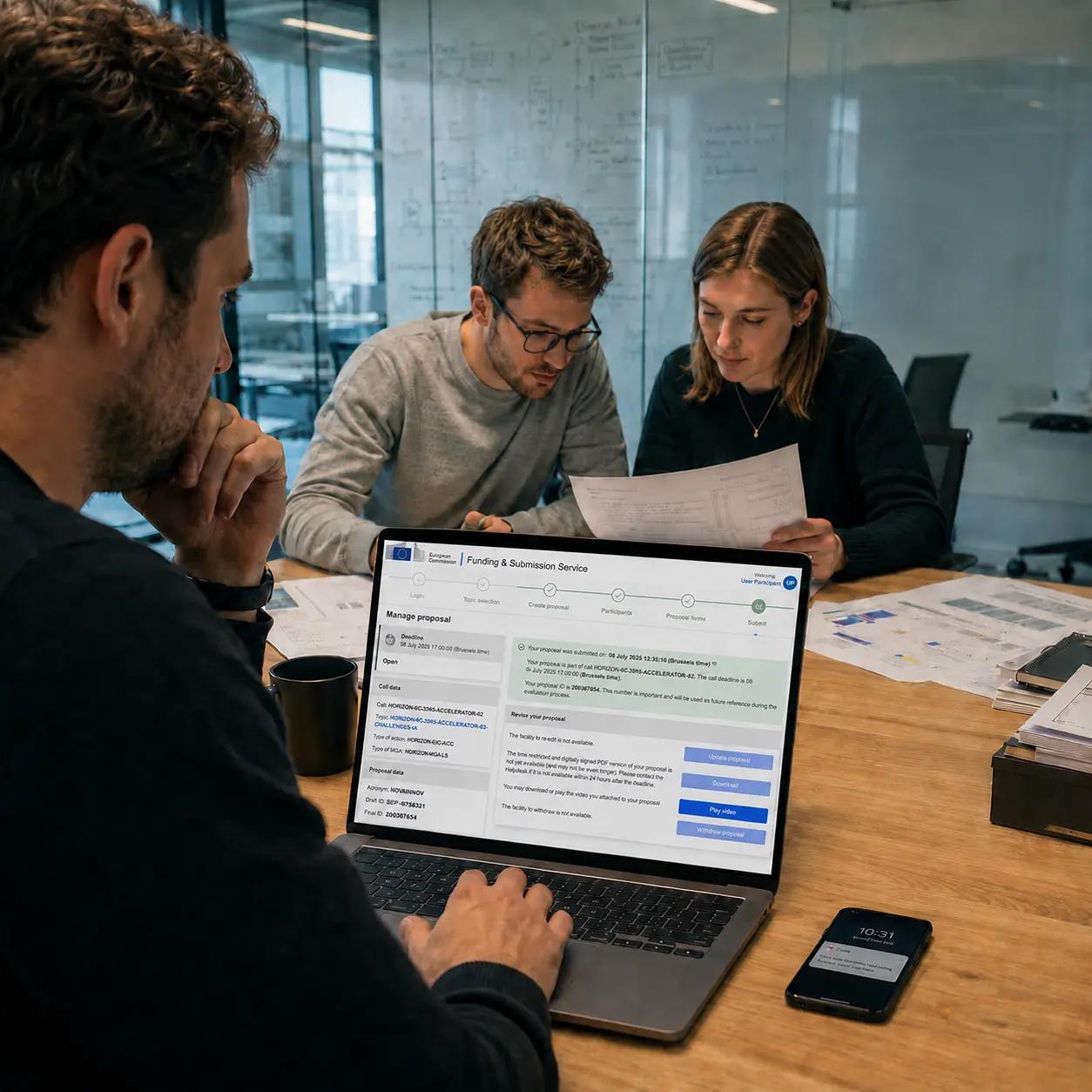
Today is the EIC Accelerator full proposal deadline.
For many applicants, this feels like the end of a long and exhausting process. The final upload has been completed, the forms have been checked, the annexes have been submitted, the financial plan has been reviewed, and the proposal has finally moved out of the hands of the writing team.
That feeling is understandable.
But it is also dangerous.
Submission is not the end of the EIC Accelerator process. It is the beginning of the next evaluation phase. Once the deadline has passed, applicants should not disappear, disconnect or wait passively for the result. The proposal is now inside the remote evaluation process, and the company may soon need to confirm practical details, appoint the right people and prepare for technical questioning.
This matters even more under the 2026 EIC Accelerator process, where the Technology Expert Interview has become an important part of Step 2 evaluation. The company should therefore treat the days after submission as a transition from proposal production to proposal defence.
The worst mistake after submission is to assume that nothing happens until the official result arrives.
Something may happen much earlier.
Step 2 submission is not the end of the evaluation journey
The EIC Accelerator full proposal requires a major effort. Applicants have to combine technology, market, business model, team capacity, financing need, implementation planning, risk management and impact into one coherent application. By the time the deadline arrives, many teams are tired, and the natural instinct is to stop thinking about the proposal for a few weeks.
That instinct should be resisted.
The evaluation process continues after the batching date. The full proposal does not simply wait in a queue until a final decision appears. It enters a process where evaluators assess the written application, and where the Technology Expert Interview can provide additional technical input into the assessment.
This means that the company may have to move quickly from written explanation to live explanation. The same assumptions that looked clear in the proposal may need to be defended verbally. The same technical milestones that were described in the work plan may need to be explained in more detail. The same risks that were summarised in a table may need to be discussed with a specialist who understands the field.
That is a different situation from writing.
A written proposal can be revised, polished and structured over time. An interview answer has to be clear immediately. It has to show that the team understands the project, not only that the consultant or proposal writer produced a good document.
This is why the post-submission period matters.
The Technology Expert Interview is not the Brussels jury interview
One of the most important distinctions for applicants is that the Technology Expert Interview is not the same as the Face-to-Face Jury Interview.
The Technology Expert Interview belongs to the Step 2 remote evaluation process. It is focused on the innovation, the development status, the feasibility of the technical plan, the remaining risks, the implementation logic and the credibility of the project from a specialist perspective.
The Face-to-Face Jury Interview comes later, only for applicants that pass Step 2 and are invited to pitch their innovation to the EIC jury. That later interview is broader. It tests the company, the market, the investment case, the team, the ambition, the execution capacity and the overall credibility of the opportunity.
The distinction matters because preparation should not be the same.
For the Technology Expert Interview, the technical lead must be ready to explain the innovation in depth. This does not mean repeating the abstract or reading the proposal aloud. It means being able to answer direct questions about what has already been validated, what remains uncertain, why the planned methodology is appropriate, which risks could affect implementation and how the team will know whether the project is progressing correctly.
For the jury interview, the company must later defend a broader investment and scale-up story. But before reaching that stage, the project has to survive Step 2.
Applicants should therefore avoid preparing only for the future pitch. The immediate priority after Step 2 submission is to be ready for technical scrutiny.
Why applicants should monitor their email carefully
After the full proposal deadline, applicants should monitor their email carefully, including the accounts linked to the application process and any addresses used by the main contact persons. This is not a cosmetic recommendation. Missing or delaying a practical confirmation can create unnecessary stress during a phase where the company should be focused on preparation.
In the days or weeks after submission, applicants may be asked to confirm or appoint the team members who will participate in the Technology Expert Interview. The company should already know who those people should be.
The right participants are not always the people who wrote the proposal.
They are the people who can defend the project.
Usually, this means the technical founder, CTO, scientific lead, engineering lead, regulatory lead or another person with direct responsibility for the innovation and implementation plan. Depending on the project, it may also make sense to involve someone who can explain industrialisation, clinical validation, data access, manufacturing, certification or another critical dependency.
The key is to avoid appointing people based only on hierarchy.
The interview should include the people who can answer the difficult questions with precision.
If the CEO is strong commercially but cannot explain the technical risk, the technical lead should be prepared. If the CTO understands the prototype but not the regulatory pathway, another team member may need to support. If the innovation depends on a manufacturing process, the person responsible for industrial scale-up should not be absent from preparation.
The company should decide this before the request arrives.
The technical lead should not read the proposal for the first time after submission
A surprisingly common weakness in funding processes is that the proposal becomes disconnected from the people who will later have to defend it.
This is risky in any programme.
It is especially risky in the EIC Accelerator.
The Technology Expert Interview can reveal whether the written proposal reflects the real understanding of the team. If the technical lead has not reviewed the final submitted version, inconsistencies may appear quickly. The expert may ask about a milestone, a performance target, a risk mitigation measure, a validation plan or a technical assumption, and the answer may not match what was submitted.
That creates a credibility problem.
The proposal should not feel like an external document produced for the deadline. It should feel like the company strategy expressed in application format.
After submission, the technical lead should revisit the final proposal, not an old draft. The team should review the exact objectives, milestones, work packages, deliverables, key performance indicators, risk table, market-entry assumptions and financing logic that were submitted.
This review should not be passive.
The team should identify where a technical expert is most likely to ask questions. Which claims are ambitious? Which assumptions depend on future validation? Which risks are critical? Which parts of the methodology are difficult to understand? Which benchmarks may be challenged? Which dependencies could delay implementation?
The best preparation is not memorisation.
The best preparation is knowing the logic well enough to explain it under pressure.
The expert may focus on what the proposal makes look too easy
A Technology Expert Interview is not likely to spend all its time on the strongest and most obvious parts of the application. The expert may focus on the areas where the proposal appears to move quickly from ambition to execution.
This is where applicants should prepare carefully.
If the proposal claims that the solution will reach a higher TRL, the team should explain what evidence supports the current TRL and what exactly will be validated during the project. If the work plan includes a pilot, the team should explain the pilot conditions, success criteria, data sources, customer role and decision points. If the innovation depends on AI performance, the team should explain datasets, model validation, bias control, robustness, cybersecurity and deployment constraints where relevant.
If the project involves medtech, biotech, energy, industrial hardware, advanced materials, robotics, space, defence, dual-use or regulated AI, the expert may also ask about sector-specific barriers. These can include clinical evidence, conformity assessment, procurement cycles, manufacturing tolerances, certification, safety, interoperability, environmental conditions, supply chain constraints, standards or field performance.
A weak answer says:
A stronger answer explains what will be tested, when it will be tested, who will be responsible, which threshold matters and what the team will do if the result is below expectation.
That is the difference between confidence and credibility.
The risk table is not enough
Many applicants treat the risk table as a submission requirement. They complete it, polish the wording and move on. After submission, they rarely return to it.
That is a mistake.
The risk table is one of the most useful preparation tools for the Technology Expert Interview, but only if the team reads it critically. The expert may ask about the real technical uncertainties behind the project, not the generic mitigation language used in the table.
Applicants should therefore revisit the risk section and ask whether each risk is specific, material and connected to the work plan. A risk such as “delays in technical development” is too broad to prepare from. A stronger risk identifies the mechanism of failure, the task where it will be tested, the indicator that will reveal the issue and the contingency plan.
The team should also identify risks that are not fully captured in the proposal but may still come up during questioning. For example, the proposal may mention regulatory approval but not fully explain the timeline. It may mention supplier dependency but not explain alternatives. It may mention customer validation but not clarify access to users, sites, data or infrastructure.
The interview is not the moment to discover these gaps.
The team should find them first.
Do not let the commercial story disappear
Although the Technology Expert Interview is technical, applicants should not forget that the EIC Accelerator is not a pure research grant. Technical feasibility is evaluated in relation to a business and impact trajectory.
This means that technical answers should not be isolated from commercial logic.
If the expert asks why a specific milestone matters, the answer should connect it to market readiness. If the expert asks why a validation environment was chosen, the answer should connect it to customer adoption, regulatory credibility, industrial performance or deployment conditions. If the expert asks why a technical risk is important, the answer should explain how it affects feasibility, cost, timeline or market entry.
The strongest EIC Accelerator projects do not treat technology and business as separate stories. They show how technical progress reduces commercial risk.
This is especially important for deep tech companies. A technical milestone may not generate immediate revenue, but it may make the company more investable, more credible with customers, more ready for certification or more capable of entering pilots.
The interview should make that connection visible.
Summer deadlines require extra discipline
The July 8 deadline arrives just before the summer period, which creates an additional practical risk. People travel, calendars fragment, inboxes are monitored less carefully and key team members may be harder to coordinate.
Applicants should not assume that the evaluation calendar will pause simply because the company is entering a slower internal period.
Timelines may be affected by summer.
They may also not be affected.
The safe strategy is to prepare as if the process could move faster than expected. Before people leave for holidays, the company should agree who monitors communication, who can respond to administrative requests, who will participate in the Technology Expert Interview and when the internal preparation session will take place.
This does not require panic.
It requires ownership.
The company has just submitted one of the most competitive funding applications in Europe. It should not allow a preventable coordination issue to weaken the next step.
What applicants should do in the first days after submission
The first days after the deadline should be used to convert submission energy into evaluation readiness. This does not mean rewriting the proposal. It means preparing the team to defend the logic that has already been submitted.
A practical sequence could look like this.
First, save and circulate the final submitted version internally. Not the near-final version. Not the version used for comments. The exact submitted version.
Second, identify the likely interview participants and make sure they understand their role. The technical lead should not be informed at the last minute.
Third, review the critical assumptions. These include the current TRL, target TRL, validation plan, technical milestones, regulatory or industrial dependencies, customer evidence, revenue timing, financing need and risk mitigation logic.
Fourth, prepare answers to the most likely technical questions. These should be concise, evidence-based and consistent with the proposal.
Fifth, check availability during the coming weeks. If there are holidays, travel days or conferences, the company should know them in advance.
Sixth, assign responsibility for monitoring email and responding quickly to EIC-related requests.
This is not overpreparation.
It is basic evaluation hygiene.
A preparation checklist for the Technology Expert Interview
Before the Technology Expert Interview, applicants should be able to answer a set of questions clearly and consistently.
Innovation and technical maturity
- What is genuinely novel about the technology?
- What has already been validated, and under which conditions?
- What evidence supports the current TRL?
- What will be validated during the EIC project?
- Which benchmarks or comparators matter?
Methodology and implementation
- Why is the planned development plan realistic?
- Which tasks are critical for feasibility?
- Which milestones are real decision points?
- Which deliverables prove progress rather than simply document activity?
- Which assumptions would change the work plan if they fail?
Risks and mitigation
- What are the main technical risks?
- How will the team detect them early?
- What thresholds define success or failure?
- What contingency options are available?
- Which risks could affect market entry, certification, manufacturing or adoption?
Team and execution
- Who owns each critical technical activity?
- Does the team have the right expertise internally?
- Which external partners, suppliers or sites are essential?
- Are access rights, facilities, data or materials secured?
- What happens if a dependency is delayed?
Market and scale-up connection
- Why do the technical milestones matter commercially?
- Which validation results will increase customer confidence?
- Which results will support investor confidence?
- Which outputs are required before first sales or pilots?
- How does the EIC project reduce the risk of scale-up?
If the team cannot answer these questions without improvising, preparation is not complete.
The two previous interview waves show why this matters
The Technology Expert Interview is still relatively new in the 2026 EIC Accelerator process, which means applicants should pay attention to how the process is evolving. We previously discussed this when the EIC Accelerator Technology Expert Meeting phase had started, and again when the EIC Accelerator Technology Expert Meetings had started.
The key lesson from those updates is simple: applicants should not treat the expert phase as an administrative formality. It is part of the evaluation architecture, and it can influence how the technical credibility of the proposal is understood.
This is particularly important for projects where the written proposal compresses complex technical logic into a limited number of pages. The expert discussion may be the moment when the company has to clarify what the proposal could not fully explain.
That opportunity should be taken seriously.
It can help a strong project become clearer.
It can also reveal weaknesses that were hidden by polished writing.
After submission, do not change the story
One important warning: preparation after submission should not become reinvention.
The company should not create a new technical story that is different from the submitted proposal. It should not introduce a different product definition, a different market-entry logic, a different validation plan or a different risk profile unless it is clarifying something that was already present in the application.
The objective is alignment.
The interview answers should help the expert understand the submitted proposal, not wonder why the live explanation sounds like another project.
This is why the final submitted document should be the basis for preparation. Every answer should be consistent with the application, but more precise, more concrete and more responsive to the question being asked.
Good preparation does not replace the proposal.
It makes the proposal easier to trust.
Submission is a milestone, not a finish line
Submitting an EIC Accelerator full proposal is a major achievement. It usually represents months of work, difficult strategic decisions, technical clarification, market analysis, financial modelling, internal coordination and repeated review.
Applicants should recognise that effort.
But they should not confuse the milestone with the finish line.
After submission, the company should stay alert, monitor communication, prepare the right people, revisit the final proposal and be ready to explain the project with technical depth and strategic clarity.
The Technology Expert Interview is not the same as the Face-to-Face Jury Interview in Brussels. It is part of the Step 2 evaluation process, and it should be prepared accordingly.
The practical advice is simple.
Do not disappear after submission.
Monitor your email.
Confirm the right team members.
Prepare the technical lead.
Revisit the critical assumptions.
Be ready to explain risks, feasibility and implementation choices clearly.
The proposal has been submitted.
Now the company has to be ready to defend it.
Run an evaluator grade review on the draft
Upload a version, select programme context, and get structured feedback you can act on.