Why strong projects still get rejected in EU evaluations
Strong projects still get rejected in EU evaluations when the proposal does not make their excellence, impact, feasibility and credibility explicit enough for evaluators to understand, assess and defend.
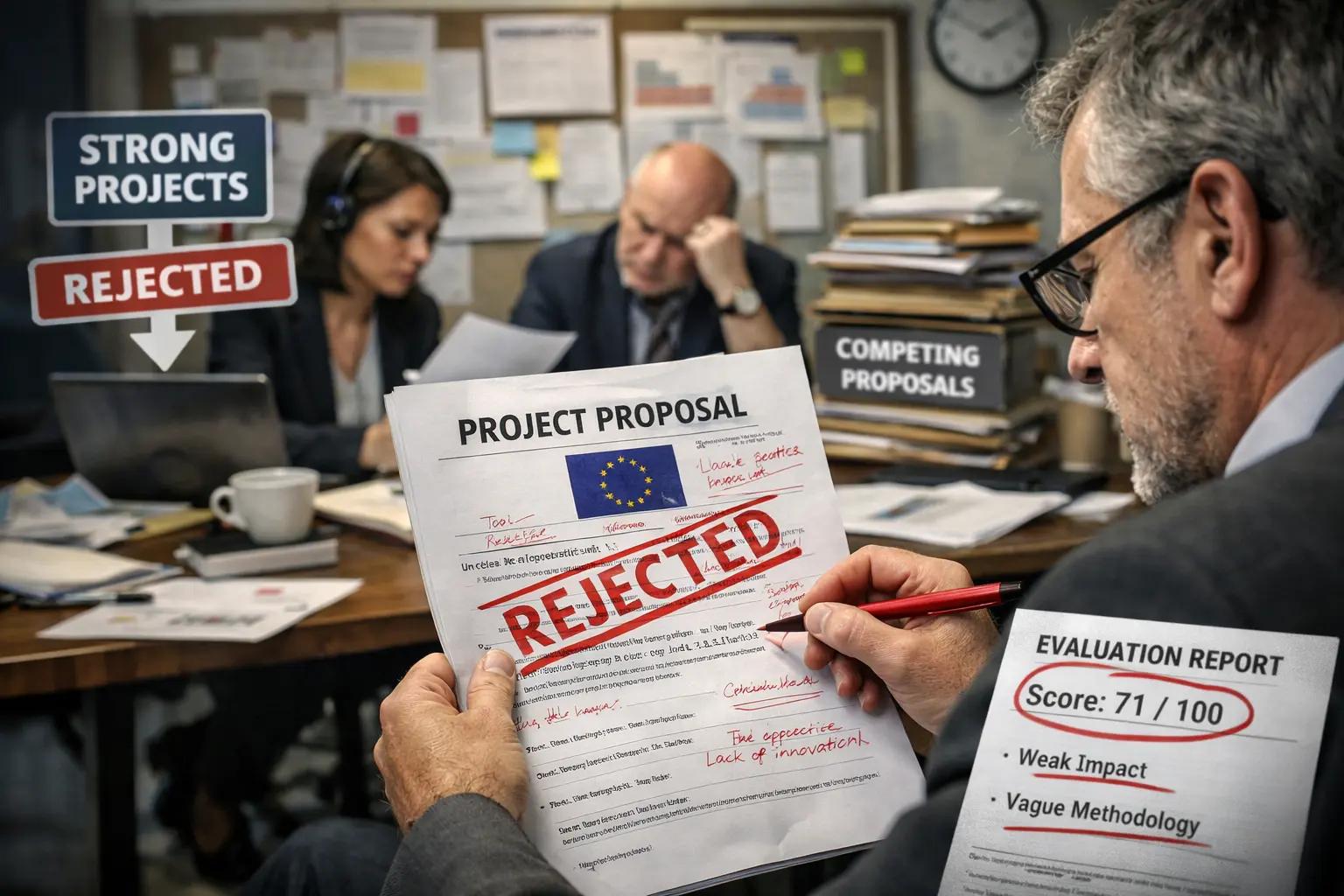
Strong projects do get rejected in EU evaluations. A project may have credible technology, a strong team, a relevant market, a solid scientific basis, and a clear need for public support. It may be aligned with Horizon Europe, the EIC Accelerator, the EIC Pathfinder, the EIC Transition, Eurostars, or another competitive EU programme. And still, it can fail. Not always because the project is weak. Often because the proposal does not make the project strength clear, specific, evidence-based, and defensible enough for evaluators. A strong project is not the same as a strong proposal. The project is what the team is building. The proposal is the evaluated case. In EU funding, the evaluated case determines the score.
Strong projects can fail when the written case is not strong enough
When a proposal is rejected, the first reaction is often frustration. The team may feel that evaluators did not understand the project or that comments missed the real quality of the work. That reaction is understandable. Proposal preparation reflects months of technical discussion, strategy, evidence collection, partner coordination, budget design, and writing. But evaluators do not see the full internal process. They see what the proposal makes visible. If the written case does not communicate the project well enough, the evaluation may not reflect the real project strength. The evaluator cannot reward what is not explicit, verify what is only implied, or defend a high score for an unsupported claim. That is why strong projects still get rejected.
EU evaluations are not purely technical
EU evaluations are structured processes based on criteria, scoring guidance, expert assessment, and sometimes panel discussions. But they are carried out by humans. Humans work under time pressure. They bring different expertise, expectations, reading habits, and tolerance for uncertainty. One evaluator may understand the technical domain but not the product context. Another may understand the market but not the scientific nuance. Another may focus more on implementation risk or impact credibility. The proposal must work across this reality. It must guide the reader, reduce ambiguity, and make the logic easy to follow. Communication quality is not cosmetic in EU funding. It is part of evaluation quality.
Blaming evaluators is rarely enough
Sometimes evaluator criticism may be questionable. Comments can be short, generic, or imperfect. EU evaluation is not perfect. But focusing only on evaluator limitations leaves the team with a conclusion it cannot act on:
A more useful question is:
If the market need was judged insufficiently justified, what evidence did the proposal provide? If implementation was judged weak, how clearly did the proposal connect tasks, deliverables, milestones, risks, and resources? If partner roles were unclear, did the proposal prove why each partner was necessary? The proposal must reduce negative interpretation where it can.
Two uncomfortable realities behind rejected strong projects
When strong projects fail, two realities are often underestimated. Strong is rarely enough. Evaluators assess only what the proposal allows them to see. A team may believe the intrinsic quality of the project should be obvious. A founder may believe the technology clearly solves an important problem. A researcher may believe the novelty is self-evident. A consortium may believe partner value is obvious. But evaluation does not assess internal conviction. It assesses the proposal. If a claim matters for scoring, the proposal must make it visible, specific, and supported. Strong projects often fail because too much remains inside team knowledge.
Strong is rarely enough
Applicants often ask whether the technology is innovative, the team credible, the market relevant, the problem important, and the call fit clear. Those questions matter. But in competitive EU calls, the real question is whether the proposal is strong enough compared with other strong proposals. In Horizon Europe and the EIC, many applicants are serious, experienced, well-connected, and technically capable. Strength is often the entry ticket, not the differentiator. The difference between funded and rejected proposals may depend on clearer problem definition, stronger evidence, better call alignment, a more coherent work plan, credible KPIs, specific partner roles, transparent risk management, stronger impact logic, and consistent terminology. These are not superficial details. They influence whether evaluators can understand, trust, and defend the proposal. A strong project can lose to a clearer proposal.
Evaluators assess only what the proposal allows them to see
Evaluators do not assess what the team knows. They assess what the proposal communicates. They do not know every internal discussion, customer interview, failed experiment, partner decision, or regulatory concern unless the proposal explains it. This principle is simple:
Hidden validation does not score. Hidden customer discovery does not score. Hidden technical maturity does not score. Hidden partner commitment does not score. Hidden regulatory thinking does not score. Only communicated strength can influence evaluation. Internal quality control should test whether the proposal communicates what the team believes it communicates.
The proposal is the evaluator interface
The proposal is the evaluator interface. It is the only interface through which the evaluator can interact with the project. If the interface is unclear, the project feels unclear. If it is inconsistent, the project feels inconsistent. If it hides evidence, the project feels unsupported. If it uses generic claims, the project feels less credible. Every unclear term, unsupported claim, unexplained assumption, inconsistent KPI, vague partner role, generic mitigation, or missing baseline creates friction. Each issue may seem small. Together, they reduce confidence. A proposal does not only need to be impressive. It needs to be assessable, credible, and useful for the evaluator who must justify the score.
Why internal knowledge often fails to become evaluation evidence
Proposal teams often write from internal knowledge. They know why the problem matters, why the technology is different, why the market timing is favourable, and why the methodology makes sense. But internal knowledge is not enough. The proposal must convert it into evaluation evidence. Teams often assume evaluators will understand terminology, state of the art comparisons, pilot design, customer validation, work plan logic, and impact pathway. That assumption is dangerous. The proposal must externalise the logic. It must show evidence where the team feels certainty, make assumptions visible, and define success in evaluable terms. This is why we have argued before that what cannot be measured does not exist in proposal evaluation terms. Ambition needs measurable anchors.
The difference between an excellent project and an excellent proposal
An excellent project may have real substance. It may offer a novel technical approach, address a relevant unmet need, involve credible partners, target a growing market, and contribute to EU priorities. But an excellent proposal must organise that substance into a clear evaluation argument. It must show how the problem leads to the solution. It must show how the solution differs from alternatives. It must show how the methodology validates key uncertainties. It must show how work packages produce outputs and how outputs lead to outcomes and impact. It must also justify the team, budget, risks, and call fit. The project is the substance. The proposal is the evaluated case. Funding decisions are made on the evaluated case.
Why strong proposals are easier to evaluate
A strong proposal does not make the evaluator guess. It does not hide evidence in vague paragraphs or rely on broad adjectives when proof is needed. It does not use call keywords without showing how the project responds. It does not describe partners as excellent without explaining why their role is necessary. It does not present impact as a list of benefits without a pathway. A strong proposal is easier to evaluate because the logic is visible. The evaluator can see what is claimed, why it matters, what evidence supports it, and how the project will prove the next step. This does not mean the proposal should be simplistic. Complex projects need technical depth. But complexity must be controlled. A complex project needs a clearer proposal, not a more complicated one.
Three reasons strong projects are rejected
Strong projects can be rejected for external reasons: competition, limited budget, or unusually strong topic response. But from a proposal quality perspective, three problems appear again and again. The proposal is unclear. The proposal is unsupported. The proposal is inconsistent. These problems do not always look dramatic during drafting. A section may sound professional. A claim may sound plausible. A work package may look complete. A partner description may seem acceptable. But when evaluators read the full application, weaknesses accumulate. The result is a proposal that is difficult to defend at the highest score level. That is enough to lose in competitive calls.
1. The proposal is unclear
Unclear proposals often contain good ideas. The problem is that the reader has to work too hard to understand them. The problem may be described broadly, the solution may be named differently across sections, and the technical novelty may be buried. The target user may shift. The methodology may describe activities without explaining why they are necessary. The work plan may list tasks without making progression clear. The impact section may describe benefits without showing the mechanism. Evaluators may not conclude that the project is bad. They may conclude that it is not clear enough. That is damaging. A strong proposal should help the evaluator understand the project quickly and accurately. Clarity is not simplification. Clarity is control.
2. The proposal is unsupported
Unsupported proposals make claims that may be true, but do not give evaluators enough basis to trust them. The proposal may state that the solution is disruptive, but the state of the art comparison is weak. It may state that market need is urgent, but evidence is generic. It may state that users are interested, but customer discovery is not described. It may state that the consortium is excellent, but partner roles are not tied to tasks. It may state that emissions, costs, waiting times, or inefficiencies will fall, but the baseline is missing. Unsupported claims create a burden of proof that the proposal does not satisfy. A claim is not strong because it sounds confident. A claim is strong because the evaluator can see why it is credible. Evidence should sit close to the claim it supports.
3. The proposal is inconsistent
Inconsistency is one of the most damaging weaknesses in EU proposals. A proposal can contain strong sections and still fail because the sections do not align. The excellence section may describe one technical ambition, while impact suggests another market direction. Objectives may not match work packages. KPIs may not measure promised outcomes. Risks may not reflect real uncertainties. Partner roles may not match task ownership. The exploitation plan may depend on outputs the project will not deliver. These inconsistencies may appear as friction rather than direct contradiction. That is why they are dangerous. They reduce trust. We discussed this in The proposal is not weak, it is inconsistent. The case must hold together as one coherent evaluation argument.
Why “we already said that” is not a sufficient defence
During internal reviews, teams often respond:
This may be true. But it is not always enough. A proposal is not a storage system. It is an argument. If a point is important for scoring, it must appear where the evaluator needs it, with the right clarity, evidence, and connection to the criterion. Pilot partners may be mentioned in the consortium section. But if they are essential to validation, their role must also be visible in methodology, work plan, risk management, and impact pathway. Customer interviews may be mentioned in the market section. But if they justify the problem, target segment, and adoption assumptions, they should connect to those arguments. The better question is:
Evaluator fatigue is a real design constraint
Evaluator fatigue is not an excuse for weak evaluation. But it is a reality proposal teams should consider. A proposal may be technically accurate and still exhausting to read. Long paragraphs without structure increase fatigue. Generic claims increase fatigue. Unexplained acronyms increase fatigue. Inconsistent terminology increases fatigue. Repetition without additional proof increases fatigue. When fatigue increases, evaluators have less patience for ambiguity. They are less likely to infer missing links and more likely to focus on what is clearly evidenced. A strong proposal should reduce evaluator effort. It should make the main argument easy to find, use headings that guide the reader, connect evidence to claims, and repeat key logic strategically. Every section should be useful for evaluation.
The Evaluation Summary Report is often the first time teams see the weakness
Many weaknesses that appear in the Evaluation Summary Report were already present before submission. They were in the draft, visible in the logic, hidden in vague claims, created by inconsistent terminology, or caused by missing evidence. They were left unresolved because the team focused on finishing rather than testing. This is why the ESR can feel surprising. A team may read a comment and think:
Sometimes the information was there. But it may not have been clear enough, connected to the right claim, placed in the right section, supported by evidence, or protected from contradiction elsewhere. Presence is not the same as effectiveness. A strong proposal uses information strategically. It makes critical claims traceable and easier to defend.
Internal quality control is not a polish step
Internal quality control is often treated as a final step. The team writes the proposal, partners send contributions, the coordinator assembles the draft, someone checks formatting, someone reviews grammar, and someone verifies page limits. Then the proposal is submitted. This is not enough. Many serious weaknesses cannot be fixed at the end. A broken proposal logic cannot be solved by polishing sentences. A weak validation design cannot be solved with stronger adjectives. An inconsistent work plan cannot be solved by formatting. Quality control should be part of proposal development. Before writing, the team should define the core logic. During writing, each section should be checked against that logic. Before submission, the full draft should be reviewed as an evaluator would read it.
A useful internal review starts with the call response
One practical quality check is a call response review. The team should take the call text, scope, expected outcomes, eligibility requirements, award criteria, and specific instructions. Then it should map where the proposal responds to each element. Not generally. Specifically. It is not enough to say:
A useful call response review asks which requirement is being addressed, where it is addressed, what evidence supports it, which work package delivers it, which partner is responsible, which expected outcome it contributes to, whether the response is explicit enough, and whether any call requirement is only superficially addressed. This often reveals that a proposal uses the right language but does not fully prove alignment. Call alignment must be demonstrated. It should not be assumed.
The claim-evidence matrix
Another useful quality measure is a claim-evidence matrix. The purpose is simple: list the most important claims and test whether each one is supported. For every critical claim, ask what exactly is being claimed, why it matters for scoring, what evidence supports it, whether the evidence is credible, whether the baseline is clear, whether numbers are traceable, whether assumptions are visible, whether the claim is proportional to the evidence, and whether remaining uncertainty is acknowledged. This can be uncomfortable because it reveals claims that sound plausible but are not fully justified. For example:
What proves uniqueness? A patent analysis, state of the art review, competitor comparison, benchmark, or only team conviction? Another example:
What proves demand? Customer interviews, letters of intent, pilot agreements, procurement data, market research, regulatory pressure, or comparable adoption evidence? The matrix separates argument from opinion.
The consistency check
A proposal should also be reviewed for consistency across sections. This is different from reviewing whether each section sounds good. Each section may sound good alone and still create problems together. A consistency check asks whether the same problem drives the proposal, the solution is described consistently, target users are stable, objectives match work packages, KPIs measure expected outcomes, deliverables support project logic, milestones are meaningful decision points, risks match real uncertainties, partner roles match task ownership and budget, and impact depends on outputs the project actually delivers. Many weaknesses do not live inside one paragraph. They live between sections. Evaluators assess the whole case. The whole case must hold together.
The contradiction check
Contradictions reduce trust. Some are obvious. Others are subtle. The proposal may state that the product targets SMEs, while exploitation focuses on hospitals. It may present current maturity as TRL 4, while the commercial plan implies near-market readiness. It may claim regulatory risk is low, while including no regulatory task or expert role. It may describe a partner as essential, while giving that partner a minor role in the work plan. Evaluators may not write:
Instead, they may comment on feasibility, insufficient justification, unclear implementation, weak impact, or limited credibility. Contradictions often become credibility problems. They should be identified before submission.
The evaluator fatigue test
Another useful quality measure is the evaluator fatigue test. This test asks whether the proposal can be read under realistic evaluation conditions without unnecessary effort. The goal is not to make the proposal simplistic. The goal is to make it easier to assess. Ask whether the main value proposition is understood quickly, key claims are visible, long paragraphs are structured, headings guide the argument, acronyms are explained, figures and tables are useful, technical explanations are precise but readable, criteria are answered directly, key evidence is easy to find, and each section helps justify a score. Evaluators do not read as authors. Authors read with memory. Evaluators read with evidence. The evaluator fatigue test helps close that gap.
The red team review
A red team review is one of the most valuable internal quality checks. It is different from a friendly review. A friendly review asks:
A red team review asks:
A red team reviewer should read like a sceptical evaluator. They should challenge unsupported claims, unclear logic, weak evidence, inconsistent terminology, overclaiming, and hidden assumptions. They should ask which claim they would challenge first, which section depends too much on trust, which assumption is not visible, which KPI is weak, which risk is underestimated, which partner role feels generic, which impact claim feels inflated, which work package lacks detail, and which call requirement is addressed only superficially. A good red team review may feel uncomfortable. That is the point.
Why “we do not have space” is not always a valid excuse
Page limits are real. EU proposals often require difficult choices. But “we do not have space” is often used too early. In many proposals, the issue is weak prioritisation. The proposal may spend too much space on generic background, broad policy context, adjectives, repetition, partner descriptions that do not explain roles, or market trends not linked to the project. Meanwhile, critical evidence is missing. The solution is not to add more words. The solution is to replace weaker text with stronger text. Less generic context. More project-specific logic. Fewer adjectives. More evidence. Less repetition. More traceability. A strong proposal says what evaluators need to assess and defend the case.
Polished weakness is still weakness
Some proposals are well written in a superficial sense. They are fluent, professional, attractive, aligned with EU vocabulary, and confident. But they remain weak. Why? Because polish is not proof. A polished unsupported claim is still unsupported. A polished inconsistent work plan is still inconsistent. A polished vague risk table is still vague. A polished impact pathway without a mechanism is still weak. Good writing matters. But good writing must serve evaluation logic. The purpose of proposal writing is to be convincing under scrutiny. That requires evidence, structure, specificity, consistency, and credible assumptions. Fluency can hide weakness. Evaluation exposes it.
What proposal quality really means
Proposal quality is often misunderstood. It is not only formatting, grammar, professional tone, strong partners, or diagrams. Proposal quality means the application enables evaluators to understand, assess, trust, and defend the project. That requires clarity, coherence, credibility, specificity, traceability, feasibility, alignment, proportionality, and risk maturity. Clarity means the evaluator understands what the project is, why it matters, and what it will deliver. Coherence means problem, solution, methodology, work plan, team, budget, and impact fit together. Credibility means claims are supported by evidence, baselines, references, validation, and realistic assumptions. Traceability means numbers, claims, assumptions, and expected results can be followed. Risk maturity means uncertainty is visible, managed, and connected to decisions. These qualities are evaluation assets. They convert project strength into score potential.
Measurement makes strong projects easier to evaluate
Measurement is one of the simplest ways to make a proposal more evaluator-friendly. Not everything valuable can be reduced to a number. But many important claims become stronger when anchored in measurable terms. Instead of saying:
The proposal should explain which indicator will improve, from which baseline, to which target, under which conditions, and compared with which alternative. Instead of saying:
The proposal should explain which cost category, for which user, by how much, based on which evidence, and at which stage of adoption. Measurement helps evaluators assess the project. It also helps the team clarify what the project is trying to prove. Use measurable evidence where it strengthens the argument.
Risk maturity can strengthen a proposal
Some teams try to hide risk because they fear it will weaken the proposal. This is usually a mistake. In innovation funding, risk is expected. If a project is ambitious, there will be technical, scientific, regulatory, commercial, operational, clinical, data, or scale-up uncertainty. The problem is not risk. The problem is unmanaged risk. A weak proposal says:
A stronger proposal explains the specific risk, why it matters, when it will be tested, which indicator will show whether it is materialising, which partner is responsible, what mitigation will be activated, and what decision will follow. Risk transparency can increase credibility. Risk management is not an administrative table. It is part of the proposal logic.
Overclaiming can damage strong projects
Strong projects sometimes weaken themselves by overstating. They claim the technology will transform an industry, that there is no competition, that adoption will be rapid, that regulatory approval will be straightforward, or that scale-up risk is low. These claims may be intended to show ambition. But evaluators may read them as immaturity. A credible proposal does not need inflated language. It needs a strong, evidenced argument. It is usually better to write:
Than to write:
Unless evidence genuinely supports that level of ambition. Ambition matters. Unsupported ambition is fragile. The strongest proposals are often the most defensible.
Strong teams review proposals differently
Strong proposal teams do not wait until the final days to discover whether the application works. They design quality into the process. They define the core logic before drafting. They align terminology early. They agree on target users, use cases, objectives, outputs, outcomes, and impact pathway. They collect evidence before writing claims. They define measurable objectives. They connect work packages to project uncertainty. They integrate risk management into the methodology. They review partner roles against task ownership and budget. They test the proposal against the call text. They read the draft as evaluators, not only as authors. This does not guarantee success. But it reduces avoidable weaknesses.
A practical quality control checklist before submission
Before submitting a Horizon Europe, EIC Accelerator, EIC Pathfinder, EIC Transition, Eurostars, or other EU funding proposal, teams should test the draft against a demanding checklist.
Clarity
- Can a critical evaluator understand the project without prior context?
- Is the problem defined specifically?
- Is the solution described consistently?
- Is the novelty easy to identify?
- Are technical terms explained where needed?
- Does each section have a clear purpose?
Call alignment
- Does the proposal explicitly address the call scope?
- Are expected outcomes mapped to project outputs?
- Are policy references relevant and specific?
- Is the fit with the programme logic clear?
- Does the proposal avoid generic call keyword insertion?
Evidence
- Are important claims supported?
- Are sources credible?
- Are market numbers traceable?
- Are customer discovery claims specific?
- Are validation results described with enough detail?
- Are benchmarks defined?
- Are assumptions visible?
Measurement
- Are objectives measurable?
- Are KPIs linked to objectives?
- Are baselines clear?
- Are targets realistic?
- Are success thresholds defined?
- Are milestones connected to decisions?
Consistency
- Do all sections describe the same project?
- Are target users consistent?
- Are use cases stable?
- Are TRL claims aligned with the work plan?
- Are impact claims supported by project outputs?
- Are partner roles consistent across sections?
- Does the budget match the described work?
Implementation
- Is the work plan credible?
- Are tasks sequenced logically?
- Are dependencies clear?
- Are responsibilities assigned?
- Are resources justified?
- Are risks linked to tasks?
- Are mitigation actions specific?
Impact
- Is the impact pathway explicit?
- Are target beneficiaries defined?
- Are adoption barriers addressed?
- Is exploitation realistic?
- Are commercial assumptions justified?
- Are expected outcomes connected to evidence?
Evaluator experience
- Is the proposal easy to read under pressure?
- Are key messages repeated strategically?
- Are figures and tables useful?
- Is the narrative coherent?
- Does the proposal reduce doubt?
- Could an evaluator defend a high score using the text?
If several answers are unclear, the proposal may still describe a strong project. But it may not yet be a strong enough proposal.
Internal quality control is not about gaming the system
Internal quality control is sometimes misunderstood. It is not about manipulating evaluators, hiding weaknesses, replacing substance with polished language, inflating claims, or making the proposal sound more impressive than the project really is. Good internal quality control does the opposite. It makes the proposal more honest, specific, transparent, coherent, evidence-based, aligned with the call, and useful for evaluators. It helps the team identify where the case is strong and where it remains vulnerable. It helps prevent avoidable criticism. It helps ensure that real project quality is not lost through weak communication. That is not gaming the evaluation. That is respecting the evaluation.
Where Ruthless Evaluator fits
This is exactly the gap Ruthless Evaluator is designed to help address. Not to flatter applicants, replace expert judgement, generate polished but unsupported language, or promise funding. Ruthless Evaluator exists because strong projects can still be rejected when the proposal leaves avoidable weaknesses unresolved. It helps applicants, consultants, universities, research centres, startups, SMEs, and innovation teams identify where a proposal becomes vulnerable under evaluator-style scrutiny. It helps detect issues such as:
- unclear proposal logic
- weak call alignment
- unsupported claims
- missing baselines
- vague KPIs
- inconsistent terminology
- unclear validation design
- generic risk mitigation
- overclaimed impact
- hidden assumptions
- weak partner role justification
- misalignment between work plan and expected outcomes
- credibility gaps that may later appear in the Evaluation Summary Report
The goal is not to make the proposal sound better. The goal is to make it harder to reject for avoidable reasons. A stronger proposal is one that survives critical reading.
Better to find the weakness before evaluators do
Every rejected proposal receives scrutiny eventually. The question is when. Before submission, scrutiny is useful. It can lead to revision, improve clarity, strengthen evidence, remove contradictions, sharpen the work plan, make the impact pathway more credible, improve risk management, and make call alignment more explicit. After rejection, scrutiny becomes retrospective. The Evaluation Summary Report may identify weaknesses. But the opportunity is already gone. That is why teams should not fear tough internal review. They should fear discovering avoidable weaknesses too late. A demanding pre-submission review is not negativity. It is protection.
Strong projects deserve proposals that make their strength impossible to miss
Strong projects still get rejected. This is not always fair, predictable, or fully under the control of the applicant. But many risks can be reduced by making the proposal clearer, supporting claims with evidence, making objectives measurable, aligning sections, showing risk maturity, connecting work plan, budget, team, and impact, writing for evaluators, and testing before submission. The question is not only:
The better question is:
If the answer is no, the project remains exposed. Not because it lacks value, but because the proposal has not converted that value into an evaluator-proof case. Before submission, teams should ask what an evaluator could misunderstand, which claims are not sufficiently justified, which numbers lack derivation, which objectives are not measurable, which KPIs do not prove progress, which risks are too generic, which partner roles sound interchangeable, which work packages do not support impact, which call requirements are superficial, and which parts depend on evaluator goodwill. These questions are uncomfortable. They are necessary. If the proposal team does not ask them before submission, evaluators may ask them during assessment. And when that happens, the answer becomes the score.
Better to meet Ruthless Evaluator before submission than inside the Evaluation Summary Report.
Run an evaluator grade review on the draft
Upload a version, select programme context, and get structured feedback you can act on.