Ruthless Intelligence: from proposal stress-test to quality assurance
Ruthless Intelligence transforms evaluation history into a quality assurance layer for EU funding proposals, revealing repeatable strengths, growth areas, quality evolution and evidence-based development priorities across researchers, teams and proposal portfolios.
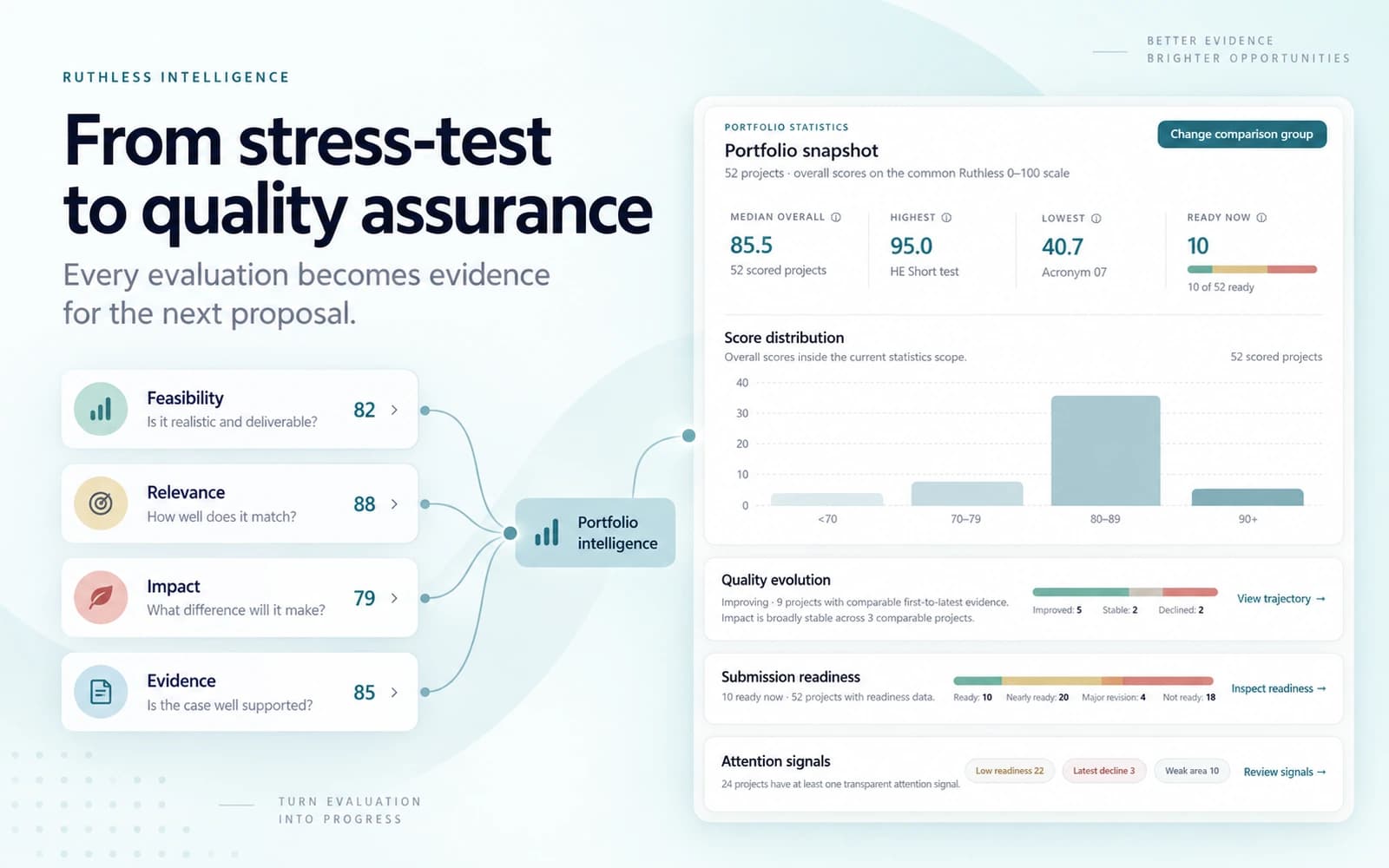
Ruthless Evaluator started with a deliberately narrow mission: stress-test an EU funding proposal before the real evaluators do.
You submit a draft. Ruthless reads what is actually on the page, applies the relevant evaluation logic, identifies score-limiting weaknesses, assesses Submission Readiness and tells you what deserves attention before the next revision.
That remains the core of the product. But it answers only one question:
Today, Ruthless can answer a second and much bigger question:
That is the idea behind Ruthless Intelligence, a new capability that turns evaluation history into an evidence-based quality assurance system for proposal work. Instead of looking at one application in isolation, it learns from the body of work already evaluated in Ruthless and helps you identify repeatable strengths, persistent growth areas, quality evolution and development priorities across a researcher, a team, a programme cohort or any custom selection of projects.
This is an important step for us because it changes what Ruthless Evaluator can be used for. It is still a demanding pre-submission stress-test. It is now also a way to build institutional memory around proposal quality and to learn from the evidence that every evaluation creates.
From one proposal to a quality system
A single evaluation tells you what is happening inside one draft. That is valuable, especially when the deadline is close and the team needs an independent view of what may still cost points.
But proposal quality is rarely a one-document problem. The same researcher may repeatedly under-justify impact. A grant office may consistently produce strong implementation sections but weaker exploitation logic. A consultancy team may improve technical credibility across revisions while continuing to lose clarity around market evidence. A university unit may have dozens of evaluated applications without any systematic way to ask what those evaluations say about the proposal-building process itself.
That is the gap Ruthless Intelligence is designed to address.
The shift is simple: an evaluation should not disappear into a PDF, a meeting or a forgotten revision cycle once the proposal is submitted. It should become part of a learning history.
We have written before that Ruthless Evaluator is not the same thing as ChatGPT or a general-purpose writing assistant. Ruthless is built around evaluation logic, evidence, criteria and revision decisions. Ruthless Intelligence extends that same philosophy from the individual proposal to the history behind the proposal.
Every evaluation becomes part of your quality history
Ruthless Intelligence starts with evaluations that already exist in your account. It can analyse the latest version of each selected project, compare the first and latest compatible versions, or work across all available evaluations when the analytical question requires a wider view.
The Overview gives a portfolio-level picture of the work currently available. It can show the number of projects, evaluation coverage, programmes represented, projects with history, Submission Readiness distribution and overall score statistics. More importantly, it goes beyond totals and asks what those evaluations have in common.
The result is what we call a Quality Signature.
A Quality Signature is not a personality test and it is not a generic AI summary. It is a structured view of patterns found across comparable proposal evaluations. Ruthless looks for strengths that repeat, growth areas that recur, signals that are starting to appear and issues that remain isolated to one project.
That distinction matters because one weak criterion in one proposal is not the same thing as a systematic quality problem.
Established patterns, emerging signals and isolated findings
One of the design decisions behind Ruthless Intelligence was to make repetition explicit rather than letting an AI model decide that something merely feels recurrent.
Pattern classification is therefore deterministic.
An established pattern requires the same type of signal to appear in at least three comparable projects and in at least 25% of the projects in that comparison group. An emerging signal appears across more than one comparable project but does not yet meet the threshold for an established pattern. A finding that appears in only one project remains isolated.
This prevents a common analytical mistake: treating repeated observations from several versions of the same proposal as if they were independent confirmation. In Ruthless Intelligence, projects are the primary unit of repetition. Five versions of one project do not magically become five separate examples of a recurring organisational weakness.
The same discipline applies to positive signals. If a researcher repeatedly demonstrates excellent evidence discipline across comparable applications, Ruthless can surface that strength. If one proposal happens to score very well in one area, the system does not automatically turn that into a defining characteristic.
This is important for quality assurance because the objective is not to produce an impressive dashboard. The objective is to distinguish what the evidence supports from what would merely be an attractive interpretation.
Quality evolution without fake comparisons
Proposal portfolios are messy. Different programmes use different structures. Different stages can use different criteria. Templates change. Evaluation frameworks evolve. A 90 in one context is not automatically comparable with a 90 in another.
Ruthless Intelligence therefore groups evaluations by compatible programme, stage and criteria structure before making criterion-level comparisons. When two evaluations do not belong to a compatible framework, the system keeps them separate instead of averaging them into a number that looks precise but means very little.
That same rule governs quality evolution.
For projects with compatible earlier and later evaluations, Ruthless can calculate whether the overall score improved, remained broadly stable or declined. At portfolio level it can then show how many comparable projects improved, stayed stable or moved backwards. If the available evidence is too limited, the interface says so rather than manufacturing a trend.
This is especially useful when teams revise proposals iteratively. A revision can improve wording while weakening evidence, solve one criterion while creating a contradiction elsewhere, or increase the overall score while leaving one structural problem untouched. Ruthless Intelligence makes that history easier to inspect.
The broader principle is familiar to anyone who has worked on complex EU proposals: quality is not only about whether each section is individually strong. It is about whether the full application remains coherent as it evolves. Our article on Horizon Europe proposal consistency explores that problem at document level. Ruthless Intelligence extends the same quality mindset across projects and over time.
Overview tells you what matters. Explore shows why.
We did not want Ruthless Intelligence to become a dashboard full of charts that look sophisticated but do not help anyone make a decision.
The workspace is therefore split into different jobs.
Overview is the executive layer. It surfaces the strongest supported quality signal, the clearest growth area, quality trajectory and projects that deserve attention. Attention does not mean that a project is bad. It means Ruthless detected a transparent signal such as low Submission Readiness, a decline in the latest comparable revision or a weak evaluation area.
Explore is where you open the evidence behind those signals. You can filter the current scope, inspect established strengths, established growth areas and emerging signals, review quality evolution, examine Submission Readiness, open attention signals and inspect programme-specific comparison groups.
That separation is deliberate. A quality assurance system should let a senior user see the important pattern quickly, while still allowing the analyst, consultant, PI or grant manager to inspect the evidence behind it.
Build an analysis around the person, team or portfolio you actually want to understand
The most powerful part of Ruthless Intelligence is not the automatic Overview. It is the ability to build a focused analysis around a selected body of work.
You can define the context as:
- one researcher;
- a team or unit;
- a programme cohort;
- a custom selection with its own analytical purpose.
You then choose which projects to include and how Ruthless should treat their evaluation history. The analysis can use the latest version per project, compare first and latest versions, or examine all evaluations.
From there, you choose what Ruthless should investigate. Current analysis focuses include overall self-discovery, readiness blockers, growth patterns, improvement and decline, comparison across selected projects and a custom QA question.
The custom option is important. It lets a team ask a question that is specific to the body of work, for example whether a researcher consistently supports claims with enough evidence, whether a unit has improved commercial logic over time, or whether a selected group of proposals shows the same implementation weakness.
Ruthless does not need to invent a generic training plan first and then force the evidence into it. The analytical question comes from the user. The evidence comes from the evaluations.
Deterministic analytics first, AI interpretation second
Ruthless Intelligence uses AI, but we designed the analytical architecture so that the model is not responsible for inventing the underlying statistics.
The quantitative layer is deterministic. It owns the counts, medians, score distributions, readiness states, compatibility groups, pattern classifications, project evolution and attention signals. The interpretation layer receives a bounded analytical digest plus evaluator-derived evidence signals and is instructed to work only from that material.
In practical terms, the AI is not allowed to recalculate the numbers, interpolate missing values, compare incompatible frameworks or turn insufficient evidence into a confident conclusion. It must respect the difference between established, emerging and isolated evidence. It must also keep sample-size and comparability limitations visible when they matter.
This matters because quality assurance needs traceability. A development priority should not appear because an AI model produced a plausible paragraph. It should be connected to evaluation evidence that the user can inspect.
The saved analysis therefore links interpretation back to supporting evaluator evidence where available. It can explain the observed pattern, why it matters, what to focus on next and which underlying evaluation signals support the conclusion.
From findings to a development plan
Knowing that a weakness repeats is useful. Knowing what to do with that information is more useful.
A Ruthless Intelligence analysis can turn supported findings into a focused development plan. The current workflow produces strengths to preserve, development priorities, supporting evidence, a practical three-week development sprint and a learning focus tailored to the selected body of work.
The purpose is not to turn every evaluation into another long report. It is to convert repeated quality evidence into an actionable learning loop.
For example, if several comparable proposals show that market claims are repeatedly under-supported, the development priority should not simply say “improve market section”. It should identify the pattern, explain why it affects proposal credibility, connect it to the available evaluator evidence and define a concrete practice for the next proposal cycle.
Likewise, a recurring strength should not disappear because teams naturally focus on problems. If a researcher consistently translates technical novelty into clear evaluator-facing evidence, that is a capability worth preserving and replicating.
This is where Ruthless Intelligence moves from analytics into self-discovery. The system is not only asking where the proposals are weak. It is helping you understand the habits behind the work.
Your Intelligence history becomes a QA memory
Each completed Intelligence analysis is saved as a snapshot. When you reopen it later, Ruthless shows the result that was saved at that moment rather than silently recalculating it from current project data.
That creates a historical record of what the evidence said at different points in time.
You can return to a previous analysis, compare it with later work, download the saved analysis as a report and see whether the priorities identified earlier are still present, have improved or have been replaced by new ones.
For individual researchers, this can become a development history. For consultancies and grant offices, it can become a quality assurance memory across client or internal work. For universities and research organisations, it can provide a more systematic way to learn from proposal preparation without relying only on informal recollection after each call.
The data still needs to be interpreted with care. Ruthless Intelligence does not prove why a proposal succeeded or failed, and it does not predict funding outcomes. It analyses the quality evidence available inside Ruthless Evaluator and helps users learn from that evidence more systematically.
Why this changes Ruthless Evaluator
When we launched Ruthless Evaluator, the proposition was deliberately sharp: expose weaknesses before submission, while there is still time to fix them.
That proposition still matters. A proposal can contain excellent science, technology or business logic and still lose evaluator confidence because evidence is missing, claims are not justified or important connections remain implicit.
Ruthless Intelligence adds another layer. It asks whether the same problems keep appearing across proposals. It asks whether revisions are actually improving quality. It asks which strengths are becoming repeatable. It asks what a researcher or team should learn next based on evaluation evidence rather than intuition.
That is the difference between a one-off review and a quality assurance system.
A stress-test protects the next submission.
A quality assurance system should also make the next proposal process better.
What this means in practice
Ruthless Intelligence is now included in Professional and Institutional plans. It is designed for users who have enough evaluation history to learn from, but it starts building that history from the first evaluated proposal.
If you already use Ruthless Evaluator iteratively, the change is immediate: the work you have been doing no longer needs to remain a sequence of separate evaluations. It can become a connected evidence base for understanding proposal quality across time.
If you are new to Ruthless, the best starting point is still the same: evaluate a real proposal, revise it, compare what changed and use the findings to make the next version stronger. Our guide on how to get more from Ruthless Evaluator explains that iterative mindset.
Then Ruthless Intelligence adds the longer view.
Every proposal teaches you something. The important part is not losing the lesson.
Open Ruthless Intelligence and start building the quality history behind your proposals.
Run an evaluator grade review on the draft
Upload a version, select programme context, and get structured feedback you can act on.