Most EU proposals do not fail because of evaluators
Most EU proposals do not fail because evaluators misunderstand them. They fail because avoidable weaknesses in clarity, evidence, consistency, and call alignment accumulate before submission.
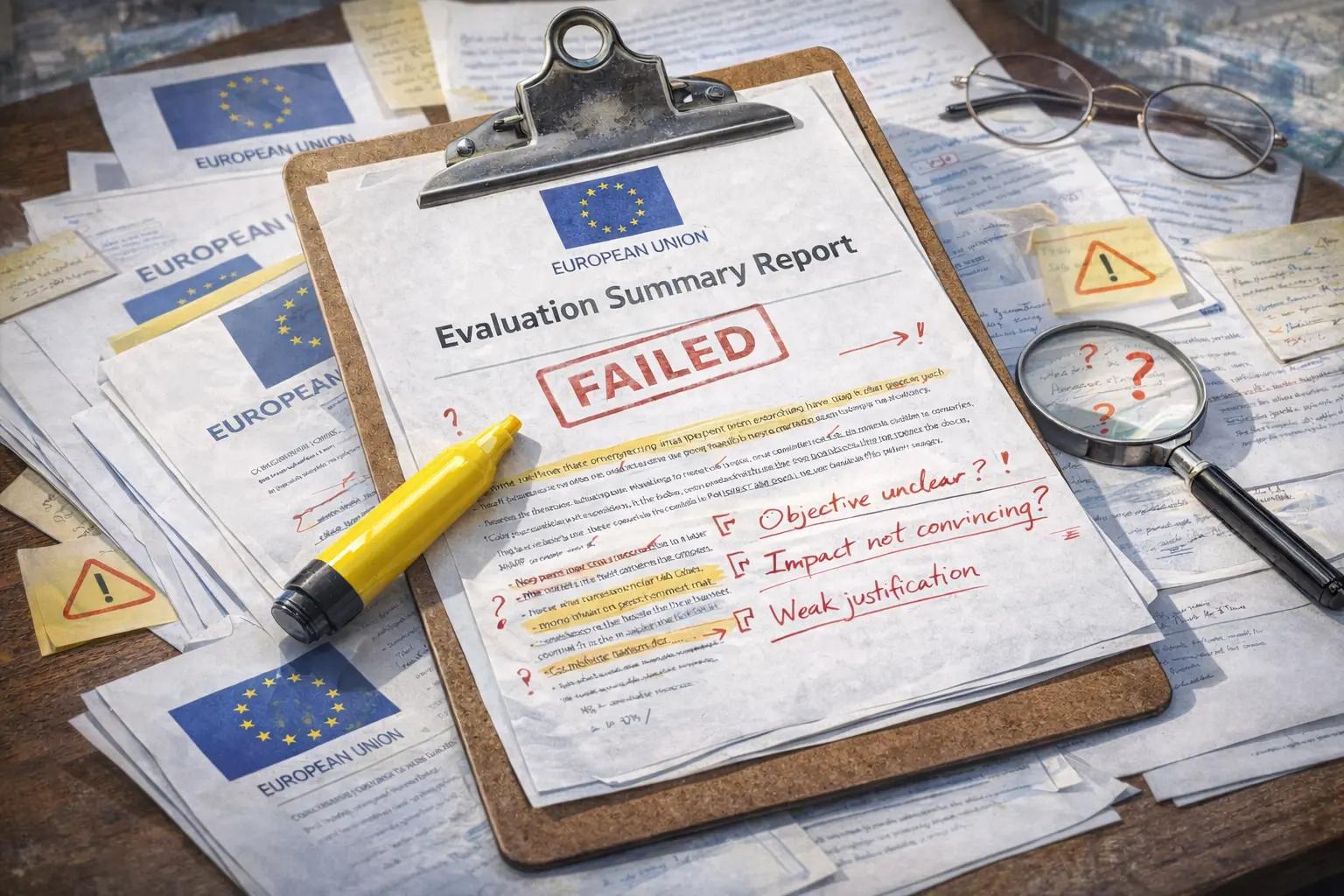
After reading hundreds of Evaluation Summary Reports, one pattern becomes difficult to ignore. Evaluators rarely kill a proposal. More often, proposals weaken themselves before evaluation even begins.
The evaluator is often not the real problem
Even imperfect evaluation can reveal real proposal weaknesses. When the result is negative, it can feel unfair. That reaction is human, but it is not always useful. The team cannot control evaluator perfection. It can control whether the proposal gives evaluators enough material to defend a high score. That shift matters because it turns rejection analysis into improvement. The aim is not to excuse every evaluation decision. The aim is to focus on what was controllable before submission. That is where proposal quality improves.
The useful question is whether the proposal gave evaluators enough clarity, evidence, consistency, and confidence to defend a high score.
Most weaknesses are created before the deadline
Last-minute pressure often makes teams preserve rather than solve these issues. Most proposal weaknesses are not created by the evaluator. They are preserved by the submission process. Evidence may be assumed rather than shown. Terminology may drift between sections. The work plan may change while the impact section remains the same. The budget may be adjusted without updating the justification. These are preparation issues, not evaluation surprises. Good review should catch them before the deadline.
Teams are compressing text, adjusting budgets, chasing partner inputs, fixing formatting, checking templates, and making last-minute decisions.
A proposal can fail without one dramatic mistake
That is why small weaknesses deserve serious attention. This is why rejection can feel confusing. The proposal may look complete. It may contain the right sections. It may sound professional. But evaluation is not only about completeness. It is about trust. Small gaps can accumulate until the evaluator cannot defend the score. That pattern is more common than a single fatal flaw.
Self-destruction mechanism 1: assumed understanding
Explicit logic is a protection against avoidable misunderstanding. Assumed understanding is dangerous because it is invisible to authors. The team reads the proposal and automatically fills the gaps. The evaluator reads the same text and sees missing logic. That difference can decide the score. A proposal should not rely on the evaluator reconstructing the project history. It should make the key reasoning visible. Important logic should not remain inside the team. It should be on the page.
What is not explicit may not be evaluated
Evaluator-friendly writing makes evidence easy to use. Important claims must be easy to locate and verify. If the evaluator has to search for the baseline, the claim is weaker. If the evidence is mentioned but not linked to the conclusion, the argument is weaker. If the partner role is implied but not explained, implementation credibility is weaker. This is not a request for longer text. It is a request for evaluable text. Clarity, evidence, and traceability matter more than volume. The proposal should connect claim to proof directly.
The proposal should explain which efficiency indicator, compared with which baseline, through which mechanism, under which conditions, and validated how. This is why we have discussed evidence in Not sufficiently justified in EU proposals: why evaluators need evidence, not more words.
The problem with internal logic
The proposal must translate the project for someone outside the room. Internal logic is efficient inside the project team. It is risky inside the proposal if it is not translated. Evaluators need external reasoning. They need to see why the task exists, why the partner matters, why the risk is manageable, and why the number is credible. Good proposals often feel simple because the difficult translation work has already been done. That simplicity is not superficial. It is a sign of maturity. It makes the evaluator work less hard.
Self-destruction mechanism 2: local excellence, global incoherence
Cross-sectional review is the antidote. Local excellence can create false confidence. Each section may be acceptable when read alone. But the proposal is scored as a full case. The objectives must match the tasks. The tasks must produce the outputs. The outputs must support the impact pathway. The risks must reflect real uncertainty. The partner roles must match implementation needs.
We explored this in Disruptive technology, clear market strategy and a strong team are not enough.
Evaluators do not only score content
Trust is built when sections reinforce rather than contradict each other. Trust is built across the full application. It is not created by one strong paragraph. It grows when details reinforce each other. It falls when the evaluator has to reconcile contradictions. Separate comments in an ESR may come from one underlying weakness. The case did not hold together clearly enough. That is why coherence is a scoring issue. It is not only a writing issue.
Where incoherence usually appears
Most of these tensions can be fixed if found early. Incoherence often hides between sections. That makes it hard for authors to spot. One section may define the user differently from another. One section may describe the solution as mature, while another reveals early-stage validation. One section may promise impact that the work plan does not generate. Each issue may look small. Together, they make the evaluator reconcile the proposal. The proposal should do that work itself.
Self-destruction mechanism 3: compliance gaps treated as minor details
Substantive compliance is part of fundability. Compliance is not only administrative. It is also substantive. The proposal must comply with the call logic, expected outcomes, template structure, criteria, and evidence expectations. A section can exist and still fail to answer the criterion. A KPI can exist and still fail to measure progress. A risk table can exist and still miss the real risks. These are not minor details in competitive calls. They are places where points are lost.
The template is not a formality
The template should be read as an evaluation map. Templates are evaluation tools. They tell applicants where evaluators expect to find key information. If evidence is in the wrong place, it may not support the score as intended. If objectives are vague, the methodology becomes harder to assess. If impact is a list of benefits without a pathway, the section remains weak. If implementation describes tasks without proving feasibility, confidence falls. Template compliance must therefore be substantive. The section must do the evaluation job.
Why small weaknesses become decisive in competitive calls
Small gaps can matter when competitors are strong. Competitive calls do not reward proposals for being merely acceptable. They reward proposals that make high scores easy to justify. When many applications are strong, small weaknesses matter. A missing baseline, generic mitigation, partial call response, or weak partner justification may affect ranking. These issues are often preventable. That is why review should be stricter before submission. The goal is not perfection. The goal is to remove avoidable reasons to lose points.
The real problem is often communication, not project quality
That is why proposal quality is a strategic issue. Many projects have real merit. But merit has to be communicated in evaluator-ready form. Internal confidence does not count by itself. Customer traction must be evidenced. Novelty must be compared against the state of the art. Partner strength must be linked to tasks. Methodology must show how uncertainty is reduced. Impact must connect outputs to expected outcomes.
A practical internal quality control system
The system should be used before the document feels final. The call response matrix prevents superficial alignment. The claim-evidence review prevents unsupported statements. The coherence review prevents sections from drifting apart. The red team review prevents avoidable evaluator objections. Together, these checks test the proposal as an evaluation object. They are more demanding than proofreading. They are also more useful. They make weaknesses visible while they can still be fixed.
This maps the call text, expected outcomes, scope, criteria, eligibility conditions, and template instructions against the proposal. It should show what evidence supports the response, which task or output delivers it, and whether the link to the call is explicit. This identifies the most important claims and tests whether each one is justified. For every claim, the team should ask what is being claimed, why it matters for scoring, what evidence supports it, what baseline is used, whether assumptions are transparent, and whether the claim is proportional to the proof. This checks whether the same problem, solution, users, objectives, outputs, risks, and impact pathway remain stable across the application. This asks how the proposal could fail by challenging ambiguity, unsupported claims, inconsistencies, overclaiming, missing baselines, weak justifications, and superficial call responses.
The evaluator fatigue test
Reducing friction helps evaluators see the case clearly. Evaluator fatigue is practical, not abstract. Evaluators read under time pressure. They may not infer links that are buried or scattered. Long paragraphs, generic language, inconsistent terms, and dense tables create friction. Clear structure reduces friction. Useful headings reduce friction. Visible evidence reduces friction. A proposal that is easier to assess is less likely to be misunderstood.
The test asks whether the main value proposition is clear, whether headings guide the reader, whether key evidence is easy to find, whether acronyms are explained, whether figures and tables help, and whether the most important claims are repeated strategically.
Ruthless Evaluator and the gap before submission
The earlier this gap is seen, the more useful the review becomes. Ruthless Evaluator is designed to find weaknesses before they become ESR comments. It checks ambiguity, inconsistency, missing baselines, weak call alignment, vague KPIs, generic risks, and unsupported claims. It does not flatter the proposal. It identifies where it becomes vulnerable. That is useful because authors are often too close to the text. They may see intention where evaluators see evidence gaps. The value is early detection. Early detection allows correction.
Ruthless Evaluator reads proposals against call requirements, official templates, and evaluator-level scoring logic. It looks for issues that often become Evaluation Summary Report comments later. Ambiguities. Inconsistencies. Missing baselines. Weak call alignment. Vague KPIs. Generic risks. Claims that sound strong but are not sufficiently justified.
What Ruthless Evaluator does not replace
It supports judgement; it does not replace it. No review tool can guarantee funding. Competitive calls depend on competition, fit, maturity, timing, and evaluator judgement. Expert judgement remains necessary. But evaluator-style review can still reduce avoidable weakness. It can show where a claim needs evidence. Where a section does not answer a criterion. Where logic is unclear. Where polishing has replaced proof.
The goal is not to blame less, but to control more
Control comes from making the case explicit and testable. The point is not to blame applicants. The point is to increase control. Teams can control explicit logic, evidence, alignment, measurable objectives, partner roles, risk management, and ambiguity. They can test whether the proposal is defensible. They can remove contradictions before submission. They can make the evaluator path easier. That is where effort should go. Preventable losses should be attacked first.
Before submission, ask the harder questions
The harder questions are the ones evaluators are likely to ask later. These questions are uncomfortable because they challenge assumptions. They force the team to test whether the proposal is only complete or actually defensible. They also shift review from tone to scoring logic. A proposal may sound good and still lack evidence. It may mention call requirements and still fail to prove response. It may describe the team and still not justify necessity. That is why harder questions matter. They find weaknesses while revision is still possible.
Not only:
But:
Not only:
But:
Not only:
But:
Not only:
But:
Not only:
But:
Better to find the weakness before the ESR does
That is the practical value of evaluator-style review. The ESR is late feedback. It may be accurate, but it arrives after the score is set. Internal review should surface the same weaknesses earlier. That means reading the proposal as evaluators are likely to read it. Not as authors hope it will be read. The aim is not to guarantee funding. The aim is to reduce avoidable weakness. That gives the real project quality the best chance to be judged fairly.
Better to meet Ruthless Evaluator before submission than inside the Evaluation Summary Report.
Run an evaluator grade review on the draft
Upload a version, select programme context, and get structured feedback you can act on.