Your proposal is not weak. It is inconsistent
EU funding proposals often lose points not because each section is weak, but because the Work Programme, official template, evaluation form, objectives, work plan, and impact logic do not align.
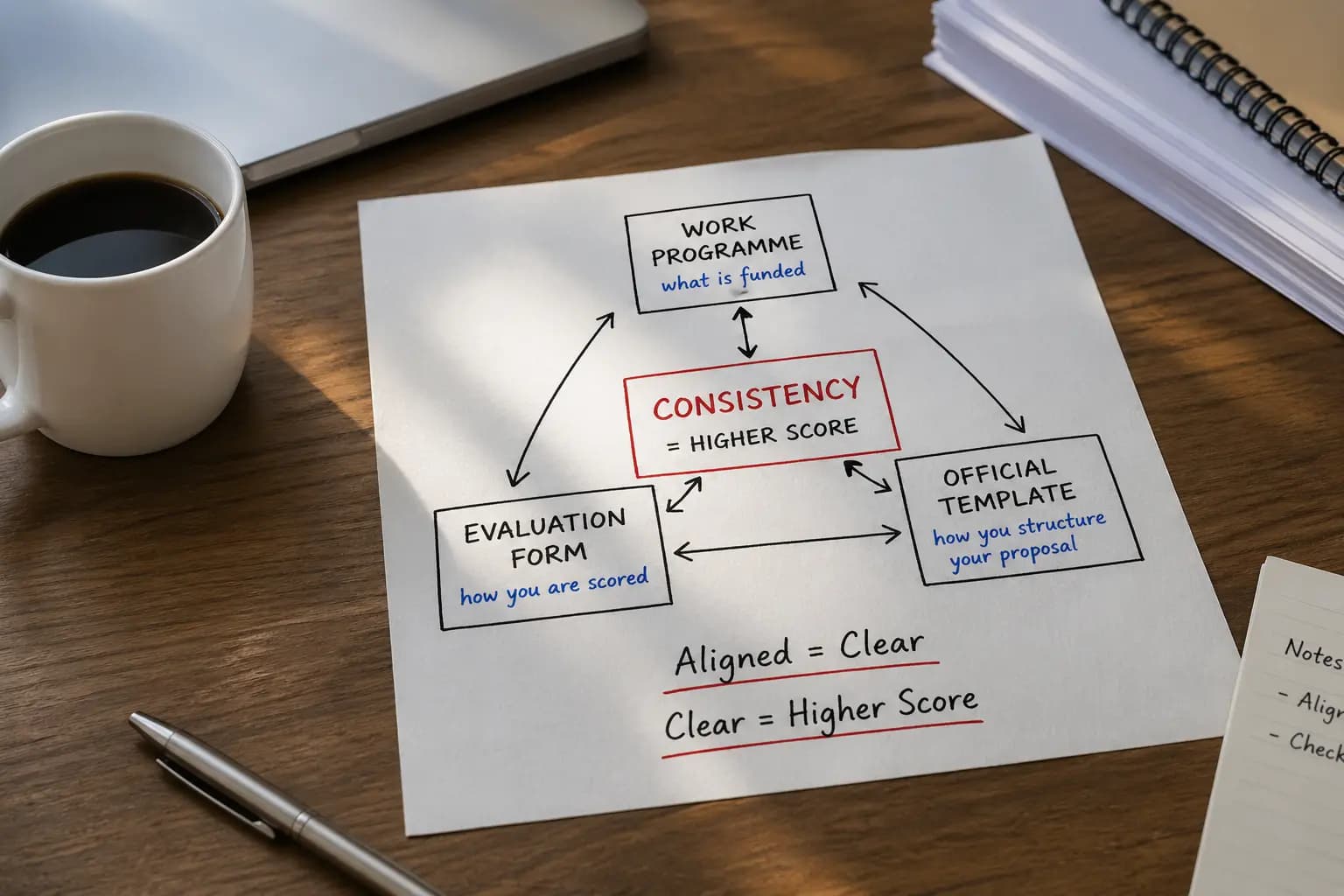
Proposal tip: Your proposal is not weak. It is inconsistent. In EU funding evaluations, consistency often matters more than brilliance. Evaluators are not looking for the best paragraph in each section. They are looking for a proposal that holds together under scrutiny. Many rejected proposals contain strong material. A strong innovation section. A credible team description. A promising market argument. A detailed work plan. A convincing impact paragraph. But when the full proposal is read as a system, the logic does not fully connect. The Work Programme says one thing. The official template asks for another structure. The evaluation form rewards specific evidence. The proposal answers parts of all three, but not in a fully aligned way. That is where points are lost. Not because the project lacks quality. Because the evaluation logic is inconsistent.
Consistency is not decoration
Consistency is often treated as a writing issue. It is not. Consistency is a scoring issue. A proposal can be fluent and persuasive while still creating confusion for the evaluator. This happens when the problem, target user, maturity level, work plan, KPIs, and budget do not tell the same story. Each issue may seem minor. Together, they create doubt. In the Evaluation Summary Report, inconsistency may appear as weak methodology, insufficient impact evidence, unclear implementation, or poor call fit.
The structural inconsistency problem
Most inconsistencies are structural. They appear when the proposal does not align with three external reference points:
- the Work Programme
- the official template
- the evaluation form
The Work Programme explains what is being funded. The template explains where the logic should appear. The evaluation form reflects how the proposal will be scored. A strong proposal connects all three and gives evaluators the evidence they need to justify the score.
The Work Programme defines the funding logic
The Work Programme is not background reading. It defines the logic of the funding opportunity. It explains priorities, expected outcomes, scope, policy relevance, targeted impacts, and sometimes specific conditions. A proposal can be technically strong and still lose points if it does not respond clearly to that logic. This happens when applicants write the project they want to present rather than the project the call is asking for. The proposal may mention the right policy keywords, but fail to show how outputs contribute to expected outcomes. Evaluators are not only asking whether the project is good. They are asking whether this project is a strong answer to this call.
The official template defines the argument structure
The official template is not only formatting. It is a logic container. It tells applicants where the evaluator expects to find certain types of information. If evidence is placed in the wrong section, it may lose force. If call alignment appears only in a general introduction, it may not support the scoring point where alignment matters. If partner roles are described in profiles but not connected to tasks, implementation credibility remains weak. A proposal that uses the template strategically makes the evaluation easier. The goal is to structure the logic in a way evaluators can follow directly.
The evaluation form defines the scoring logic
The evaluation form is where the proposal becomes a score. It reflects the questions evaluators must answer. That means the proposal should provide direct material for those answers. If the form asks whether the methodology is credible, the proposal must show why the methodology can deliver the objectives. If it asks whether impact is convincing, the proposal must show the pathway from outputs to outcomes and expected effects. If it asks whether implementation is credible, the proposal must connect tasks, resources, responsibilities, milestones, risks, and governance. The evaluator may like the project. But liking the project is not the same as being able to justify a high score.
Why strong proposals lose points
Strong proposals often lose points because the main pieces do not reinforce each other. The innovation may be strong, but the link to Work Programme priorities is weak. The market claims may be large, but the impact section does not translate them into expected outcomes. The KPIs may be numerous, but not aligned with what evaluators are asked to assess. The TRL progression may sound plausible, but the work plan does not prove the transition. The budget may be detailed, but not justified against activities and results. None of these issues may destroy the proposal alone. But each one reduces confidence.
Misalignment signals risk
Evaluators are sensitive to risk. Not only technical risk. Also proposal risk. If the proposal does not align internally and structurally, the evaluator may question whether the team is fully in control of the project. A misaligned proposal can suggest that objectives were written separately from the work plan. It can suggest that impact claims were added after the methodology. It can suggest that the budget was built from partner requests rather than project logic. Evaluation is about trust in the full case, and misalignment reduces that trust.
The 15 to 12 problem
In competitive EU calls, proposals rarely fail because everything is wrong. Often, they fail because enough small weaknesses accumulate. A project that could have scored 15 becomes a 13. A 13 becomes a 12. A 12 drops below threshold or below the funding line. This drop comes from friction: a weak link to the Work Programme, a KPI that measures the wrong outcome, a risk table that misses the real uncertainty, or a work package that does not produce the evidence used in impact. Each issue may cost a fraction of confidence. Together, they change the evaluation outcome.
The proposal must be easy to score
A simple test is this:
If the answer is no, the proposal is creating friction. The evaluator should not have to reconstruct the project logic, infer how the work plan supports impact, guess why a KPI matters, search for call alignment, or reconcile different versions of the target market. Under time pressure, evaluators will score what is clear. Not what is implied. A strong proposal makes the score easy to justify.
Consistency starts before writing
Many inconsistencies are created before writing begins. They appear when the team has not agreed on the core proposal logic. What problem are we solving? Which target user matters most? What is the current maturity level? What will the project validate? Which outputs will be produced, which outcomes will follow, and which partners are essential? If these questions are not settled early, each section may evolve in a different direction. Consistency must be designed, not repaired at the last minute.
Inconsistency often hides between sections
A proposal may have no obvious contradiction inside any single section. The inconsistency appears between sections. The excellence section defines the solution as a platform. The impact section presents it as a product. The implementation section validates only one module. The market section sells a full workflow. The risk table manages generic delays rather than module integration. This is why section-by-section review is not enough. Someone must read across the full proposal as an evaluation system.
The problem-solution inconsistency
The first common inconsistency is between the problem and the solution. The proposal may define one problem, then present a solution that seems to solve a slightly different issue. The problem may be framed as high operational cost, while the solution is described in terms of technical accuracy. Or the problem may be user adoption, while the solution focuses on performance. Or the problem may be regulatory uncertainty, while the work plan focuses only on prototype development. This creates a gap. A strong proposal makes the problem-solution relationship explicit. The solution should address the specific limitation described, and the impact should flow from solving it.
The objective-work plan inconsistency
Another frequent inconsistency appears between objectives and the work plan. Objectives may promise measurable progress, but the tasks do not clearly deliver the evidence required. The proposal may state that it will validate performance in relevant environments, but include only laboratory testing. It may state that it will demonstrate market readiness, but include no customer validation task. It may state that it will reduce environmental impact, but include no lifecycle or operational assessment. It may state that it will reach a defined TRL, but the activities do not match that maturity transition. A strong proposal lets the evaluator trace every objective to tasks, deliverables, milestones, risks, and resources. If the trace is broken, scoring becomes harder.
The KPI-impact inconsistency
KPIs often create inconsistency when they do not measure what the proposal promises. A proposal may claim to improve clinical outcomes, but measure workshops and dissemination materials. It may claim industrial efficiency, but measure prototype completion rather than throughput, downtime, cost, or energy use. It may claim customer adoption, but measure website visits. It may claim environmental impact, but omit emissions, energy, waste, or resource indicators. This is not only a KPI problem. It is an impact credibility problem. Aligned KPIs are evidence anchors. Disconnected KPIs are decorative.
The TRL-implementation inconsistency
TRL progression is often described too confidently. The proposal may state that the project will move from TRL 5 to TRL 7. But the work plan may not include the activities needed to justify that transition. TRL 7 usually implies demonstration in an operational environment. If the project only tests under controlled conditions, the claimed progression may look inflated. Similarly, a proposal may claim near-market readiness while still lacking user validation, regulatory pathway, manufacturing feasibility, or integration evidence. Evaluators notice this because TRL is not just a number. It is a claim about evidence.
The budget-outcome inconsistency
Budget inconsistency is another source of doubt. A proposal may claim that an activity is central, but allocate limited resources to it. It may describe a partner as essential, but give that partner a minor budget and unclear task ownership. It may promise extensive validation, but allocate insufficient personnel, travel, subcontracting, equipment, or testing costs. It may claim strong exploitation work, but under-resource business development, regulatory planning, IP work, or customer engagement. Evaluators may not analyse every budget line in detail, but they do assess credibility. The budget should reflect the project logic. If the budget tells a different story from the narrative, credibility suffers.
The partner-role inconsistency
Strong partners do not automatically create a strong consortium. Evaluators assess whether partner roles are necessary and credible. A proposal may include impressive organisations, but still look weak if the work plan does not show specific responsibilities. The partner description may claim unique expertise, but the tasks may not depend on that expertise. The impact section may claim market access, but the exploitation plan may not use that access. The methodology may depend on partner data, but data access may not be clearly described. A strong proposal connects partner expertise to tasks, deliverables, risks, outputs, and impact. The work plan should prove why each partner is needed.
The risk-claim inconsistency
Risk tables often reveal whether the team really understands the proposal. A common inconsistency occurs when the proposal makes bold claims but the risk table remains generic. The project may depend on model performance across external datasets, but the risk table only mentions general technical delays. It may depend on regulatory approval, but risks do not discuss classification, evidence requirements, or compliance uncertainty. It may depend on customer adoption, but risks do not address procurement, integration, or willingness to pay. It may depend on scale-up, but manufacturing or supply chain risks are missing. A strong risk table reflects the real uncertainties behind the main claims. If the risk section manages a different project than the narrative describes, evaluators will notice.
The market-impact inconsistency
Market and impact sections often drift apart. The market section may focus on one customer segment, while the impact section describes benefits for another group. The business model may target enterprises, while the societal impact depends on public sector adoption. These differences are not always wrong, but they must be explained. A proposal can have multiple beneficiaries and stakeholders. However, the relationships between them must be clear. Who pays, who uses, who benefits, who influences adoption, and who is affected by impact? Commercial success and societal value do not need to be identical, but the relationship between them must be explicit.
The call-template inconsistency
Sometimes a proposal follows the official template but misses the Work Programme logic. Other times, it responds to the Work Programme but places information poorly within the template. Both situations create risk. The Work Programme tells the applicant what matters. The template tells the applicant where to explain it. For example, the call may emphasise stakeholder uptake, but the proposal may only discuss stakeholders in dissemination. Or the call may require demonstration in relevant environments, but the work plan may not define the environment clearly. Alignment requires translating Work Programme expectations into template sections in a way that supports scoring.
The template-evaluation inconsistency
The official template and the evaluation form are related, but not identical. A proposal may fill the template and still fail to provide enough scoring material. This happens when sections are completed descriptively rather than evaluatively. A methodology section may describe what will be done, but not why the approach is credible. A work plan may list tasks, but not explain dependencies or decision points. An impact section may describe benefits, but not evidence, scale, or pathway. The template asks for content. The evaluation form asks whether the content is convincing.
Why ChatGPT alone may miss consistency problems
General writing tools can improve clarity, flow, and tone. They can make each section sound better. But consistency problems often require external comparison. The proposal must be checked against the Work Programme, official template, and evaluation logic. It must also be read across sections. A model asked to rewrite a section may improve that section locally while preserving global misalignment. This is why we discussed the difference in Ruthless vs ChatGPT. Writing improvement is useful, but consistency requires evaluator-style scrutiny.
Why AI evaluation must check the structure, not only the text
AI can be useful for proposal preparation, but only if it checks the right things. A superficial AI review may flag grammar, clarity, or missing details. A stronger AI evaluation must test whether the proposal structure holds. Does the proposal answer the call? Do objectives match work packages? Do KPIs match expected outcomes? Does the budget match the plan? Do risks match the main uncertainties? This is the kind of evaluation-oriented review we discussed in EU proposal AI evaluation: would your application survive?. The key issue is not whether the proposal reads well, but whether it can survive scoring logic.
The evaluator should not need to reinterpret
Reinterpretation is dangerous. If the evaluator needs to reinterpret the proposal, the applicant loses control of the meaning. The evaluator may connect the dots correctly, or they may not. They may infer the intended logic, or they may see a gap. They may assume evidence exists, or penalise its absence. A strong proposal should reduce the need for reinterpretation. It should state the logic directly, align terminology, connect evidence to claims, avoid different versions of the project, and make scoring evidence easy to find. This does not mean repeating everything everywhere. It means making the argument traceable.
Traceability makes proposals stronger
Traceability means that the evaluator can follow the chain from one part of the proposal to another. Problem to objective. Objective to task. Task to deliverable. Deliverable to milestone. Output to outcome. Outcome to impact. Risk to mitigation. Partner to responsibility. Budget to activity. Claim to evidence. When this chain is visible, the proposal becomes easier to trust.
Consistency does not mean rigidity
Consistency does not mean the proposal should be repetitive or simplistic. Complex projects often involve multiple objectives, user groups, technologies, partners, and impact pathways. That is normal. Consistency means the relationships between those elements are clear. If there are several target users, explain their roles. If there are several markets, define the sequence. If there are several technologies, explain how they integrate. Complexity is not the problem. Uncontrolled complexity is the problem.
A consistency review should happen before final editing
Many teams review consistency too late. They wait until the proposal is almost finished. At that point, inconsistencies are harder to fix. The page limit is tight. The budget is locked. The work plan is difficult to change. The team focuses on wording rather than logic. This is why consistency review should start early. Before writing, align the project logic. Before submission, test the proposal against the Work Programme, template, and evaluation form.
A practical consistency checklist
Before submission, teams should test the proposal with a consistency checklist.
- Does the same problem drive the whole proposal?
- Is the solution described consistently?
- Are target users stable across sections?
- Are objectives linked to tasks?
- Are KPIs linked to objectives and expected outcomes?
- Does the work plan deliver the promised results?
- Does the TRL progression match validation activities?
- Do risks reflect the real uncertainties?
- Do partner roles match task ownership?
- Does the budget match the work plan?
- Does the market section align with the impact pathway?
- Does the proposal answer the Work Programme?
- Does the evaluation form have enough scoring evidence?
If the answer is unclear, the proposal is exposed.
The Work Programme, template, and evaluation form test
A more advanced consistency test uses three columns. Column one: Work Programme requirement. Column two: where the proposal addresses it in the official template. Column three: which evaluation criterion or subcriterion the evidence supports. This exercise can reveal gaps quickly. A requirement may be mentioned, but not evidenced. A call expectation may appear in the wrong section. An expected outcome may not connect to any work package. This three-column test turns the proposal into a map, not just a document. And a proposal that is easier to follow is easier to score.
What consistency looks like in practice
A consistent proposal does not leave the evaluator asking how things connect. The problem is defined clearly. The objectives respond to the problem. The methodology explains how objectives will be achieved. The work packages generate the evidence needed. The partners have roles that match the tasks. The KPIs measure meaningful progress. The risks reflect the real uncertainty. The budget supports the activities. The impact pathway uses the project outputs. The evaluation criteria can be answered directly from the text.
Where Ruthless Evaluator fits
This is exactly what Ruthless Evaluator is designed to detect. It does not read the proposal in isolation. It confronts the proposal against the Work Programme, the official template, and evaluator-style scoring logic. It helps identify issues such as:
- weak call alignment
- structural inconsistency
- objectives not reflected in the work plan
- KPIs disconnected from outcomes
- TRL progression not supported by validation activities
- impact claims not supported by project outputs
- budget not aligned with ambition
- partner roles not justified
- risks disconnected from the real uncertainties
- evidence placed where it does not support scoring
- template sections completed without evaluation logic
These issues directly affect whether evaluators can understand, trust, and defend the proposal. The goal is not to make the proposal sound better. The goal is to make it hold together under scrutiny.
Better to find inconsistency before the ESR does
Inconsistency is painful because it often becomes visible only after rejection. The Evaluation Summary Report may not say:
Instead, it may say that the impact was not fully justified, the work plan was not convincing, the role of partners was unclear, the methodology lacked detail, or the proposal did not sufficiently address the call. Those comments may feel separate. But they may all come from the same underlying problem. The proposal did not hold together. If all sections do not describe the same project, the proposal may not be weak. It may be inconsistent. And in EU funding evaluations, inconsistency costs points.
Better to meet Ruthless Evaluator before submission than inside the Evaluation Summary Report.
Run an evaluator grade review on the draft
Upload a version, select programme context, and get structured feedback you can act on.