Patent Granted Does Not Mean Freedom to Operate
A granted patent can protect your invention, but it does not prove Freedom to Operate. EU funding proposals must distinguish IP protection from infringement risk, commercial readiness, and third-party blocking rights.
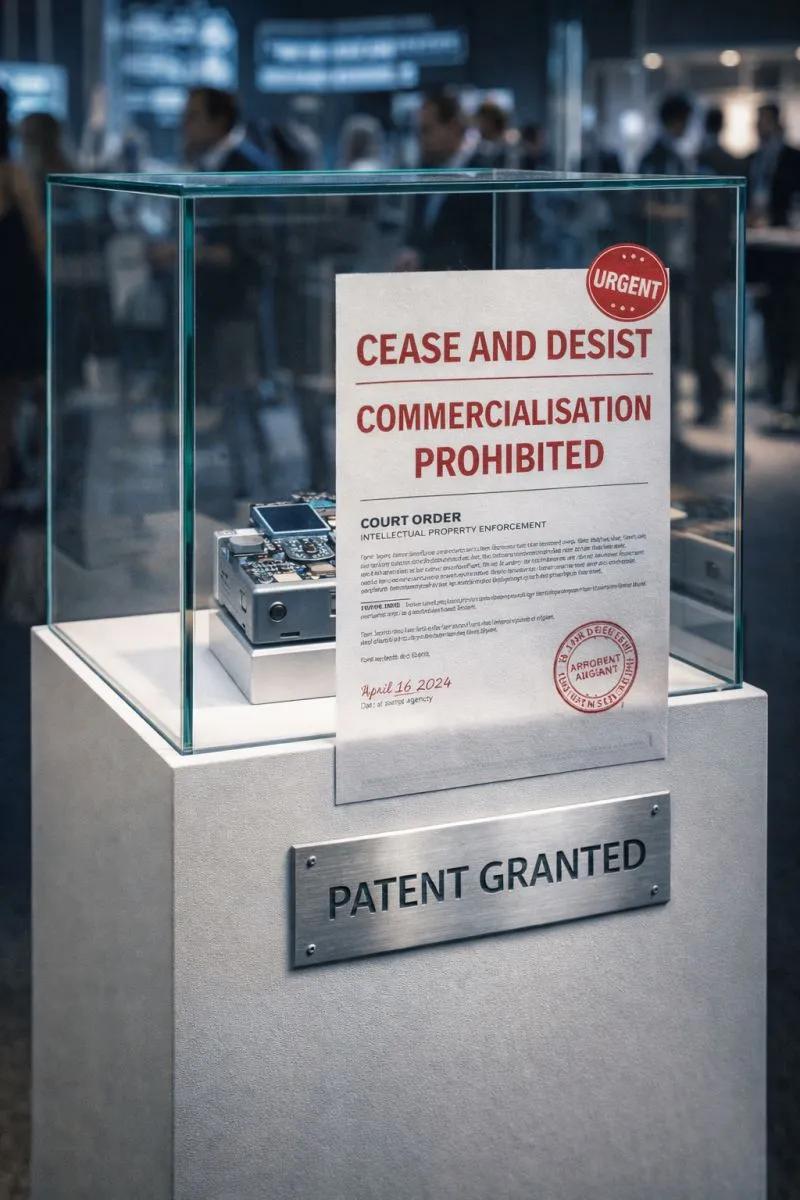
One of the most persistent misconceptions in deep tech, biotech, medtech, clean tech, AI, advanced materials, robotics, and industrial innovation is this:
A granted patent and Freedom to Operate answer different questions. A patent asks whether your invention can be protected. Freedom to Operate asks whether your product can be commercialised without infringing third-party rights. Confusing them weakens EU funding proposals because evaluators assess whether the route to market is credible. If patent protection is presented as proof of commercial clearance, the proposal creates a credibility gap.
Patent protection and Freedom to Operate are not the same thing
A granted patent gives the owner the right to exclude others from using the claimed invention in relevant territories. It can support novelty, defensibility, licensing value, investor confidence, and competitive positioning. But it does not give automatic permission to commercialise. FTO asks whether the actual product, process, platform, device, formulation, software-enabled system, manufacturing method, or commercial configuration can be used without infringing active third-party rights. A company can own a patent and still face infringement risk.
What Freedom to Operate actually means
Freedom to Operate is an assessment of commercial risk. It asks:
Specific product matters because configuration changes can change the analysis. Specific territory matters because patent rights are territorial. Specific time matters because legal status changes. An FTO review usually examines active third-party claims, legal status, expiry dates, pending applications, claim scope, product-to-claim mapping, design-around options, and licensing needs.
What a patent actually proves
A granted patent may show that the invention met patentability requirements in a given jurisdiction. It may support novelty, inventive step, defensibility, and serious IP management. But it proves only what it proves. It does not prove that the product is safe to sell, that no third-party patents exist, or that every target country is clear. A patent protects claims. It does not clear the market.
What patent offices do not assess
Patent offices assess patentability. They may examine novelty, inventive step, industrial applicability, clarity, support, sufficiency, formal requirements, or unity. They do not normally conduct Freedom to Operate clearance. They do not confirm that commercialisation avoids third-party patents. They do not map the final product against all active claims owned by others. They do not issue a commercial permission certificate.
Why a patented invention can still infringe
Patents can overlap. Your invention may improve a broader patented technology, include a protected subsystem, rely on a protected method, or use a protected formulation, coating, carrier, or manufacturing step. You may have a patent on the improvement and still need permission to commercialise the full product. A simple distinction is:
The blocking patent problem
A blocking patent exists when a third-party patent covers something necessary for commercialising the product, process, or service. A company may patent an improved sensor while a broader system is covered by another patent. A biotech company may patent a formulation while the delivery platform is protected elsewhere. A materials company may patent an additive while production depends on a patented step. Evaluators do not need a full legal opinion, but they need to see that the team understands the risk.
Why this distinction matters for EU funding
For EU funding applicants, patent protection versus FTO affects commercial readiness, exploitation credibility, investment readiness, risk management, and market entry. In EIC Accelerator, EIC Transition, Eurostars, and Horizon Europe proposals, evaluators often expect IP and exploitation risks to be considered seriously. A proposal that says only “we have a granted patent” may look insufficient. Evaluators may ask which territories are protected, whether third-party rights were reviewed, whether blocking patents exist, whether licenses are needed, and whether FTO is complete, partial, ongoing, or not yet performed.
IP strategy answers a different question
An IP strategy asks:
It may include patents, trade secrets, jurisdictions, ownership, background and foreground IP, licensing, software, data, know-how, designs, brands, enforcement, partnerships, and investment. A strong IP strategy can be central to the commercial case. But it does not answer whether the company can commercialise without infringing third-party rights. IP strategy is about protection and value capture. FTO is about operational permission and infringement exposure.
FTO answers the commercial clearance question
FTO asks whether the planned product or process can be deployed in defined territories without unacceptable infringement risk. A prototype may not be the final product. A pilot version may avoid elements that later enter the scaled product. A European launch may face a different patent landscape than a US, Japanese, Chinese, or global launch. A proposal should avoid saying:
Unless the scope is clear: for what, where, when, based on which analysis, and with which limitations.
The problem with generic IP claims
Many proposals include IP claims that sound confident but mix different concepts. For example:
A granted patent may support IP position, but it does not ensure FTO. A stronger proposal separates the claims:
Why “we have a patent” is not enough for commercial readiness
A granted patent can be a strong asset. But commercial readiness requires more than asset ownership. If a proposal claims near-term market entry while FTO status is unclear, evaluators may question the route to market. If it claims rapid scale-up across countries without territory-specific review, the plan may look premature. If it claims low risk but relevant third-party rights are not discussed, the risk plan may look incomplete. We discussed the market side of this problem in Does your project have a higher market share than Tesla?. The same logic applies to FTO: assumptions must be visible.
FTO is not a one-time slogan
Freedom to Operate is sometimes written as if it were a static label:
But FTO is a scoped assessment that can change. New applications may publish, pending claims may be granted, claims may be amended, competitors may file, patents may expire, and product configuration may change. A mature proposal describes FTO status with scope and limitations. For example:
Territory matters
Patent rights are territorial. A European patent may be validated only in selected countries. A US patent has no direct effect in Europe. A competitor may have active rights in one market but not another. An FTO review for Spain does not automatically clear the United States. If Europe comes first, say so. If the US comes later, explain whether FTO has been assessed or will be assessed before entry. The market entry plan and IP risk assessment should be aligned.
Product configuration matters
FTO is not assessed against an abstract idea. It is assessed against the actual product or process. The analysis may depend on components, method steps, software functions, materials, manufacturing process, dosage, formulation, delivery system, data pipeline, model architecture, interface, or device integration. If the product is still evolving, the FTO analysis may need to evolve too. A strong proposal can state that FTO has been reviewed for the current configuration and will be updated at design freeze points.
Time matters
FTO depends on time. Patent rights expire, applications publish, claims change, oppositions occur, licenses are negotiated, and competitor portfolios evolve. The risk landscape at submission may not be identical to the landscape at market entry. For long development timelines, the proposal should make updates part of risk management. For example:
Legal status matters
Not every patent document creates the same risk. A granted active patent is different from a pending application. A lapsed patent is different from an enforceable one. An expired patent is different from a pending divisional. A broad claim under examination is different from a narrowed granted claim. If risks are material, avoid simplistic statements. A stronger proposal may say that adjacent patent families were identified, expired rights were discounted, pending claims will be monitored, and no active granted claim reads onto the current pilot configuration.
Claim scope matters
FTO is not based on patent titles, abstracts, or broad descriptions. It depends on claims. A title may sound relevant while the claims are narrow. An abstract may describe a similar field while the claims do not cover the product. The opposite can also happen. A harmless-looking document may contain a claim covering a critical method step, component, or use case. Serious FTO analysis maps product features against claim elements. A proposal does not need the full mapping, but it should show claim-level awareness where FTO matters.
Patent landscape is not the same as FTO
A patent landscape review and an FTO review are related, but not identical. A landscape review maps activity in a technological field. It does not automatically answer whether the product infringes active claims. An FTO review is narrower and legally focused. It asks whether specific commercial activity may infringe enforceable rights. A landscape may inform FTO. It does not replace it.
Why evaluators care about the distinction
EU evaluators are not patent courts. They are not expected to conduct infringement analysis. But they assess credibility. If a proposal depends on commercialisation, scale-up, licensing, market entry, or investor readiness, IP and FTO become relevant. A proposal that handles IP accurately signals maturity. A proposal that confuses patentability and FTO signals risk. The weakness may appear as comments on commercialisation, exploitation, third-party IP constraints, route to market, or IP-related risk management.
Patent claims and proposal claims are different
Patent claims define legal scope. Proposal claims define what applicants ask evaluators to believe. A proposal that says “our patent protects the solution globally and ensures market exclusivity” may make several unsupported claims at once. Does the patent protect the full solution? In which territories? Does it cover the commercial differentiator? Are substitutes available? Are third-party rights relevant? Proposal claims about IP should be as disciplined as technical or market claims.
Protection and permission are different
The simplest distinction is this: Protection and permission are different. Patent protection is about what you can prevent others from doing within the scope of your rights. Freedom to Operate is about whether others can prevent you from doing what your commercial plan requires. A mature proposal can say:
A weak proposal says:
FTO and investor readiness
Investors often care about FTO because infringement risk can affect exit value, licensing strategy, market entry, and litigation exposure. This is especially true in patent-dense sectors such as biotech, medtech, pharma, advanced materials, semiconductors, robotics, energy storage, manufacturing systems, telecommunications, AI-enabled hardware, and industrial equipment. Commercial products may combine multiple protected technologies. If a proposal claims investment readiness but does not discuss FTO where relevant, the argument may be incomplete. IP protection supports value. FTO supports execution.
FTO and licensing strategy
FTO does not always mean no third-party rights exist. Sometimes a license may be needed. That is not necessarily fatal. A credible licensing strategy can be a valid mitigation. For example:
This is stronger than pretending the issue does not exist.
FTO and design-around strategy
A design-around strategy modifies the product or process to avoid infringement risk while preserving commercial value. It requires technical and legal analysis. It is not enough to say that design-around is possible. The proposal should explain whether alternatives exist and whether they affect performance, cost, timeline, or regulatory pathway. For example:
This links FTO risk to technical contingency.
FTO and staged market entry
A staged market entry strategy can reduce IP risk. The company may launch first in territories where FTO risk is lower or already assessed. It may delay entry into jurisdictions where additional clearance is needed. It may start with a product configuration that avoids riskier features. It may partner with an established player that holds relevant licenses. For example:
FTO and consortium projects
In collaborative Horizon Europe proposals, FTO can become more complex. Multiple partners may contribute background IP. New foreground IP may be created during the project. Different partners may have different exploitation routes. Joint ownership may arise. A university may contribute research results. An SME may commercialise a product. An industrial partner may provide platform technology. The proposal should clarify ownership, access rights, exploitation rights, licenses between partners, and monitoring of third-party IP where relevant.
Background IP is not automatically available
Consortium partners cannot freely use each other rights just because they are in the same project. Access rights must be defined. Background IP must be identified where relevant. Use for project implementation may differ from use for exploitation. A partner may allow use during the project but not commercialisation. If exploitation depends on partner background IP, the proposal should show that access has been considered.
Trade secrets and FTO
Trade secrets can be a valid IP strategy. Know-how, manufacturing parameters, data processing methods, algorithms, formulations, supplier relationships, or process optimisations may be better protected as secrets. But trade secrets do not provide FTO. They may protect internal know-how from disclosure or misuse. They do not prevent infringement of third-party patents. A company can keep a process secret and still infringe an active claim. Confidentiality is not clearance.
Open-source software and FTO are also different
For software-enabled projects, open-source compliance is important. It concerns license obligations, redistribution, copyleft, attribution, compatibility, and commercial use conditions. But it is not identical to patent FTO. Some open-source licenses include patent grants. Some include termination provisions. Some do not eliminate patent risk from third parties outside the license. Software licensing, patent FTO, data rights, copyright, confidentiality, and contractual issues should be treated separately where relevant.
Regulatory clearance and FTO are different too
Regulatory clearance and FTO are also different. A medical device may receive regulatory approval and still face patent infringement risk. A product may comply with safety standards and still infringe a third-party patent. Regulatory approval asks whether the product meets requirements for safety, performance, quality, or market authorisation. FTO asks whether third-party rights may block commercial activity. Compliance is not permission to infringe. FTO is not regulatory approval.
How to write IP and FTO in a proposal
A strong proposal does not need a full legal memorandum. It needs enough precision to show maturity. A useful IP and FTO paragraph can state what IP the applicant owns or controls, what it covers, which territories matter, whether it covers the commercial configuration, whether an FTO review was performed, what scope it covered, which territories were assessed, whether third-party risks were identified, what mitigation is planned, when the analysis will be updated, and how IP/FTO risks fit the exploitation plan.
Weak wording versus stronger wording
A weak proposal might write:
This is weak because the conclusion does not follow from the evidence. A stronger version would write:
This separates patent ownership from FTO, defines scope, identifies uncertainty, and connects mitigation to the work plan.
When FTO is not yet complete
Not every project has full FTO at proposal submission. That is not automatically a problem. Early-stage projects may still be defining the final product. Research projects may not yet have a commercial configuration. Pathfinder-type projects may be far from market deployment. Transition or Accelerator projects may need more advanced IP and FTO evidence. The problem is not always incomplete FTO. The problem is pretending it is complete. A mature proposal can state when full FTO will be conducted and how monitoring, design-around assessment, and risk management will be handled.
FTO depth should match the maturity level
Expected FTO detail should match project maturity. An early research project may mainly need IP awareness and exploitation governance. A project moving toward a validated innovation opportunity may need a clearer view of third-party constraints. A near-market deep-tech project may need concrete FTO status for the first commercial configuration. An EIC Accelerator proposal claiming rapid launch should not rely only on broad IP statements. If the proposal claims commercial readiness, FTO maturity should be consistent with that claim. The IP section, risk management, work plan, and roadmap should tell the same story.
Why overclaiming IP strength can backfire
Teams often overstate IP strength to demonstrate defensibility. But overclaiming can backfire. If the proposal says global protection but the patent is granted only in selected territories, the claim is weak. If it says complete exclusivity but alternatives exist, the claim is weak. If it says there are no IP risks but no FTO analysis is described, the claim is weak. If it says the patent protects the entire product but it covers only one component, the claim is weak. Evaluators need accuracy, not perfection. A precise, realistic IP statement is stronger than inflated confidence.
IP credibility supports fundability
Innovation does not equal fundability. A project can be innovative and still fail if the proposal does not show a credible route to implementation, adoption, commercialisation, or impact. We discuss this broader issue in Innovation does not equal fundability. The same principle applies to IP. A patent can support innovation. But it does not automatically prove exploitation readiness. Fundability depends on whether innovation is protected, differentiated, commercialisable, supported by aligned IP strategy, and not blocked by unmanaged third-party rights.
A practical FTO checklist for proposals
Before submission, test the IP and FTO section with a practical checklist.
- What exactly is patented?
- Does the patent cover the commercial product or only one component?
- Which territories are protected and targeted?
- Has a patent landscape or FTO review been performed?
- What product configuration and territories did it cover?
- Were third-party risks or pending applications identified?
- Are design-around or licensing options available?
- Will FTO be updated before product freeze or launch?
- Are IP risks in the risk plan?
- Does exploitation depend on partner background IP?
- Are patent, trade secret, data, and software rights separated?
- Is the proposal avoiding unsupported exclusivity claims?
Where Ruthless Evaluator fits
This is exactly the type of gap Ruthless Evaluator is designed to detect. Not to provide legal advice, replace a patent attorney, or conduct a formal FTO opinion. But to identify proposal claims evaluators may question. Ruthless Evaluator helps detect patent protection presented as FTO, IP strategy confused with clearance, missing territories, undefined product configuration, unsupported exclusivity, commercial readiness claims without FTO status, third-party risks not discussed, generic IP mitigation, partner background IP dependencies, unclear ownership or exploitation rights, and market entry plans that do not match IP evidence. Finding these gaps before submission is much better than seeing them in the Evaluation Summary Report.
Better to separate protection from permission before submission
Patent granted does not mean Freedom to Operate. A patent may protect your invention, strengthen competitive positioning, support exploitation strategy, increase company value, and demonstrate protectable innovation. But it does not clear the path to commercialisation. Freedom to Operate requires a separate analysis of third-party rights, product configuration, territory, timing, legal status, and claim scope. For EU funding proposals, this distinction matters because evaluators assess credibility. They want to know whether the route to market is realistic, IP risks are understood, commercial assumptions are supported, and the team distinguishes protection from permission. Treating patent protection and FTO as equivalent is a strategic error. Before submission, ask whether you are claiming protection or permission, whether product configuration and target territories are defined, whether third-party rights have been assessed, whether FTO status is accurate, whether mitigation exists, and whether the IP story supports the commercial roadmap. If the answer is unclear, the proposal is exposed.
Better to meet Ruthless Evaluator before submission than inside the Evaluation Summary Report.
Run an evaluator grade review on the draft
Upload a version, select programme context, and get structured feedback you can act on.