Horizon Europe €167B Budget: Can Europe Close the Innovation Gap With Budgetary Hesitation?
A €167B Horizon Europe budget would still be significant, but the real question is whether it matches the scale of the competitiveness, innovation and strategic autonomy challenge Europe has diagnosed for itself.
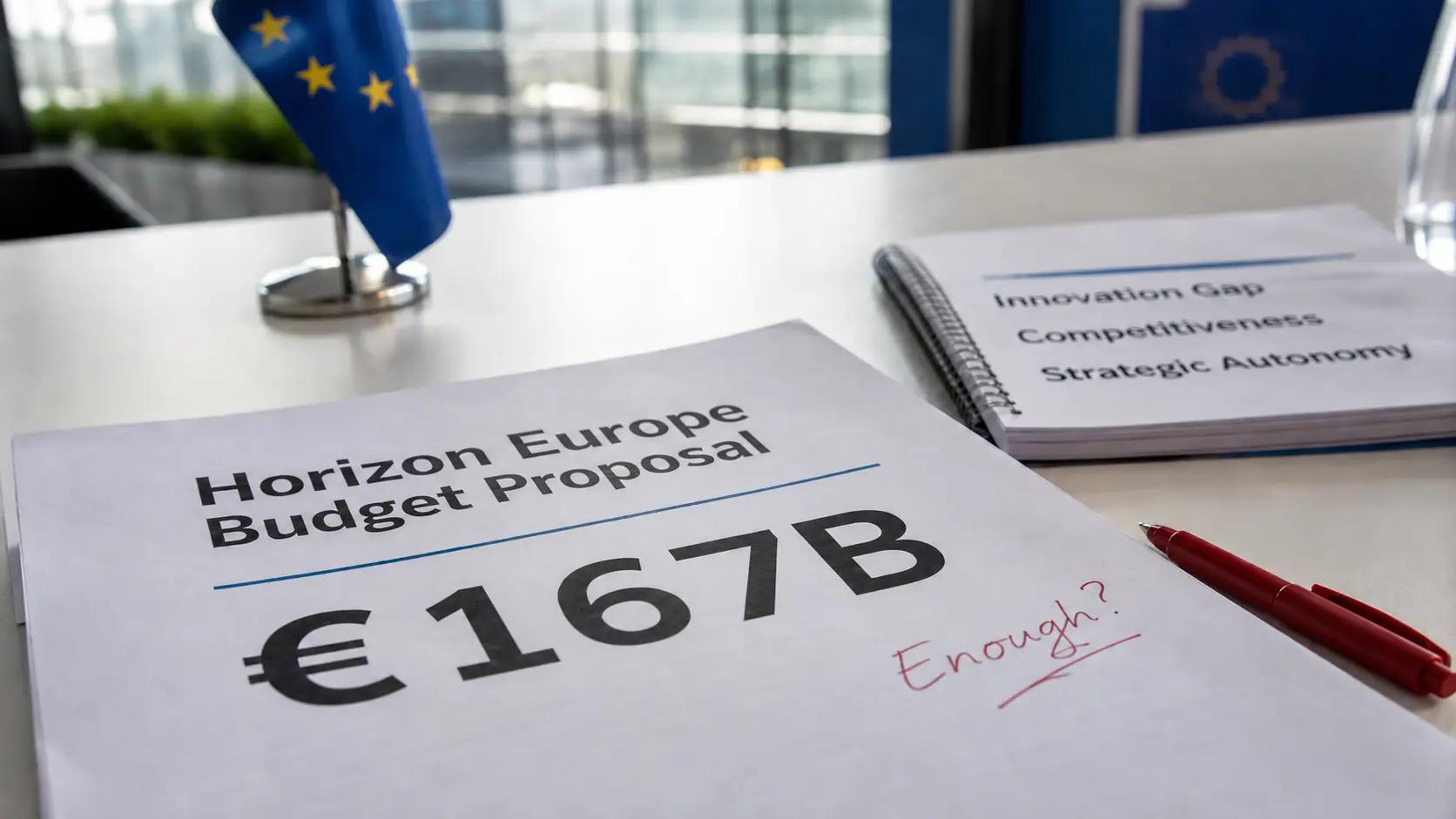
European research and innovation policy is entering one of its most important budget debates in years.
The discussion is not only about the next Horizon Europe figure. It is about whether Europe is prepared to fund research and innovation at the level of its own strategic diagnosis.
According to Science|Business, the Council presidency has proposed a Horizon Europe budget of around €167.9B, presented in the headline as €167B.
That is not a small number.
It is also important to be precise: this updated figure appears after Science|Business corrected figures that had previously been presented in 2025 prices. The substance of the debate therefore changes from “is €167B too low?” to a more mature question: even at around €167B, is the proposal ambitious enough compared with the scale of European competitiveness challenge?
It would represent a major research and innovation envelope, and it would likely be higher than the current Horizon Europe programme. But the political meaning of the number depends on the context in which it arrives.
Over the last year, European policy language has become unusually urgent. We have heard the same themes repeatedly: competitiveness, strategic autonomy, deep tech, industrial resilience, scale-ups, defence innovation, clean technologies, artificial intelligence, health resilience and the innovation gap with the United States and China.
That language matters because it creates expectations.
If Europe says that research and innovation are strategic, the budget should look strategic too.
Ambition, compromise and the signal behind the number
The research and innovation ecosystem had been discussing much higher levels of ambition for the next framework programme.
Figures around €200B became a symbolic benchmark for many organisations, universities, research centres, innovation actors and policy observers who believed that Europe needed a step change, not just a gradual increase.
The new Science|Business figure is therefore materially better than €167B, but the political question remains: the Council presidency figure is still below the €175B proposed by the Commission and far below the €200B proposed in the European Parliament first draft report.
Of course, budget negotiations are budget negotiations. Each institution, member state and political family pulls in a different direction. The first number is rarely the final number, and the final agreement may still move.
But the signal matters.
The issue is not whether €167B is significant. It clearly is.
The issue is whether it is significant enough for the level of ambition Europe has been describing.
That distinction is important. A serious debate should not pretend that €167B would be insignificant. It should also not pretend that any increase automatically matches the scale of the challenge.
Both things can be true at the same time.
A €167B Horizon Europe budget can be historically large and still feel politically cautious.
The Draghi report changed the terms of the debate
The debate around Horizon Europe cannot be separated from the wider competitiveness discussion triggered by the Draghi report.
The report was not a routine policy document. It framed European competitiveness as a structural challenge linked to productivity, innovation, industrial capacity, energy, regulation, capital markets and the ability to scale technology companies.
Its message was uncomfortable: Europe cannot rely on scientific excellence alone if it cannot turn that excellence into industrial, technological and economic strength.
That is why the Horizon Europe budget matters.
Research and innovation funding is not the whole answer to the Draghi diagnosis. It would be simplistic to say that a larger Horizon budget automatically solves the European competitiveness problem.
It does not.
Europe also needs faster decision-making, deeper capital markets, better technology transfer, simpler regulatory pathways, stronger scale-up financing, more effective procurement, more coherent industrial policy and better coordination across member states.
But public research and innovation funding remains one of the core instruments Europe has to shape the future.
If the diagnosis is that Europe is falling behind in breakthrough technologies, then the budget for research and innovation becomes more than an accounting line.
It becomes a test of seriousness.
Budgets reveal priorities
Political speeches are easy to make.
Budgets are harder.
They force institutions to decide what matters when priorities compete. They show whether innovation is treated as a strategic investment or as a flexible line that can be compressed when negotiations become difficult.
This is the uncomfortable part of the Horizon Europe discussion.
Europe cannot ask researchers, universities, startups, SMEs and industry to deliver technological sovereignty, climate transition, health resilience, industrial competitiveness and frontier science while reducing the level of ambition behind the programme designed to support much of that work.
The problem is not only financial.
It is psychological and strategic.
When the research and innovation community hears ambitious language but sees cautious budgeting, it receives a mixed message. Europe says that innovation is existential, but then negotiates as if it were adjustable.
That mismatch weakens confidence.
And confidence matters because the best applicants, the best researchers and the most ambitious innovation teams make strategic decisions about where to invest time, effort and resources.
A larger budget is not a substitute for better execution
There is a tempting argument in this debate: if the Horizon Europe budget were larger, everything would improve.
That argument is too simple.
More money can help, but it does not automatically create better outcomes. A larger programme can still suffer from fragmentation, slow processes, low risk appetite, excessive administrative burden, poor alignment with industrial needs or weak translation from research to market.
Europe does not only need more funding.
It needs funding that moves faster, reaches the right actors, supports real risk, rewards quality and creates stronger bridges between research, innovation and deployment.
This is particularly important for deep tech and breakthrough innovation, where the path from scientific excellence to market impact is long, uncertain and capital intensive.
A larger budget without better execution would not be enough.
But better execution without sufficient budget would also be insufficient.
The real policy challenge is not to choose between money and reform.
Europe needs both.
The risk of treating research as negotiable
The proposed figure also raises a broader question about how Europe treats research and innovation during political negotiation.
Every budget has trade-offs. Defence, cohesion, agriculture, migration, climate, digital infrastructure and external action all compete for resources. No serious policy actor can ignore those pressures.
But if research and innovation are repeatedly described as essential for long-term competitiveness, they cannot always be the area where ambition gets softened first.
That is the danger.
When research funding becomes too negotiable, the long-term costs are not immediately visible. A reduced budget does not create a crisis tomorrow morning. Laboratories do not close overnight. Universities do not disappear. Startups do not instantly leave.
The damage is slower.
Fewer projects are funded. Fewer risky ideas receive support. Fewer consortia are formed. Fewer early-stage technologies survive. Fewer researchers see Europe as the best place to build a long-term scientific or innovation career.
Over time, that becomes a competitiveness problem.
And by the time the consequences are obvious, they are much harder to reverse.
Horizon Europe is not only a funding programme
One of the reasons the Horizon Europe budget debate matters is that the programme is more than a funding mechanism.
It shapes incentives.
It structures collaboration.
It creates networks between universities, research centres, SMEs, large companies, hospitals, public authorities and civil society organisations.
It defines what Europe rewards, where it takes risk and how it channels scientific and technological ambition.
When Horizon Europe works well, it does not only fund projects. It creates ecosystems.
This is why the budget debate should not be reduced to a simple comparison between the current programme and the proposed future programme.
The more relevant question is whether the next framework programme is being designed for the Europe that policymakers say they want to build.
A Europe that wants to lead in deep tech, climate technologies, health innovation, industrial resilience, artificial intelligence, biotechnology and strategic technologies needs a funding architecture that can support that ambition at scale.
A cautious budget sends a cautious signal.
The link with ERC and EIC debates
The same tension is visible in other parts of the European research and innovation landscape.
The debate around ERC rules, for example, is not only a technical discussion about eligibility or resubmission. It is part of a wider question about whether Europe wants to keep excellence engaged or make participation more difficult for the very researchers it wants to attract. We discussed this in our analysis of the ERC resubmission rules rollback for 2027.
The EIC debate raises a parallel issue from the innovation side. If Europe wants breakthrough startups and scale-ups, it must ask whether the available funding instruments are large, fast and flexible enough to support the real cost of building globally competitive companies. That is why the question of the real value of the EIC Accelerator grant in FP10 matters.
These debates are connected.
ERC is about frontier scientific excellence.
EIC is about breakthrough innovation and scale-up potential.
Horizon Europe is the wider system that connects research, collaboration, missions, industrial competitiveness and innovation capacity.
If Europe lowers ambition in one part of the system, the effect is not isolated. It affects the entire innovation pipeline.
The problem is not that €167B is low
A mature discussion needs to avoid easy exaggeration.
The problem with a €167B Horizon Europe budget is not that the figure is low in absolute terms.
It is not.
The problem is that it may be low relative to the political claims Europe is making about its future.
If Europe simply wanted to continue with a stronger version of the current framework programme, €167B would look like meaningful progress.
But if Europe wants to respond seriously to the competitiveness gap, reduce dependence on external technologies, build strategic autonomy, accelerate deep tech and remain a global scientific power, the question becomes more demanding.
Then the issue is not whether the number is large.
The issue is whether the number is transformational.
That is the debate Europe should be having.
What the research and innovation ecosystem will hear
Policy negotiations often focus on institutional arithmetic.
But ecosystems listen to signals.
Universities, research centres, startups, SMEs, grant offices, investors and industry partners will interpret the final Horizon Europe budget as a statement of intent.
If the final number feels ambitious, it will reinforce the idea that Europe is serious about research and innovation as a strategic priority.
If it feels cautious, it will reinforce a more familiar perception: Europe understands the problem, writes excellent reports about the problem, gives speeches about the problem, but struggles to act at the scale required by the problem.
That perception matters.
It affects trust.
It affects participation.
It affects whether ambitious teams believe that European programmes are worth the time and effort required to compete.
Why this matters for applicants
For applicants, budget debates are not abstract.
They shape success rates, call design, evaluation pressure and the probability that excellent projects receive funding.
When budgets do not match demand, competition becomes extreme. Good proposals fail. Excellent proposals fail. Entire consortia invest months of work into applications that may have little statistical chance of success.
This does not mean funding should be easy.
Competitive funding must remain selective.
But when budgets are too constrained relative to ambition, selection can begin to feel less like strategic investment and more like statistical elimination.
That has consequences.
It rewards applicants with more resources, more experience and more professionalised proposal capacity. It may discourage newcomers. It may reduce risk-taking. It may make applicants more conservative precisely when Europe says it wants breakthrough innovation.
This is why the Horizon Europe budget is not only a Brussels negotiation.
It affects the behaviour of the innovation ecosystem.
The FP10 question
The next framework programme, often referred to as FP10, will be judged not only by its total budget but by the credibility of its design.
It will need to answer several difficult questions.
Can it keep frontier researchers engaged?
Can it fund breakthrough innovation at a scale that matches global competition?
Can it support deep tech without trapping applicants in excessive administrative complexity?
Can it improve success rates enough to keep strong applicants in the system?
Can it connect research, industrial strategy and market deployment more effectively than before?
Can it support both scientific excellence and strategic European priorities without diluting either?
These questions cannot be answered by budget alone.
But they cannot be answered without budget either.
That is why the €167B discussion matters so much.
It is not just a number.
It is an early signal of how seriously Europe intends to translate its innovation rhetoric into operational capacity.
Where Ruthless Evaluator comes in
Ruthless Evaluator cannot change the Horizon Europe budget.
No tool can.
But when funding becomes more competitive, proposal quality becomes even more decisive.
If the budget is constrained relative to demand, applicants cannot afford unclear logic, weak evidence, unsupported claims, inconsistent work plans or poor alignment with the call.
The stronger the competition, the less room there is for avoidable weakness.
That is where Ruthless Evaluator becomes useful.
It helps applicants, consultants, universities, research centres and innovation teams stress-test their proposals before submission, identify gaps in logic and evidence, and detect weaknesses that evaluators may later penalise.
A better budget would help Europe.
Better proposals help applicants compete within the system that exists.
Both things matter.
Europe should fund research and innovation at the level of its ambitions.
Applicants should prepare proposals at the level of the competition.
Better to detect the weaknesses before submission than inside the evaluation report.
Run an evaluator grade review on the draft
Upload a version, select programme context, and get structured feedback you can act on.