Ruthless Evaluator now supports ERC proposals
Ruthless Evaluator now supports ERC Starting Grant, Consolidator Grant, Advanced Grant, Synergy Grant, and Proof of Concept proposals, helping researchers, universities, research centres, and grant offices stress-test ERC applications before submission.
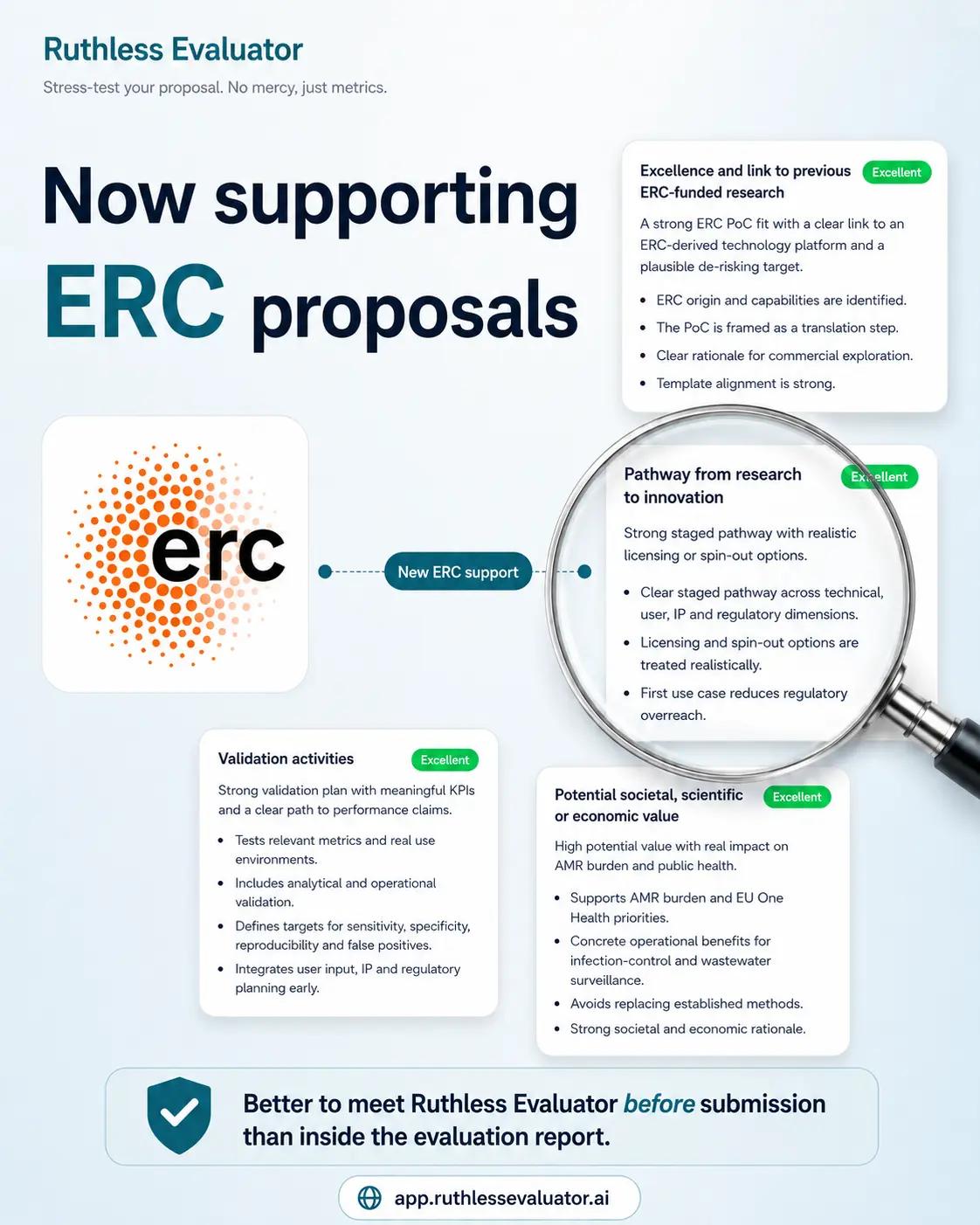
🔥 Ruthless Evaluator now supports ERC proposals.
Our research users asked for it.
So we built it.
Researchers, universities, research centres, and grant offices can now use Ruthless Evaluator to review proposals for some of the most competitive research funding schemes in Europe:
- 🧠 ERC Starting Grant
- 🧠 ERC Consolidator Grant
- 🧠 ERC Advanced Grant
- 🧠 ERC Synergy Grant
- 🧠 ERC Proof of Concept
And yes, ERC Plus is next.
We will include it as soon as the official template and guide for peer reviewers are available.
This is an important step for Ruthless Evaluator.
Not because it adds another programme to a list.
But because it brings structured, evaluator-style proposal review to a funding family where clarity, ambition, originality, feasibility, and scientific leadership matter enormously.
ERC proposals are different.
And they deserve to be reviewed differently.
Why ERC support matters
The European Research Council is one of the most prestigious funding bodies in the European research ecosystem.
ERC grants are not simply about supporting good science.
They are about supporting ambitious, original, investigator-driven research with the potential to open new directions.
That creates a very specific proposal challenge.
An ERC proposal must make the scientific case with exceptional precision.
It must show why the idea matters.
It must show why now.
It must show why this Principal Investigator or team is the right one to pursue it.
It must show why the risks are worth taking.
It must show why the planned work is not just interesting, but genuinely compelling.
That is not easy.
Especially when the science is complex.
Especially when the ambition is high.
Especially when the proposal needs to convince expert reviewers that the idea is both bold and credible.
In ERC, vague excellence is not enough.
A strong CV is not enough.
A brilliant idea is not enough if the proposal does not make the evaluation case clearly.
ERC proposals are not generic Horizon Europe proposals
Many proposal teams are used to thinking in the structure of Horizon Europe collaborative projects.
Excellence.
Impact.
Implementation.
That logic is familiar.
ERC is different.
The evaluation lens is centred on scientific excellence, intellectual ambition, the research project, and the applicant or research team behind it.
For ERC Proof of Concept, the logic shifts again, because the proposal must connect ERC-funded research to a credible route toward innovation, validation, use, and future value.
That is why ERC support inside Ruthless Evaluator is not just a label change.
It requires programme-specific review logic.
It requires attention to ERC-specific expectations.
It requires different questions.
For ERC Starting Grant, Consolidator Grant, Advanced Grant, and Synergy Grant, the review must help test whether the scientific ambition, originality, methodology, feasibility, risk management, and intellectual leadership are clearly defended.
For ERC Proof of Concept, the review must also test whether the link to previous ERC-funded research is explicit, whether the innovation potential is credible, and whether the proof-of-concept plan is concrete enough.
That is exactly the kind of difference Ruthless Evaluator was built to handle.
Programme by programme.
Criterion by criterion.
Reviewer expectation by reviewer expectation.
What Ruthless Evaluator now helps ERC applicants review
Ruthless Evaluator does not write the proposal for you.
It does not replace scientific judgement.
It does not turn a weak idea into a strong one.
It does something more useful before submission.
It helps stress-test the proposal.
That means reading the draft with the kind of distance, discipline, and scepticism that is often difficult to maintain when a team has been working on the same document for weeks or months.
The objective is to detect the issues that may reduce reviewer confidence before the proposal is submitted.
Examples include:
- ⚠️ unclear scientific ambition
- ⚠️ weak justification of breakthrough potential
- ⚠️ vague methodology
- ⚠️ unsupported claims
- ⚠️ inconsistency between objectives, methodology, work plan, and expected outcomes
- ⚠️ feasibility risks that are not properly addressed
- ⚠️ weak link between prior ERC-funded research and the Proof of Concept plan
- ⚠️ insufficient evidence for innovation potential
- ⚠️ gaps that reviewers may challenge later
These are not cosmetic issues.
They are confidence issues.
And in ERC evaluation, confidence matters.
A reviewer may agree that the idea is interesting and still question whether the proposal has made the case strongly enough.
A reviewer may respect the applicant and still find the methodology insufficiently clear.
A reviewer may recognise the ambition and still worry that the feasibility logic is underdeveloped.
Ruthless Evaluator helps make those risks visible earlier.
The goal is not to make ERC proposals sound polished
There is a common misunderstanding about proposal review.
Many teams assume that reviewing a proposal means improving the wording.
Sometimes that helps.
But wording is rarely the core problem.
The more dangerous problems are structural.
A claim is made but not evidenced.
A risk is mentioned but not managed.
A methodology is described but not connected to the objective it should deliver.
A scientific ambition is stated but not clearly differentiated from the state of the art.
A Proof of Concept plan includes activities but does not define what would count as successful validation.
A proposal reads well, but the evaluation argument is incomplete.
That is why Ruthless Evaluator is deliberately not positioned as an AI grant writer.
ERC applicants do not need generic polished language.
They need a sharper proposal.
They need clearer logic.
They need fewer unsupported assumptions.
They need a draft that can survive a demanding review.
Better language can help.
But better reasoning matters more.
What this means for researchers
For researchers, ERC support inside Ruthless Evaluator means one thing above all:
A more disciplined pre-submission check.
ERC applicants often know their science extremely well.
That can be a strength.
It can also create blind spots.
When the research vision is obvious to the applicant, it can be tempting to assume that it will be equally obvious to reviewers.
It may not be.
Reviewers assess what is written.
They cannot evaluate the months of thought behind the proposal if the logic is not visible on the page.
They cannot reward an ambition that is implied but not explained.
They cannot infer evidence that is not provided.
They cannot defend a high score if the proposal leaves avoidable doubts.
Ruthless Evaluator helps researchers look at the draft from the outside.
Not warmly.
Not politely.
Usefully.
It helps identify where the proposal needs to be clearer, more explicit, more evidenced, or more coherent.
That can make the final version sharper.
And in a highly competitive ERC environment, sharper matters.
What this means for universities and research centres
For universities and research centres, ERC support creates a different type of value.
Internal review capacity is always under pressure.
Grant offices and research support teams often need to help many applicants at the same time, especially near ERC deadlines.
The challenge is not only volume.
It is consistency.
Different reviewers may focus on different aspects.
Some may emphasise scientific originality.
Others may focus on feasibility, risk, or the clarity of the work plan.
Some may provide detailed feedback.
Others may only have time for a quick read.
Ruthless Evaluator gives research support teams a structured way to review drafts before the final rush.
It can help identify recurring weaknesses.
It can support earlier conversations with applicants.
It can give grant offices a clearer view of where proposals need attention.
It can also help applicants receive feedback that is specific enough to act on.
For institutions supporting multiple ERC applicants, that matters.
It is not a replacement for expert internal review.
It is a way to make internal review more scalable, more consistent, and more focused.
What this means for grant offices
Grant offices know the reality of proposal season.
The final days before submission are intense.
Documents change quickly.
Applicants need feedback.
Reviewers are busy.
Small issues become urgent.
Large issues are discovered too late.
That is exactly when avoidable weaknesses become expensive.
A proposal may be complete, but still not convincing.
A proposal may be well written, but still not clear enough.
A proposal may include every required section, but still fail to make the evaluation argument explicit.
Ruthless Evaluator gives grant offices a way to support applicants earlier and more systematically.
It helps surface problems before the final version is locked.
It helps distinguish between minor editing and real evaluation risk.
It helps teams decide what to fix first.
And it helps reduce one of the most common proposal problems:
Discovering too late that the draft is weaker than the team thought.
Built around user needs, not hype
This launch also says something about how we want to build Ruthless Evaluator.
We do not want to add features because they sound fashionable.
We want to build around real bottlenecks.
The kind that slow proposal teams down.
The kind that reduce proposal quality.
The kind that create uncertainty before submission.
ERC support came from a repeated user request.
Researchers asked for it.
Universities asked for it.
Research centres asked for it.
Grant offices asked for it.
So we built it.
That is the same logic behind Topic Fit Engine, another feature shaped by users who needed a faster and more structured way to identify suitable Horizon Europe topics before proposal writing even begins.
In both cases, the principle is the same.
Listen to the people doing the work.
Find the bottleneck.
Build something useful.
Then keep improving it.
Ruthless Evaluator is evolving feature by feature, programme by programme, need by need.
That is how we want it to grow.
ERC is also evolving under pressure
This ERC launch arrives at a moment when the wider ERC system is also adapting.
Demand for competitive European research funding remains extremely high.
Evaluation capacity is under pressure.
Applicants are investing significant time into proposals that face very selective assessment processes.
The research community is paying attention to how ERC access, resubmission rules, and evaluation processes evolve.
We recently discussed this in A rare win for applicants in EU funding, where the ERC reversed most of its draft 2027 resubmission restrictions after coordinated feedback from more than 1,000 scientists.
That episode showed something important.
The ERC system is not static.
It is responding to pressure.
It is being challenged by applicants.
It is having to balance excellence, access, reviewer workload, and fairness.
For applicants, this reinforces a simple point.
ERC proposal readiness matters.
Not only because the proposal must be excellent.
But because the funding environment is selective, dynamic, and demanding.
The clearer the proposal, the easier it is for reviewers to assess it fairly.
The more explicit the logic, the fewer doubts it creates.
The stronger the evidence chain, the more defensible the evaluation case becomes.
What an ERC-ready proposal needs to make clear
Every ERC scheme has its own logic.
But across ERC proposals, several questions come back again and again.
Is the ambition unmistakable?
The proposal must make the scientific ambition visible.
Not hidden in technical detail.
Not implied through reputation.
Not diluted by cautious language.
Visible.
Reviewers should understand what makes the project intellectually exciting and why it deserves ERC-level support.
Is the originality clearly defended?
Originality cannot be assumed.
The proposal must explain what is genuinely new.
It must show how the work differs from existing research.
It must clarify whether the novelty lies in the question, method, theory, data, combination, direction, or expected insight.
Is the methodology credible?
A bold idea still needs a credible route.
The proposal must show how the research will be carried out, why the method is suitable, and how major uncertainties will be handled.
For ambitious science, risk is expected.
But unmanaged risk is different from justified risk.
Is the feasibility logic convincing?
Feasibility does not mean playing safe.
It means showing that the applicant understands what could go wrong and has a credible strategy to move forward.
ERC reviewers do not need risk-free science.
They need confidence that the risk is worth taking and that the plan is serious.
Is the link to ERC-funded research clear for Proof of Concept?
For ERC Proof of Concept, the connection to previous ERC-funded research must be explicit.
The proposal should make clear which result is being taken forward, why it has innovation potential, and how the planned activities will validate the next step.
A Proof of Concept proposal is not just a small innovation project.
It is a bridge from ERC-funded research to future value.
That bridge must be visible.
Where proposals often become vulnerable
Many ERC proposals do not fail because they are careless.
They become vulnerable because some parts of the argument are too implicit.
Common issues include:
- The scientific ambition is clear to the applicant but not fully explicit to the reader
- The breakthrough potential is asserted rather than demonstrated
- The methodology is technically rich but not easy to evaluate
- The risk section is generic rather than specific to the real uncertainties
- The work plan is logical internally but not clearly connected to expected outcomes
- The applicant profile is strong but not clearly linked to the research challenge
- The Proof of Concept route is promising but not sufficiently evidenced
- The innovation value is described, but target users, validation logic, or next steps are too vague
These weaknesses are frustrating because they are often fixable.
But they must be detected early enough.
That is why pre-submission review should be more than a final polish.
It should be a serious test of the proposal argument.
A sharper proposal before the evaluation report
The worst time to discover a weakness is inside the evaluation report.
At that point, the proposal is already submitted.
The decision is already made.
The feedback may be useful, but it arrives too late for that round.
Ruthless Evaluator exists to change that timing.
To make weaknesses visible while there is still time to revise.
To help teams separate small wording issues from real evaluation risks.
To support better internal review.
To help applicants submit with a clearer understanding of what their proposal does well and where it still needs work.
For ERC proposals, that can make a meaningful difference.
Not because any tool can guarantee success.
No tool can.
But because avoidable doubts should be removed before submission, not explained after rejection.
What comes next
ERC Starting Grant, Consolidator Grant, Advanced Grant, Synergy Grant, and Proof of Concept are now supported in Ruthless Evaluator.
ERC Plus will follow as soon as the official template and guide for peer reviewers are available.
And this is only one step.
We will keep listening to researchers, universities, research centres, grant offices, consultants, and innovation teams.
We will keep adding support where it genuinely helps proposal quality.
We will keep improving the platform around real user needs.
Not hype.
Not vanity features.
Real bottlenecks.
Real deadlines.
Real proposal pressure.
Real evaluation logic.
To everyone who asked for ERC support:
Thank you.
You asked.
We listened.
We built it.
And we are just getting started.
Better to meet Ruthless Evaluator before submission than inside the evaluation report.
#ERC #EuropeanResearchCouncil #HorizonEurope #EUFunding #ResearchFunding #GrantWriting #ProposalWriting #ResearchExcellence #Universities #ResearchCentres #RuthlessEvaluator
Run an evaluator grade review on the draft
Upload a version, select programme context, and get structured feedback you can act on.