How to adapt an old Horizon Europe proposal to a new topic without starting from zero
A strong Horizon Europe proposal from a previous call can be a valuable starting point, but adapting it to a new topic requires more than changing the deadline and call text. The proposal must be repositioned around the new expected outcomes, policy logic, consortium needs and evaluation risks.
A strong Horizon Europe proposal from 2025 can be a useful starting point for a new call in 2026 or 2027. It may already contain a clear problem statement, a credible consortium, a mature methodology, a good understanding of the market or policy context, and a significant amount of validated technical content. Starting again from a blank page would often be inefficient.
However, reusing an old proposal is not the same as adapting it properly. A new topic is rarely just a new deadline with similar wording. It may introduce a different expected outcome, a different intervention logic, a different impact pathway, new policy priorities, new consortium expectations and different evaluation risks. If those changes are not understood early, the adapted proposal may look complete but remain misaligned with the call.
This is one of the most common questions we hear from Ruthless Evaluator users:
The answer is yes, but only if the adaptation is treated as a strategic repositioning exercise, not as a cosmetic update. The objective is not to recycle the old document. The objective is to identify what still works, what no longer fits and what must be rebuilt so the proposal becomes convincing under the new topic.
That distinction matters because evaluators do not score the effort invested in the previous version. They score the fit, clarity, evidence and credibility of the proposal submitted to the current topic.
A new topic changes the logic of the proposal
Many applicants underestimate how much a new Horizon Europe topic can change the proposal logic. Two topics may sit under the same destination, address a similar policy challenge and use familiar vocabulary, yet still require different project architectures. One topic may prioritise demonstration in operational environments, while another may focus on methodology development, standardisation, stakeholder engagement, policy uptake, industrial validation or cross-border deployment.
This means that an old proposal cannot be assessed only on whether the science or technology remains relevant. The stronger question is:
That is a demanding test. A proposal written for one topic may have strong technical content but the wrong expected outcomes. It may have credible partners but lack the stakeholder group now required. It may describe a valid methodology but fail to address the new call emphasis. It may include relevant impacts but not the impacts that evaluators are now instructed to assess.
This is why proposal adaptation should begin before rewriting. The first task is to understand whether the new topic is genuinely suitable and what the proposal would need to become. Without that step, teams often spend weeks editing text that should have been rethought.
Step 1: find the right new topic
The first mistake is choosing a new topic because it looks broadly similar to the old one. In Horizon Europe, broad similarity is not enough. The proposal must fit the scope, expected outcomes, destination logic, action type, budget assumptions and likely competitive landscape of the new topic.
A practical way to start is to take the abstract of the old application and run it through the Topic-Fit Engine in Ruthless Evaluator. This helps convert the old proposal into a focused shortlist of currently available Horizon Europe topics that may match the project. Instead of manually screening hundreds of pages, the team can begin with a smaller set of opportunities that deserve closer review.
For each topic, the analysis can help identify elements such as fit score, rationale, reasons why the topic may fit, consortium recommendations, gaps to verify, deadline, action type, topic budget, expected contribution and likely number of funded projects. This does not replace expert judgement, but it gives the team a more structured starting point.
That structure is important because topic selection is often where adaptation succeeds or fails. If the topic is wrong, even excellent rewriting will not solve the core problem. A misaligned topic creates pressure across the entire proposal: the objectives feel forced, the work plan becomes artificial, the impact section sounds generic and the consortium may appear incomplete.
The goal of Step 1 is therefore not to find any topic that can be made to fit. The goal is to identify the topic where the project can compete credibly.
Topic fit is not keyword matching
Applicants sometimes assume that topic fit can be assessed by searching for familiar terms in the call text. If the topic mentions AI, circularity, resilience, health, energy, manufacturing, digital tools or climate adaptation, the project may appear relevant at first sight. But Horizon Europe evaluation is not based on keyword overlap.
A topic is a policy and funding instrument with a specific purpose. It describes what the European Commission wants to achieve through the funded portfolio, not merely a list of acceptable technologies. This means the proposal must show alignment with the expected outcomes, target stakeholders, implementation logic and contribution to the wider destination.
For example, an old proposal may have focused on technical performance, while the new topic may require large-scale deployment, policy uptake or replication across regions. Another proposal may have been built around academic excellence, while the new topic expects industrial leadership and measurable innovation impact. A third proposal may have used a narrow pilot setting, while the new topic expects broader stakeholder engagement and transferability.
These differences are not small editorial details. They affect objectives, work packages, partners, deliverables, milestones, risks, exploitation plans and impact indicators. If the old proposal is adapted without changing those foundations, the application may remain elegant but fail to become evaluable against the new topic.
This is where the discipline of topic-fit analysis matters. The team needs to know not only whether the project can be connected to the topic, but also whether the proposal can be rebuilt around the topic without losing coherence.
Step 2: evaluate the old proposal against the new topic
Once the team has selected the most promising topic, the next step is to evaluate the old proposal using the new topic as the reference. This is where the real value of the adaptation process appears, because the question changes from whether the old proposal was good to whether it is now suitable.
A strong previous proposal may still contain weaknesses when tested against a new topic. The problem may not be writing quality. It may be topic alignment, missing evidence, insufficient policy connection, weak implementation logic, incomplete partner capacity, outdated work packages or impact claims that no longer match the expected outcomes.
Ruthless Evaluator can help by identifying what must change first. The Action Plan report gives a structured view of the areas that need attention, including topic alignment, methodology gaps, impact logic, consortium needs, section-by-section improvements and risks that evaluators may penalise.
This is more useful than a general quality review because adaptation is a prioritisation exercise. Not every section needs the same level of rewriting. Some content can be preserved with minor changes. Some sections need repositioning. Some assumptions need new evidence. Some parts may need to be removed because they belong to the old call logic, not the new one.
The aim is to avoid wasting effort on polishing text that is no longer strategically relevant.
Resubmission is not copy-paste
The most dangerous adaptation strategy is to keep the old proposal structure and simply insert references to the new topic. This often produces a document that looks updated but still thinks like the previous application.
Evaluators notice this. They may not know the proposal was adapted from an earlier version, but they can detect when the logic does not fully match the call. The objectives may feel slightly off. The impact indicators may not correspond to the expected outcomes. The work plan may spend too much effort on activities that are secondary in the new topic. The consortium may lack a role that the topic clearly requires. The policy narrative may sound added rather than integrated.
That is why resubmission is not copy-paste. It is repositioning.
Repositioning means deciding how the project should be framed under the new topic. Which problem now leads the proposal? Which expected outcome does each objective support? Which partners are essential under the new call logic? Which evidence must be strengthened? Which parts of the old proposal create noise? Which claims are no longer safe? Which risks become more visible under the new evaluation context?
These questions should be answered before the team starts rewriting at paragraph level. Otherwise, the proposal may improve stylistically while remaining strategically weak.
Step 3: iterate until the proposal is ready
After applying the first set of changes, the proposal should be evaluated again. Adaptation is rarely solved in one pass because every major change affects other parts of the document. A revised objective may require changes in the work plan. A new partner role may require changes in implementation capacity. A stronger impact pathway may require new indicators, stakeholders or dissemination activities. A clearer methodology may reveal new risks.
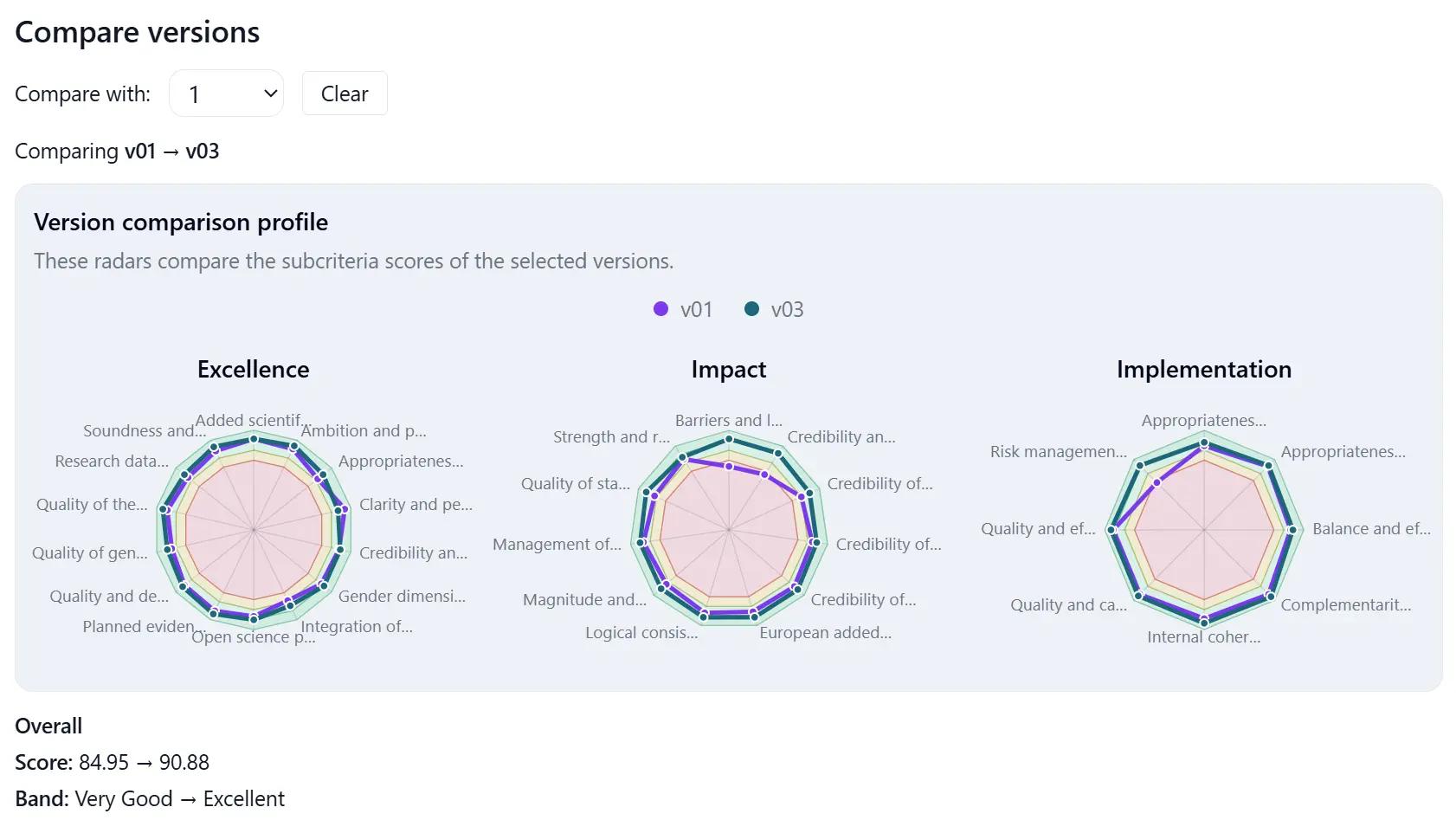
This is why version comparison matters. Teams should not only ask whether the new draft sounds better. They should ask whether each subcriterion is improving and whether the proposal is moving from weak or acceptable areas into very good or excellent performance.
Ruthless Evaluator can support this by allowing teams to compare versions and track how the proposal evolves after each iteration. That is useful because proposal improvement is often uneven. One section may become stronger while another remains underdeveloped. A methodology improvement may not yet be reflected in the risk table. A stronger impact section may still lack measurable indicators.
Iteration makes these gaps visible. It also helps teams avoid the false confidence that comes from internal familiarity. Authors often know why the project makes sense, but evaluators only see the written evidence. Each iteration should reduce the distance between what the team knows and what the proposal proves.
The goal is not endless rewriting. The goal is disciplined improvement until the proposal fits the new topic with clarity, evidence and coherence.
What should usually change in an adapted proposal
A well-adapted proposal normally changes more than the introduction and the expected impact section. If the new topic is materially different, the changes should be visible across the proposal architecture.
The objectives should be reviewed to confirm that they answer the new topic rather than the previous one. The methodology should be checked against the new scope, TRL expectations, validation needs, stakeholder requirements and interdisciplinary logic. The work plan should be updated so tasks, deliverables and milestones support the new expected outcomes.
The consortium should also be reassessed. A partner that was sufficient for the previous call may not be enough for the new topic. The new call may require additional expertise in regulation, standardisation, social sciences, clinical validation, industrial demonstration, data governance, market uptake, public authorities, end users or replication. If those needs are not reflected in the consortium, evaluators may question implementation capacity.
The impact section usually needs the deepest repositioning. It should not merely replace one policy reference with another. It should explain how the project contributes to the new destination, which outcomes it supports, which stakeholders benefit, what adoption pathway is realistic and which indicators can demonstrate progress.
Finally, the risk section should be rewritten, not recycled. A new topic creates new evaluation risks, new dependencies and new interpretation issues. If the risk table still reflects the old proposal logic, it may expose that the adaptation has not gone deep enough.
Evidence gaps are often different in the new topic
One reason old proposals are difficult to adapt is that evidence does not transfer automatically. A strong evidence base for one topic may be incomplete for another.
For example, the old proposal may include strong technical validation, but the new topic may require stronger stakeholder acceptance evidence. It may include excellent scientific references, but the new topic may require market, policy or deployment evidence. It may include pilot results in one setting, but the new topic may require replication across regions or user groups. It may include a convincing consortium, but the new topic may require clearer access to data, infrastructure, test sites or end users.
This matters because evaluators do not only assess whether the proposal contains evidence. They assess whether the evidence supports the claims that matter for the topic.
A proposal adapted to a new call should therefore include an evidence-gap review. Which claims are already supported? Which claims require updated sources? Which assumptions need validation? Which partners can provide proof? Which user needs or policy priorities require fresh justification?
This is especially important when the proposal is adapted across years. The policy landscape, competitive environment, regulatory context and state of the art may have changed. A reference that was sufficient in 2025 may be outdated by 2027. A market assumption that looked credible under one destination may be too generic under another.
A strong adaptation does not rely on old evidence simply because it is already written. It updates the proof where the new topic requires it.
The consortium may need to change
Many teams prefer to preserve the old consortium because it is politically easier and administratively faster. That is understandable, but it can weaken the proposal if the new topic requires capabilities that the consortium does not clearly cover.
Horizon Europe evaluators look for credible implementation capacity. That capacity is not only about having well-known organisations. It is about having the right organisations for the specific work proposed. If the topic requires policy uptake, the consortium may need public authorities, agencies or policy-facing partners. If it requires deployment, it may need end users, operators or infrastructure owners. If it requires standardisation, it may need relevant bodies or experts. If it requires market uptake, it may need industrial partners, customers or exploitation capacity.
This does not mean every adapted proposal needs a completely new consortium. Often, the existing partners remain valuable. But their roles may need to be redesigned, and gaps may need to be filled.
The key test is simple: can the evaluator see why each partner is necessary for the new topic?
If the answer is not clear, the consortium section will feel inherited rather than designed. That is a problem because adapted proposals often fail not because the old team is weak, but because the new topic demands a different execution logic.
Adaptation should preserve strength, not preserve text
A good old proposal is an asset. It may contain strong reasoning, validated content, mature work packages, partner descriptions, figures, evidence and a clear understanding of the problem. The adaptation process should preserve that strength.
But it should not preserve text for the sake of convenience.
This is an important distinction. Some paragraphs may still be useful. Others may now create misalignment. A section that scored well in the previous call may still need rewriting because the new topic asks a different question. A strong technical description may remain valid, but the framing around it may need to change. A previous impact pathway may need to be replaced because the new topic defines success differently.
The guiding principle should be:
This is where many adaptations become stronger than the original proposal. The team already has material, feedback, internal alignment and a better understanding of the project. If that foundation is combined with a rigorous topic-fit review and iterative evaluation, the new proposal can become more focused than the old one.
The value is not in starting from zero. The value is in knowing what no longer belongs.
What Ruthless Evaluator adds to the adaptation workflow
Ruthless Evaluator is useful in this process because it supports a sequence that many teams otherwise handle manually and inconsistently. First, the Topic-Fit Engine helps identify promising Horizon Europe topics based on the old proposal abstract. Then, the evaluation workflow helps assess the old proposal against the selected topic. Finally, version comparison helps track whether the proposal is improving after each revision.
This workflow helps applicants, consultants, universities, research centres, startups and innovation teams move from broad opportunity scanning to concrete proposal improvement. It also helps reduce one of the main risks in adaptation: believing that a proposal is close to ready because it was strong in another context.
The tool does not remove the need for expert judgement. It does not replace call analysis, consortium strategy or scientific leadership. But it can make the adaptation process more disciplined by showing where the proposal fits, where it does not fit and what should be changed first.
This connects with a broader trend in how proposal teams are using Ruthless Evaluator. In our update on Ruthless Evaluator now supporting ERC proposals, we discussed how different funding instruments require different evaluation logic. The same principle applies here. A proposal cannot be improved properly unless it is assessed against the right reference framework.
It also connects with the feedback we have received from proposal professionals, discussed in What EU funding professionals told us about Ruthless Evaluator. The most valuable output is not generic criticism. It is specific guidance that helps teams decide what to fix, in which order and why.
A practical checklist for adapting an old proposal
Before investing heavily in rewriting, teams should test the old proposal against the new topic using a structured checklist.
Topic fit
- Does the project clearly address the new topic scope?
- Does it contribute directly to the expected outcomes?
- Does the action type match the project maturity and implementation plan?
- Does the likely project budget fit the topic budget and expected number of funded projects?
- Are there any topic conditions that the old proposal does not satisfy?
Proposal logic
- Does the problem statement match the new topic policy logic?
- Are the objectives still the right objectives?
- Does the methodology answer the new call requirements?
- Are the work packages designed around the new expected outcomes?
- Are deliverables and milestones still meaningful under the new topic?
Consortium
- Does the consortium include all capabilities required by the new topic?
- Are partner roles specific, necessary and credible?
- Are end users, industrial actors, public authorities or other stakeholders included where relevant?
- Does the implementation capacity match the revised work plan?
Evidence and impact
- Are the main claims supported by updated evidence?
- Are the impact pathways aligned with the new destination?
- Are KPIs measurable and relevant to the expected outcomes?
- Are dissemination, exploitation and communication activities adapted to the new audience?
- Are policy, market, scientific or societal benefits specific enough to evaluate?
Iteration
- Has the revised version been evaluated against the new topic?
- Are weak subcriteria improving after each revision?
- Are changes tracked across versions?
- Are remaining weaknesses prioritised before final polishing?
If the answer to these questions is unclear, the proposal may still be a strong old application, but it is not yet a strong new submission.
Do not start from zero, but do not pretend nothing changed
Adapting an old Horizon Europe proposal can be efficient and strategically smart. It allows the team to reuse previous work, preserve validated content, integrate lessons learned and avoid unnecessary duplication. But efficiency should not become complacency.
A new topic changes the evaluation environment. It may change the problem framing, the expected outcomes, the consortium requirements, the evidence needs, the impact pathway and the risks evaluators will focus on. If those changes are ignored, the adapted proposal may carry the weaknesses of both versions: old assumptions and new misalignment.
The right approach is to treat adaptation as a structured workflow. First, identify the most suitable topic. Second, evaluate the old proposal against that topic. Third, implement the Action Plan. Fourth, iterate until the proposal is no longer merely adapted, but genuinely aligned.
That is the real advantage. You do not need to start from zero. But you also cannot pretend that the new topic is the same as the old one.
The proposals that succeed will be the ones that preserve the best of the previous version while rebuilding the logic that the new topic requires.
Run an evaluator grade review on the draft
Upload a version, select programme context, and get structured feedback you can act on.