The EIC financial annex may be asking the wrong question
The EIC Accelerator Financial Plan Annex asks for Year N to Year N+4 projections, but many deep tech companies only start real commercialisation late in that window. A strong annex must explain the scale-up logic behind the numbers, not simply complete five years of cells.
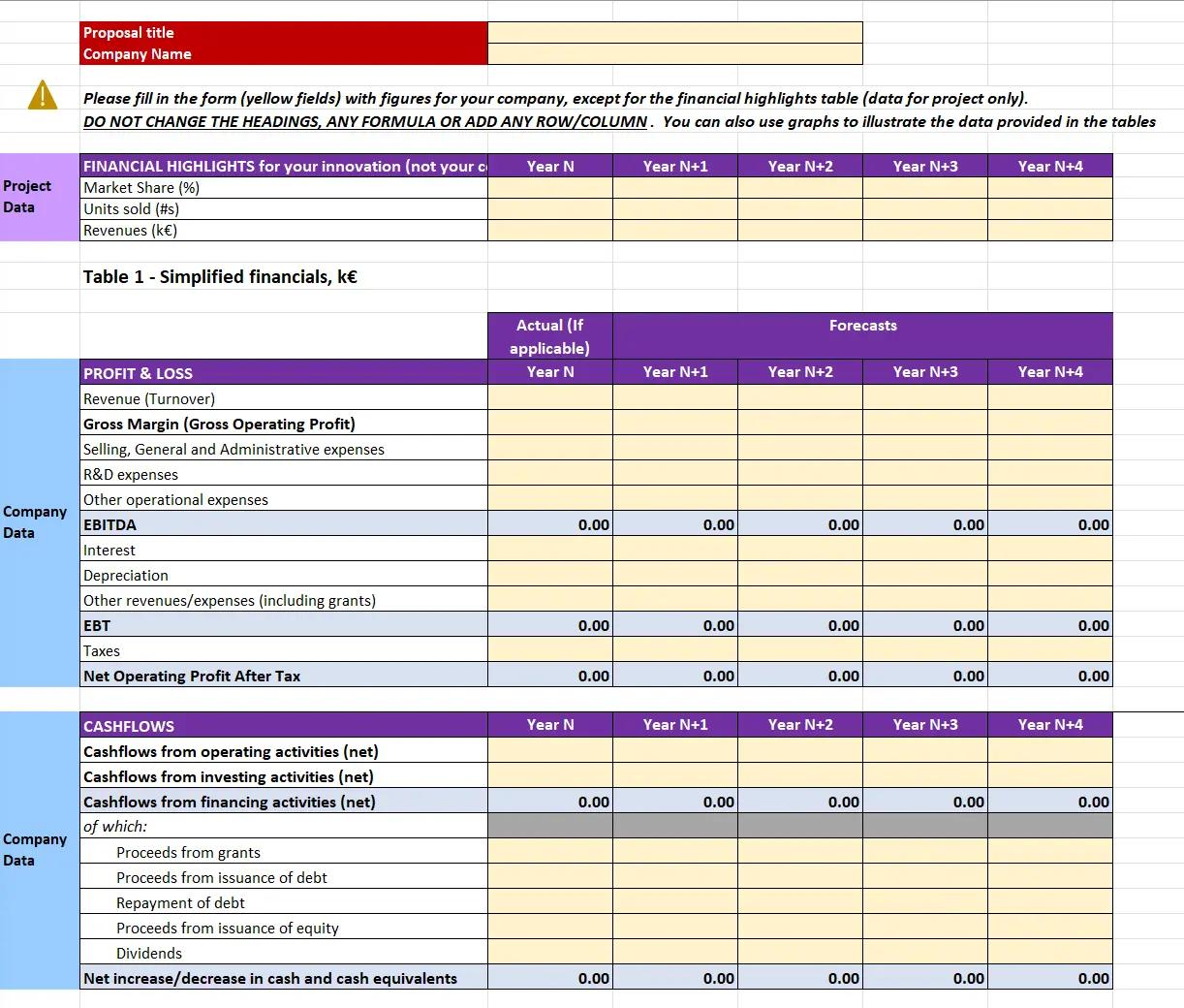
The EIC Accelerator Financial Plan Annex may look like a straightforward financial template. It asks applicants to provide financial statements from Year N to Year N+4, which seems reasonable at first sight. Five years should be enough to understand the company, assess the funding need, review the expected revenues and evaluate whether the business case makes sense.
However, for many EIC Accelerator applicants, especially deep tech companies working in medtech, biotech, hardware, energy, industrial technology, regulated AI, advanced materials or manufacturing, those five years do not necessarily represent five years of commercialisation. In many cases, the template captures a much more compressed story: the current year, one or two years of development and validation, a first market entry year, and only one additional commercial year.
That distinction matters because the annex is not only asking for numbers. It is testing whether the applicant understands how grant funding, investment, product development, validation, market entry and scale-up fit together. A financial plan that looks complete in Excel may still be weak from an evaluator perspective if it does not explain why the numbers are credible and how they connect to the project logic.
The problem is not the template itself. The problem is treating the template as if it were the whole financial story.
The five-year window can hide the real commercialisation timeline
The Financial Plan Annex starts with Year N, the current or submission year, and continues until Year N+4. This structure is administratively practical, but it can create a misleading impression when the project will spend a large part of that period completing technical development, validation, certification, clinical work, regulatory preparation, industrial pilots or commercial readiness activities.
For a company with an already launched software product, the five-year window may include five meaningful years of revenue growth. For a medtech company requiring clinical evidence, conformity assessment, procurement integration and reimbursement preparation, the same window may include only one or two years after market entry. For an industrial technology company that must complete pilot validation before full customer adoption, Year N+4 may still be an early commercial year rather than a mature scale-up year.
A common pattern looks like this:
- Year N: current position and submission year.
- Year N+1: EIC-funded development, validation or system integration.
- Year N+2: continued validation, regulatory, industrial or customer readiness work.
- Year N+3: first meaningful market entry or first commercial contracts.
- Year N+4: second commercial year, often still before full scale-up maturity.
This means that what appears to be a five-year forecast may actually be a two-year commercial snapshot. If the proposal does not make this explicit, evaluators may interpret modest Year N+4 revenues as weak market potential, when the real issue is that the commercialisation curve starts late inside the annex window.
This is particularly important in the EIC Accelerator because the programme is not designed to fund routine growth. It supports high-risk innovations with strong market potential, where public funding should unlock a credible pathway towards deployment, investment and scaling. Therefore, the financial annex should not only show what happens during the template period. It should explain how that period fits into the wider financing and commercialisation journey.
The better question is not only what the numbers are
Many applicants approach the annex as a forecasting exercise. They complete the profit and loss account, balance sheet, cash flow, staff costs, investment needs and revenue assumptions, then check whether the totals are internally consistent. That is necessary, but it is not enough.
The stronger question is not:
The stronger question is:
This shift changes the purpose of the annex. The annex is no longer a static table of expected figures. It becomes a test of causality. The evaluator needs to understand what changes because of the EIC project, which milestones reduce risk, when the company becomes commercially stronger, why additional investment is needed and how the project moves from an innovation opportunity to a financeable growth case.
That requires narrative discipline around the financial plan. The proposal should explain when the product reaches the market, which assumptions drive revenue, how pricing and margins were calculated, what adoption curve is expected, why commercialisation may start late, which milestones delay or unlock revenue, and how grant, equity and private investment work together.
Without this explanation, the numbers may be technically complete but strategically weak. The evaluator sees revenue lines, cost lines and financing gaps, but not the logic that connects them to the EIC project.
Late commercialisation is not necessarily a weakness
A frequent concern in EIC Accelerator proposals is that revenue may not become substantial within the Year N to Year N+4 window. Applicants sometimes try to compensate by accelerating revenue assumptions, increasing market penetration too early or presenting aggressive sales curves that do not match the project timeline. This is usually a mistake.
Late commercialisation is not necessarily a weakness. In many deep tech projects, it is the natural consequence of the technology, sector and route to market. A medical device may need clinical evidence and regulatory clearance. An energy technology may need pilot validation under real operating conditions. An industrial solution may need integration into customer infrastructure, performance qualification and procurement approval. A regulated AI system may need validation, compliance work, data governance and customer trust before large-scale deployment.
The weakness appears when the proposal does not explain this timing. If market entry depends on validation or regulatory milestones, those milestones must be connected to the financial forecast. If revenue starts in Year N+3, the proposal should make clear what must happen in Year N+1 and Year N+2 to make that revenue credible. If revenue becomes meaningful only after Year N+4, the proposal should explain why the annex window still supports the investment logic.
In other words, the financial plan should not pretend that the business is more mature than it is. It should show that the company understands the maturity gap and has a credible plan to close it. This is especially important when the proposal also asks for equity investment, because the investment case depends on the transition from grant-funded risk reduction to investor-backed scale-up.
A similar principle applies to the wider proposal. As discussed in No problem, no grant, evaluators need to understand the logic behind the need, not only the existence of a technology. The same applies here. Evaluators do not only need to see a forecast. They need to understand the commercial problem that the funding helps solve.
The annex is a consistency test
The EIC Accelerator Financial Plan Annex should never be treated as an isolated administrative document. It is one of the places where evaluators can test whether the proposal is internally coherent. The numbers should match the project timeline, the work packages, the grant request, the equity need, the go-to-market strategy, the hiring plan, the commercial assumptions and the expected financing trajectory.
If the work plan says that clinical validation ends in Year N+2, but the revenue forecast assumes large commercial sales in Year N+1, the proposal creates a credibility problem. If the market section describes long procurement cycles, but the forecast assumes immediate adoption after launch, the annex becomes inconsistent with the commercial strategy. If the company claims that EIC equity is needed for scale-up, but the financial plan does not show how that investment funds the transition beyond the grant period, the financing story becomes unclear.
This is why the annex is a consistency test. It should connect the project timeline, grant-funded activities, equity need, commercialisation plan, revenue assumptions and company runway into one coherent argument. Every major number should have a reason, and every major assumption should be traceable to the project plan.
A strong annex does not make the evaluator guess. It helps the evaluator understand what is already proven, what remains to be de-risked, what the EIC funding enables and when the company becomes ready for wider commercial and financial scaling.
Revenue assumptions need a commercial explanation
Revenue assumptions are one of the most sensitive parts of the financial plan because they reveal whether the company has understood the route to market. A revenue forecast is not credible because it grows each year. It is credible because the growth follows a realistic adoption logic.
For example, a medtech company entering the market in Year N+3 should explain whether early revenue comes from first hospital contracts, pilots, distributor agreements, direct sales, reimbursement-based adoption or another route. The forecast should clarify the expected number of customers, average contract value, sales cycle, pricing model and adoption constraints. Without this logic, revenue becomes an isolated number.
The same applies to industrial technologies. Early revenue may come from paid pilots or limited deployments, while scalable product revenue may arrive later, once performance, reliability, integration and return on investment have been validated. If the annex does not distinguish between pilot revenue and repeatable commercial revenue, evaluators may misunderstand the business model.
Margins also need explanation. A hardware or manufacturing company may have low margins during early production because volumes are small, supply chains are not optimised and installation costs remain high. A software or AI company may show stronger gross margins but higher customer acquisition, compliance, support or integration costs. A credible annex explains these differences instead of relying on generic percentages.
The objective is not artificial precision. The objective is traceability. Evaluators should be able to see how pricing, volumes, margins and adoption assumptions were built, and why they are reasonable for the sector, customer type and maturity stage.
Equity and grant funding should tell one financing story
The EIC Accelerator is especially sensitive to financing logic because many applicants combine grant funding with an investment request. The grant usually funds high-risk development, validation, demonstration or market readiness activities. Equity should support market entry, scale-up, industrialisation, commercial expansion or other investment needs that go beyond the grant-funded project.
Problems appear when these two parts are not connected. The proposal may request a grant for technical development and equity for scale-up, but the financial plan does not show when the company moves from one phase to the next. It may show future investment needs, but not explain which milestones make the company more financeable. It may show negative cash flow, but not explain whether this reflects planned growth, delayed revenue, working capital needs or unresolved commercial uncertainty.
A strong financial plan should make the financing pathway visible. It should explain what the grant de-risks, what equity enables, when private investment may enter, which milestones change the investor case and how the company avoids a funding cliff after the project. This is where the annex becomes more than a financial statement. It becomes a bridge between public funding, private capital and commercial maturity.
This also requires intellectual property and market access realism. A granted patent may help demonstrate defensibility, but it does not automatically prove freedom to operate, market exclusivity or investability. We discussed this distinction in Patent granted does not mean freedom to operate. The same discipline is needed in the financial annex: strong claims need a clear basis, and financing assumptions should not depend on untested legal, regulatory or commercial assumptions.
Where applicants often weaken the annex
Many EIC Accelerator financial annexes become less convincing because they try to look complete rather than explain the business. The most common weaknesses are not mathematical. They are logical.
One frequent weakness is revenue growth that is disconnected from the work plan. The proposal may show ambitious sales before the project has delivered the validation, regulatory or production milestones that would make those sales possible. Another weakness is a financing gap that is not explained. The annex may show negative cash flow, future investment needs or dependency on equity, but the proposal does not explain when the company becomes financeable, what milestones unlock investor confidence or why the requested amount is proportionate.
A third weakness is treating all customers as if they adopt at the same speed. In reality, early adopters, pilot customers, reference customers, distributors, strategic partners and mainstream buyers behave differently. The financial forecast should reflect this progression. A fourth weakness is presenting market potential without adoption logic. A large total addressable market does not justify revenue by itself. The forecast should explain how the company moves from target segment to beachhead customers, then from first adoption to repeatable sales.
The most damaging weakness is hiding uncertainty. Evaluators do not expect applicants to know every future number with perfect precision. They do expect them to understand the main drivers, constraints and dependencies. A financial plan becomes more credible when uncertainty is made visible and managed.
What evaluators need to understand
Evaluators do not only need projections. They need to understand the reasoning behind them. They need to see why the company can move from the current state to the funded project, from the funded project to market entry, from market entry to scale-up, and from scale-up to investor readiness.
This means the proposal should answer several questions clearly:
- What is the current financial and commercial baseline?
- What exactly does the EIC project change?
- Which activities are required before revenue can start?
- Which milestones unlock market entry?
- Which assumptions drive pricing, volumes and margins?
- Which costs are linked to development, validation, regulatory work, production and commercial expansion?
- When does the company need equity investment, and why?
- What happens after the Year N to Year N+4 window?
The final question is often the most important. If meaningful scale-up starts after Year N+4, the applicant should not ignore it simply because the annex stops there. The proposal should explain what the annex window proves and what it does not fully capture.
A five-year table can be useful. But for many EIC Accelerator companies, it is not enough to show the full commercial story.
A practical checklist before submission
Before submitting the EIC Accelerator Financial Plan Annex, applicants should test whether the financial story is understandable without internal explanations from the team.
Commercialisation timing
- Does the proposal clearly state when the product reaches the market?
- Does it distinguish between pilots, validation, first sales and scalable commercialisation?
- Does it explain why revenue may start late inside the Year N to Year N+4 window?
- Does it clarify what happens after Year N+4 if the main scale-up period starts later?
Revenue and margin logic
- Are customer segments, pricing, volumes and adoption assumptions visible?
- Are revenues linked to specific milestones or commercial actions?
- Are early revenues separated from scalable recurring or repeatable revenues?
- Are margins, working capital needs and hiring costs realistic for the business model?
Financing pathway
- Is the grant need clearly connected to project de-risking?
- Is the equity need clearly connected to market entry or scale-up?
- Is the timing of private investment credible?
- Does the plan explain when the company becomes more financeable?
Consistency with the proposal
- Do the numbers match the work packages, milestones and deliverables?
- Do they match the regulatory, clinical, industrial or customer validation pathway?
- Do they match the market entry strategy?
- Do they support the same story told in the main proposal?
If the answer to these questions is not clear, the annex may be complete in form but incomplete in substance.
The Financial Plan Annex must tell the scale-up story
The EIC Accelerator Financial Plan Annex should not be approached as a mechanical requirement. It is a strategic annex that helps evaluators understand whether the company has a credible path from innovation to market, from market to scale-up, and from public funding to private financing.
For many deep tech applicants, Year N to Year N+4 will not show the full commercial potential of the company. It may show the de-risking period, the first market entry year and only the beginning of scale-up. That is acceptable if the proposal explains it well. It becomes risky when the table is left to speak for itself.
My advice to applicants is simple: do not just fill in Year N to Year N+4. Use the narrative around the annex to explain what the table cannot show clearly. If real commercialisation starts late, say it. If revenue becomes meaningful after the template window, explain why. If the equity need goes beyond the grant period, make the logic explicit. If market entry depends on clinical, regulatory, industrial or customer validation milestones, connect those milestones to the numbers.
Because evaluators do not only need projections. They need to understand the logic behind them.
And in the EIC Accelerator, a financial plan that looks complete but does not tell a credible scale-up story is not really complete.
Run an evaluator grade review on the draft
Upload a version, select programme context, and get structured feedback you can act on.