How to present ROI in an EU funding proposal without weakening your case
ROI can be powerful in EU funding proposals, but only if the evaluator understands what is being measured. A credible proposal should define the investment base, the return metric, the analysis period and the conclusion behind the number.
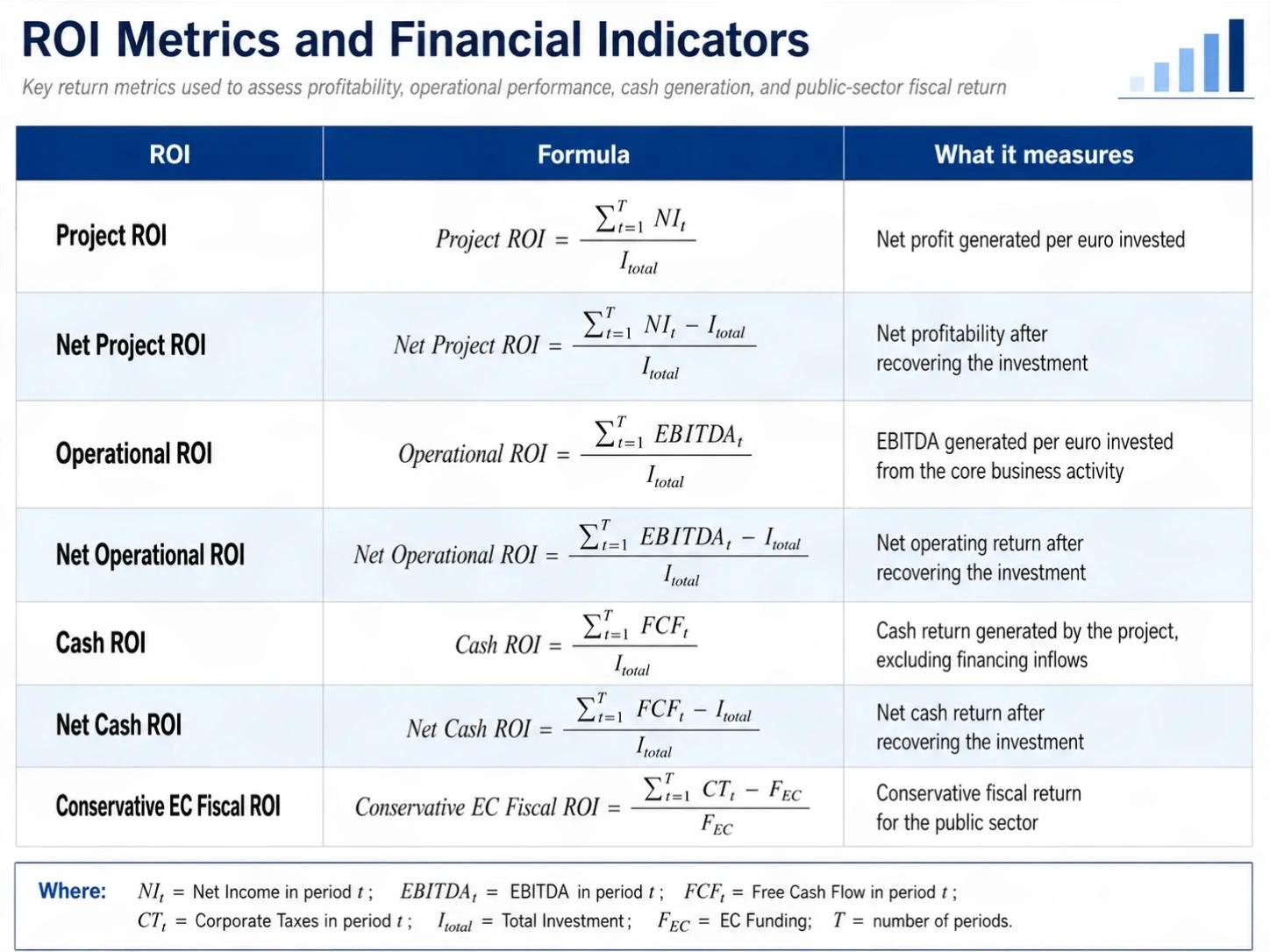
ROI can be a powerful element in an EU funding proposal.
It can help evaluators understand whether a project makes economic sense, whether the requested funding is proportionate and whether the expected results justify the investment. It can also help applicants connect financial projections with the wider impact story, especially in innovation projects where the proposal must show not only technical excellence, but also credible exploitation and scale-up potential.
However, ROI is also one of the easiest financial concepts to misuse.
Many proposals write something like this:
That may sound impressive, but it is not yet evidence. It does not tell the evaluator who is investing, what investment base is being used, what return is being measured, which period is covered or whether the calculation reflects profit, operating performance, free cash flow or public-sector recovery.
That distinction matters because ROI is not one universal number. A project can have several valid ROIs depending on the question the applicant wants to answer. A company may want to show profitability. An investor may want to understand capital efficiency. A public funder may want to see whether public support is likely to be recovered indirectly through fiscal returns. A project manager may want to know whether operating performance is strong enough to justify further scale-up.
Those are different questions.
They require different calculations.
A badly explained ROI can therefore weaken the proposal instead of strengthening it. It creates the impression that the applicant is using financial language decoratively rather than analytically. In competitive EU funding, that is dangerous because evaluators do not need impressive numbers. They need numbers they can understand, verify and trust.
ROI should answer a specific evaluation question
The first mistake is to calculate ROI before deciding what question the proposal needs to answer. This often happens when applicants treat ROI as a standard financial indicator that can be inserted into the impact section, business plan or financial annex without further explanation.
A stronger approach starts with the evaluation logic.
What does the proposal need to prove? Is the objective to show that the project can generate profit after public support? Is it to show that the company can create operating value from the funded activities? Is it to show that the project can generate cash rather than accounting profit? Is it to show that the public contribution is proportionate compared with the expected tax recovery or economic impact?
Each of these questions is legitimate, but they are not the same.
For example, cumulative net income can be useful to communicate profitability, but it does not show cash generation. EBITDA can show operating performance, but it does not include capital expenditure, working capital or financing effects. Free cash flow is closer to cash generation, but it must be calculated carefully to avoid including grants, debt or equity injections as if they were returns generated by the project.
This is why the proposal should never simply state the ROI percentage. It should explain the logic behind it.
A credible ROI statement should clarify:
- what investment is included;
- what return is being measured;
- which period is covered;
- why that ROI metric is relevant;
- what the evaluator should conclude from the result.
Without this context, ROI is just a number looking for an argument.
Project ROI: simple, useful and often misunderstood
One of the simplest metrics is Project ROI:
This shows how much net income the project generates per euro invested during the period analysed. It is easy to communicate and can be useful when the applicant wants to show the profit generation capacity of the project.
For example, if a project requires €2M of total investment and generates €6M of cumulative net income over the period analysed, the Project ROI would be 300%. This means that the project generates three euros of cumulative net income for every euro invested.
That sounds clear, but there is an important limitation.
This formula does not subtract the investment from the numerator. It does not answer the stricter question of what remains after the full investment has been recovered. It measures profit generation capacity, not net return after recovering the investment.
That is not wrong, as long as the proposal explains it.
The problem appears when applicants present Project ROI as if it were the net gain after repayment of the investment base. In that case, the number may look stronger than the underlying economics justify. Evaluators may notice this, especially if the proposal includes financial annexes or projections that allow them to reconstruct the logic.
Project ROI is therefore useful when the applicant wants a simple profitability indicator, but it should be described precisely. The proposal should make clear that it measures cumulative net income relative to total investment during a defined period.
Net Project ROI: a stricter measure of financial return
A stricter version is Net Project ROI:
This metric answers a different question:
This is often more intuitive for readers who expect ROI to reflect the surplus created after the investment base has been recovered. Using the same example, if the project requires €2M of investment and generates €6M of cumulative net income, the Net Project ROI would be 200%, not 300%.
The difference is not cosmetic.
Project ROI says that the project generates three times the investment in cumulative net income. Net Project ROI says that after recovering the initial investment, the project creates two times the investment as net return.
Both figures can be valid, but they tell different stories.
This is why applicants should be careful when selecting the ROI formula. A proposal that uses the more generous version without explanation may look inflated. A proposal that uses the stricter version can appear more conservative and credible, especially when the application is already making ambitious claims about market growth, scale-up and investor attractiveness.
In EU funding proposals, credibility often matters more than maximum numerical impact. A smaller ROI that is clearly explained may be stronger than a larger ROI that looks unclear or opportunistic.
This connects with a broader proposal-writing principle we discussed in Not sufficiently justified in EU proposals: why evaluators need evidence, not more words. The issue is rarely whether a proposal contains a claim. The issue is whether the claim is sufficiently justified.
ROI is no different.
Operational ROI: useful for business performance, but not cash return
Another useful metric is Operational ROI:
This metric focuses on the operating performance of the project. EBITDA, which means earnings before interest, taxes, depreciation and amortisation, can help show whether the project generates profitability from its core business activity before financing structure, tax effects and accounting depreciation.
Operational ROI can be useful in proposals where the applicant wants to demonstrate that the project creates a viable business operation. This may be relevant for deep tech companies that expect heavy early investment, but also want to show that once the product reaches market, the core business can generate strong operating margins.
However, applicants must be careful.
EBITDA is not cash.
A company can show positive EBITDA and still face cash pressure because of capital expenditure, working capital needs, inventory build-up, delayed customer payments, manufacturing scale-up, certification costs or investment in commercial expansion. This is particularly relevant in hardware, medtech, biotech, industrial technology, energy, advanced materials and manufacturing projects, where operating profitability and cash generation can diverge significantly.
A stricter version is:
This shows the net operating return after recovering the investment base. It can be useful when the applicant wants to demonstrate that the business does not merely generate operating income, but generates enough operating income to justify the investment over the period analysed.
The key is to avoid overstating what the metric proves. Operational ROI can support the business case, but it should not be presented as a cash return, investor return or public-sector return unless the calculation is adapted to those specific questions.
Cash ROI: closer to cash generation, but easy to distort
Cash ROI is often more rigorous when the proposal wants to show the cash generated by the project:
A useful definition is:
This formulation focuses on cash generated or consumed by operations and investment activity. It excludes financing cash flows because financing is not a return generated by the project.
This is a critical point.
Grants, equity injections and debt proceeds are sources of funding. They help finance the project, but they are not cash returns created by the project. If the proposal includes grant income, equity proceeds or loan disbursements as part of cash return, the ROI becomes distorted.
That mistake can be serious.
A project may appear to generate strong cash simply because it receives public funding or investment capital. But that does not prove that the business generates cash. It only proves that the company receives financing. Evaluators, investors and financial reviewers can distinguish between the two.
A stricter version is:
This shows the net cash return after recovering the investment base. It is often more demanding than net income or EBITDA-based ROI, especially for capital-intensive projects.
Cash ROI can be powerful, but only when the proposal is transparent about what is included and excluded. The applicant should explain the period covered, the treatment of capital expenditure, the treatment of working capital and the exclusion of financing flows.
If those elements are not clear, the calculation may create more questions than confidence.
Conservative EC Fiscal ROI: a public-sector perspective
EU funding proposals sometimes need to explain not only the company-level return, but also the public value of the funding. One way to do this is through a conservative fiscal perspective.
A simple version is:
This metric answers a public-sector question:
It is conservative because it only includes corporate taxes. It excludes VAT, payroll taxes, social security contributions, employee income taxes, supplier effects, customer productivity gains, regional spillovers, environmental benefits and wider economic impacts.
That conservatism can be useful. It avoids making exaggerated claims about total public return and focuses on one fiscal channel that can be derived from the company financial projections.
However, the denominator must be defined carefully.
EC Funding must be consistent.
In some proposals, EC Funding may mean grant only. In others, it may mean grant plus EC-backed investment. The applicant must state clearly what is included. Otherwise, the result may be impossible to interpret.
For example, a fiscal ROI calculated against grant only will usually look stronger than one calculated against grant plus investment. Neither is automatically wrong, but the proposal must not mix definitions. If the denominator changes between sections, the financial argument becomes unreliable.
Applicants should also be careful not to present Conservative EC Fiscal ROI as the full public return of the project. It is not. It is a narrow fiscal indicator. It can support the impact case, but it does not replace a broader explanation of social, environmental, strategic, industrial or scientific value.
This distinction matters in EU funding because public value is not always captured by company profitability. A project may generate environmental benefits, health outcomes, industrial resilience, reduced dependency, new standards, open knowledge or strategic capabilities that are not fully reflected in corporate tax. Those benefits should be explained separately, using appropriate indicators and evidence.
ROI does not replace the problem statement
A frequent mistake in proposals is to use financial indicators as if they could compensate for a weak problem definition. They cannot.
A high ROI does not prove that the project addresses an urgent need. It does not prove that customers will adopt the solution. It does not prove that the market pain is real. It does not prove that the innovation is necessary.
ROI can support the business case, but it should not become the business case.
A proposal should first explain the problem, who experiences it, why existing alternatives are insufficient, what evidence confirms the need and why the project is the right response. Only then can ROI help quantify the value created.
This is why the financial argument must connect back to the need. If the proposal claims that customers will pay for the solution, the ROI should be linked to a clear adoption logic: pricing, customer segments, sales cycles, expected volumes, margin assumptions and evidence of willingness to pay.
If the proposal claims that the project creates public value, the ROI should be linked to the policy or societal problem being addressed. A fiscal return metric may be useful, but it must be connected to the broader intervention logic.
As discussed in No problem, no grant, a proposal becomes weak when it starts from the solution and assumes that the problem is obvious. The same applies to ROI. A number is only useful if the evaluator understands the underlying problem that makes the return meaningful.
The investment base must be explicit
The denominator is often where ROI calculations become unclear.
What exactly is Total Investment?
Is it the total project budget? The company contribution? The grant-funded activities plus private co-financing? The total capital needed until market entry? The cumulative investment across the full scale-up period? The EIC grant only? Grant plus equity? A wider funding round?
Each option can be valid, but each answers a different question.
For example, if the applicant calculates ROI using only the grant amount as the denominator, the return may look very high. But that may not reflect the true investment required to generate the result. If the project also requires private co-financing, equity investment, debt, internal resources or follow-on scale-up investment, the evaluator may question whether the ROI has been calculated on a complete investment base.
A stronger proposal states the denominator explicitly.
For example:
Or:
Both approaches can be acceptable if the logic is clear.
What is not acceptable is leaving the evaluator to guess.
The analysis period must match the project logic
ROI also depends heavily on the time period used. A five-year ROI, a seven-year ROI and a ten-year ROI may tell very different stories, especially in deep tech projects where commercialisation may start late.
This is important for EIC Accelerator, Horizon Europe and other innovation funding proposals because many projects spend the first years on development, validation, certification, clinical work, industrial pilots, regulatory preparation, manufacturing scale-up or market-entry activities. Revenue may only become meaningful after the funded project ends.
If the ROI period is too short, the project may look weaker than it really is. If it is too long, the calculation may depend on speculative forecasts that are difficult to defend.
The proposal should therefore explain why the selected period is appropriate.
For example, a five-year period may be suitable for a software product with fast commercial deployment. A seven-year period may be more suitable for industrial technology requiring pilot validation and scale-up. A ten-year period may be necessary for medtech, biotech or infrastructure-heavy projects, but the assumptions should become more conservative as the forecast extends further into the future.
The key is not to choose the period that creates the highest ROI.
The key is to choose the period that makes the evaluation logic credible.
ROI should be traceable to the financial model
A proposal should not present ROI as an isolated figure. The evaluator should be able to understand where the numerator and denominator come from.
If the numerator is cumulative net income, it should be traceable to the profit and loss forecast. If it is cumulative EBITDA, it should be traceable to the operating projections. If it is free cash flow, it should be traceable to the cash flow forecast. If it is corporate tax, it should be traceable to the tax assumptions used in the financial model.
This does not mean that the proposal needs to reproduce the entire spreadsheet. It means that the calculation should be transparent enough for the evaluator to follow the reasoning.
A strong ROI paragraph may include the formula, the investment base, the period, the main assumptions and the interpretation.
For example:
This is much stronger than simply writing:
The first version gives the evaluator something to assess. The second version asks the evaluator to trust a number without understanding it.
ROI should not overclaim what the proposal has not proven
A financial model can make almost any project look attractive if the assumptions are aggressive enough. High adoption rates, rapid market penetration, strong margins, short sales cycles, low customer acquisition costs and optimistic pricing can generate excellent ROI figures.
But evaluators are not only reading the result. They are reading the plausibility of the assumptions.
If the proposal has not proven customer demand, a high revenue-based ROI will look fragile. If the regulatory pathway remains uncertain, a fast commercial ramp-up may look unrealistic. If production costs are not validated, strong margins may look premature. If freedom to operate has not been assessed, market access assumptions may be incomplete.
This is why ROI should be proportionate to the evidence.
A proposal can still be ambitious. It should be ambitious. But ambitious ROI must be supported by adoption evidence, credible pricing logic, realistic cost assumptions, defensible market-entry timing and clear risk management.
Financial claims are also connected to defensibility. As discussed in Patent granted does not mean freedom to operate, owning a patent does not automatically prove that a company can commercialise without infringing other rights. If ROI depends on future market access, manufacturing, licensing, distribution or technology deployment, the proposal should avoid assuming that IP protection alone removes all commercial risk.
The evaluator does not need a perfect forecast.
The evaluator needs a trustworthy one.
Where ROI is useful in the proposal
ROI can appear in several parts of an EU funding proposal, but it should be placed where it supports the argument rather than where it merely looks impressive.
In the impact section, ROI can help show the economic value created by the project, especially when linked to exploitation, market uptake and scalability. In the business plan or commercialisation section, ROI can support the investment logic, pricing strategy and growth case. In the financial annex, ROI can help interpret projections that would otherwise remain as tables of revenue, cost and cash flow. In the justification of funding need, ROI can help show why public support is proportionate to the expected economic and public return.
However, ROI should not be scattered across the proposal with different definitions. If several ROI metrics are used, the proposal should explain why each one is included.
For example:
- Project ROI can show profit generation capacity.
- Net Project ROI can show return after recovering the investment.
- Operational ROI can show core business performance.
- Cash ROI can show cash generation.
- Conservative EC Fiscal ROI can show a narrow public funding recovery perspective.
Using several metrics can be helpful, but only if the proposal avoids confusion. A small table with definitions, formulas and interpretation may be clearer than several isolated percentages across different sections.
The goal is not to overwhelm the evaluator with financial indicators.
The goal is to use the right metric for the right question.
A practical ROI checklist before submission
Before submitting a proposal that includes ROI, applicants should test whether the calculation is clear enough for an evaluator to trust.
Definition
- Is the ROI formula explicitly stated?
- Is the numerator clearly defined?
- Is the denominator clearly defined?
- Is the period of analysis stated?
- Is the metric named accurately?
Investment base
- Does Total Investment include the full cost required to generate the return?
- If the denominator is grant only, is that explained?
- If the denominator includes equity, debt or private co-financing, is that explained?
- Is the same investment base used consistently throughout the proposal?
Return metric
- Is the return based on net income, EBITDA, free cash flow, corporate tax or another metric?
- Is the selected metric appropriate for the argument being made?
- Are financing flows excluded when calculating cash return?
- Is EBITDA clearly distinguished from cash flow?
Evidence and assumptions
- Are revenue assumptions traceable to customer segments, pricing and adoption logic?
- Are margin assumptions realistic for the technology and business model?
- Are market-entry timing and scale-up timing credible?
- Are key risks visible rather than hidden?
- Are claims proportionate to the evidence available?
Interpretation
- Does the proposal explain what the ROI means?
- Does it explain what the evaluator should conclude?
- Does it avoid presenting ROI as proof of impact by itself?
- Does it connect ROI to the problem, market need, exploitation strategy and funding need?
If these questions are not clearly answered, the ROI may be mathematically correct but strategically weak.
The evaluator needs to trust the story behind the number
ROI can strengthen an EU funding proposal when it helps the evaluator understand the economic logic of the project. It can show that the requested funding is proportionate, that the company understands its financial pathway and that the expected return is connected to a credible exploitation strategy.
But ROI can also weaken a proposal when it is presented as a decorative percentage. If the investment base is unclear, the return metric is not defined, the period is not stated or the assumptions are not traceable, the number becomes difficult to evaluate.
The practical advice is simple: do not write only that the project ROI is X%. Explain what investment is included, what return is measured, what period is covered, why the metric is relevant and what conclusion the evaluator should draw.
That is the difference between a financial claim and financial evidence.
Ruthless Evaluator helps applicants, consultants, universities, research centres, startups and innovation teams detect these issues before submission: financial claims that look impressive, but where the logic behind them is unclear, unsupported or difficult to evaluate.
Because in a competitive proposal, numbers are not enough.
The evaluator needs to trust the story behind them.
Run an evaluator grade review on the draft
Upload a version, select programme context, and get structured feedback you can act on.