EIC Fund Investment Guidelines 2026: how the investment component actually works
The EIC Fund investment component is not simply an amount awarded alongside a grant. The August 2026 guidelines explain how investment size, instruments, co-investors, due diligence, transaction buckets, tranches, monitoring and exit decisions actually work.
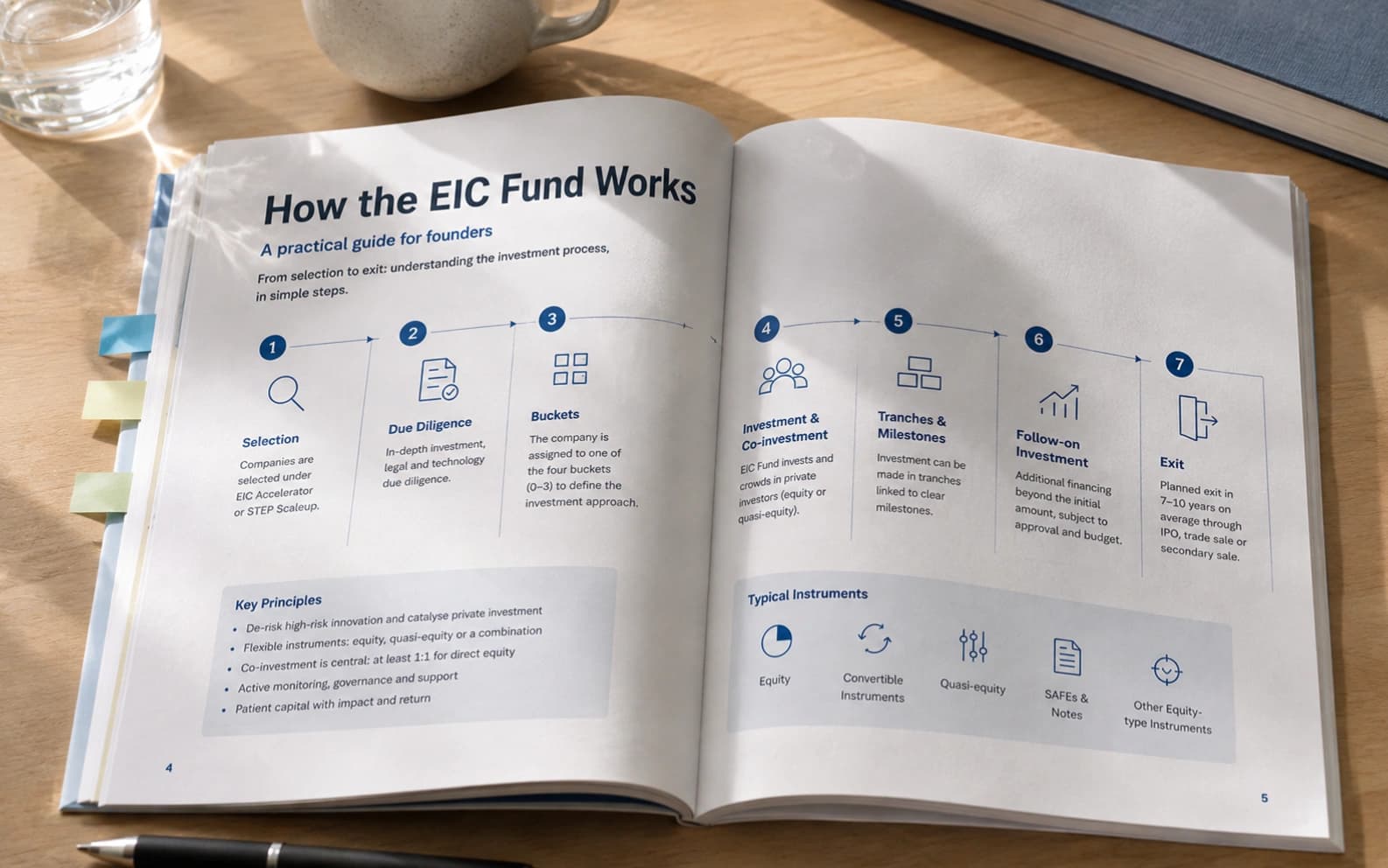
On 27 August 2026, the European Innovation Council published an updated set of EIC Fund Investment Guidelines. The EIC announcement states that the text applies to companies selected under the EIC Accelerator, including blended finance and equity-only support, and under EIC STEP Scaleup calls.
For applicants, the most useful part is the explanation of what happens to the investment component after selection. The amount in the award decision is only one part of a process that can include due diligence, co-investors, milestones, transaction structuring, governance and eventual exit.
The guide is detailed, but the process becomes much easier to understand when it is read as a sequence.
1. The purpose is to de-risk companies and catalyse private investment
The starting point in the guidelines is the financing gap. EIC Accelerator support is intended for high-risk projects that are not yet sufficiently attractive for investors, including because of the scale of investment required. The objective is to de-risk those projects and catalyse private investment during the life of the EIC investment.
This explains why private capital is central to the model. Crowding in other investors is part of the design of the instrument. The EIC Accelerator is designed to fulfil the role of initial or first risk-taker where needed, while the investment model aims to attract additional financing for market deployment and scale-up.
The investment component can cover financing from seed-stage to growth equity rounds. It can use convertible instruments, including loans, bonds, notes, participation rights and SAFE-type instruments, a combination of quasi-equity and direct equity, or direct equity.
The guidelines set an investment range from €500,000 to €30M per company, subject to the applicable EIC Work Programme, which may provide for a higher amount in specific cases. When the EIC Fund uses equity or quasi-equity, it generally targets a minority stake of 10% to 20%. A blocking stake, through minority or majority ownership, can be acquired where the EU Commission award decision identifies a need to protect EU or Associated Country interests.
The practical implication is simple: the investment component is not a fixed-form cheque. The guide allows different instruments and transaction structures depending on the case.
2. The amount recommended during evaluation is not necessarily the final investment amount
The investment amount decided by the External AIFM, with support from the Adviser, can be lower or higher than the amount proposed by the independent expert evaluators, subject to the terms of the EU Commission award decision. The maximum amount must be authorised in advance through that award decision, but the investment still has to be structured and negotiated.
If the investment is made in tranches, the External AIFM takes a position on the entire amount considered for funding. The timing and conditions of the tranches are then negotiated with the company and can depend on predefined milestones.
The guidelines define milestones as meaningful achievements in company development, including maturity stages, TRLs achieved and co-investment leveraged. If measurable milestones are not reached, support can be suspended, amended or, where justified, terminated. The guide also states that support may be terminated where expected market deployment, especially in the EU, can no longer realistically be achieved.
This is one reason the financial and scale-up story needs to remain coherent. Our article on the EIC Accelerator Financial Plan Annex and the Year N to N+4 scale-up story explains why development, financing, market entry and scale-up should form one credible sequence.
3. Direct equity is built around co-investment
The guide is explicit about the role of co-investors. From the start and during the life of the EIC Fund investment, the External AIFM will connect the potential EIC Fund Final Recipient with the EIC Accelerator investor community ecosystem. Selected applicants are also encouraged to seek co-investors themselves.
For direct equity investments, excluding quasi-equity instruments, the EIC Fund will systematically seek co-investment and syndication with other investors on at least a 1:1 matching basis. Across the investment horizon, the objective is a 1:3 leverage effect.
This distinction matters. The 1:1 matching statement in the guidelines is specifically linked to direct equity. It should not be converted into a universal rule for every possible EIC Fund instrument.
The guide also explains why Qualified Investors matter: they can bring knowledge, expertise, teams and networks as well as capital. Potential investors can include Business Angels, Venture Capital funds, Impact investment funds, Family offices, Venture debt funds, National Promotional Banks and Institutions, and corporate venture arms.
If the company and the External AIFM agree on a co-investment opportunity, financial and commercial due diligence and negotiations may be performed jointly with potential co-investors. The External AIFM and the Adviser retain control to ensure sufficient due diligence and the inclusion of required conditions in the investment documentation.
4. The four buckets explain what can happen after the initial assessment
After initial assessment, KYC compliance checks and market consultation, the Adviser classifies the transaction into one of four buckets. The classification is not static. A case can move between buckets as due diligence progresses, co-investment interest develops or project milestones are reached.
Understanding these buckets is probably the fastest way to understand how the EIC Fund thinks about investment implementation.
Bucket 0: issues that prevent investment
Bucket 0 covers cases where initial assessment or due diligence identifies substantial negative issues that prevent an investment by the EIC Fund.
This due diligence is more detailed than the evaluation performed before the EU Commission award. It does not repeat the proposal evaluation, but its findings can still call into question the legality or rationale of the transaction.
Examples in the guidelines include fraud, money laundering or tax avoidance issues, sanctions or exclusion problems, misrepresentation, insufficient information for an informed investment decision, substantial negative changes after the award, major changes in management or control, serious litigation, loss of key suppliers, clients or partners, cap table misalignment, insufficient founder incentives, contradictions between proposal-stage financial documentation and company books, and intellectual property that is not owned by or accessible to the applicant or is under litigation.
If no remedy is possible, the External AIFM can decide not to proceed. The guidelines state that this may have consequences for the wider EIC Accelerator support, including possible re-evaluation, grant-only conditions, termination or cancellation depending on the case.
Bucket 1: addressable shortcomings and high investment risk
Bucket 1 covers companies with shortcomings that can be addressed through EIC Fund support but that are not yet ready for private investors because risk remains very high.
The guide gives examples such as very early technology maturity, a long time to market, a market that is too small compared with the investment need, or limited readiness to absorb additional equity because of the team or cap table.
Bucket 1 can use quasi-equity, a combination of quasi-equity and equity, or direct equity. The guide also describes a possible two-tranche structure.
For the first tranche, the guidelines state that the EIC Fund would invest the maximum of either 50% of the estimated EIC Fund investment or the unfunded cash needs of the applicant over a period generally up to 18 months. This can take the form of a convertible loan. The guide describes, generally, an 18-month maturity, 8% fixed interest accruing and capitalised at prepayment or conversion, and a 20% discount at conversion for an 18-month maturity. It also allows the External AIFM, on recommendation from the Adviser, to introduce a conversion cap case by case.
For the second tranche, the EIC Fund would in principle invest the remaining estimated amount in an equity round, subject to private investors co-investing an amount that fully matches the total EIC Fund investment, including the convertible loan from the first tranche. The EIC Fund may require those co-investors to be Qualified Investors and may set a minimum round size based on the financing needs identified during due diligence.
In certain Bucket 1 cases, the EIC Fund can seek a board seat and external mentoring, and mentoring can be mandatory as an investment condition.
Bucket 2: private investors are ready to co-invest
Bucket 2 applies when potential investors, including a Qualified Investor, show immediate interest in co-investing in the selected company.
Here, the EIC Fund seeks an equity investment that is at least matched by the potential investors, meaning that they cover at least 50% of the round. The longer-term objective remains 1:3 leverage across the full EIC investment cycle.
The EIC Fund may rely on financial, commercial and technology due diligence performed by Qualified Investors and should seek alignment with their terms. It can also reserve part of the authorised investment as a possible top-up for a later investment step.
Bucket 3: private investors can provide the full investment
Bucket 3 covers cases where potential investors show immediate interest in providing the full investment required by the EIC applicant company.
The EIC Fund can still co-invest where a blocking minority is needed to protect EU interests, or reserve the authorised investment as a possible top-up for a later step.
For companies comparing EIC Accelerator and larger scale-up financing routes, our earlier article on EIC STEP Scale Up Defence versus EIC Accelerator explains why the financing logic and company maturity should drive the instrument choice rather than the maximum ticket alone.
5. Passing the EIC evaluation is not the same as passing investment due diligence
The financial and commercial due diligence focuses on governance and management quality, capital structure and financial planning, business strategy, competition, market assessment, value creation, legal form and jurisdictions.
Additional technology due diligence can also be required by the Investment Committee on a case-by-case basis. The guide explains that technology has already been assessed before the award decision, but a deeper investor-angle review may still be needed to obtain a more complete view or investigate concerns related to technology and market prospects.
Compliance and KYC checks occur before the initial investment and again before possible later tranches, top-ups and Follow-on Investments. These checks extend beyond the applicant to shareholders and ultimate beneficial owners.
Application information needs to withstand comparison with due diligence findings. The guide identifies contradictions between proposal-stage financial documentation and company books as a potential Bucket 0 issue. Intellectual property, the cap table, shareholder structure and key management changes also form part of the investment risk assessment.
6. The instrument can vary, and EU safeguards can change the transaction
The guide lists common shares, preferred shares, convertible instruments such as loans, bonds, notes, participation rights and SAFEs, and other appropriate equity-type instruments. It does not define one standard instrument for every company. The final structure depends on the case and negotiated transaction.
Where the EU Commission award decision identifies a need to protect EU interests, the EIC Fund can use additional safeguards. The guidelines include measures such as secondary share purchases and blocking stakes, and they state that the EIC Fund can seek to keep intellectual property within the EU and Associated Countries where this is relevant to the development of the company and the protection of EU interests.
7. Closing the transaction is followed by active monitoring
Once terms are agreed, the External AIFM executes the investment and closes the legal documentation. After closing, the guide provides for active management of milestone funding, conversions, Follow-on Investments, write-downs, restructurings and exits. Board voting representatives or non-voting observers can also be appointed through the stated processes.
The relationship between grant and investment components also continues after the transaction. The guide states that a material breach related to the EIC Accelerator grant component can prevent further investment and can eventually lead to an early exit, and vice versa.
8. Follow-on Investment is different from investing the authorised amount in several steps
The guidelines make a useful distinction between staged investment and Follow-on Investment.
If the EIC Fund invests one part of the equity amount first and another part later, for example in a subsequent funding round, this is not treated as Follow-on Investment as long as the total remains within the amount authorised by the EU Commission award decision.
A Follow-on Investment goes beyond that maximum authorised amount. It requires an ex ante amending award decision by the EU Commission and remains subject to eligibility, the applicable EIC Work Programme, matching requirements, available budget and a valid EU Commission financing decision.
Tranches, top-ups and Follow-on Investments are therefore not interchangeable terms.
9. The EIC Fund is patient capital, but it still plans an exit
The guidelines describe the EIC Fund as patient capital. The stated average perspective on return is 7 to 10 years, with a maximum of 15 years in general. The main objective is impact investment rather than maximising return, although a positive return is planned at the time of investment and the transaction follows general market practice.
Exit strategy is defined case by case with co-investors. Routes can include an IPO, management buy-out, secondary sale or liquidation. In general, co-investors, especially a lead investor, should drive the exit process. Divestment should also occur when market financing, including InvestEU, becomes available and EIC support is no longer needed. Failure to find co-investors can also influence an exit decision.
10. A practical due diligence checklist derived from the guidelines
The guide does not present this as an applicant checklist, but its due diligence and Bucket 0 sections make the required preparation visible. Before an EIC Fund investment process, a company should be able to document and explain:
- capital structure: current shareholders, ultimate beneficial owners, founder incentives and any issues that could create misalignment;
- financial integrity: financial data that is consistent with company books, a credible financing plan and a clear explanation of cash needs;
- governance: management quality, responsibilities, decision structures and any material changes since the EIC evaluation;
- business strategy: how the company creates value and how the proposed investment supports market deployment and scale-up;
- market and competition: the market assessment and competitive position that support the investment case;
- intellectual property: ownership or access rights, absence or status of litigation and the role of IP in company development;
- legal and jurisdictional structure: the legal form, jurisdictions, shareholder structure and information required for compliance and KYC;
- co-investment: current investor interest, the role of Qualified Investors where relevant and the financing round needed to execute the scale-up plan;
- milestones: measurable development achievements, TRL progression and co-investment milestones that can support staged financing.
This is not an additional set of EIC rules. It is a practical reading of the areas that the August 2026 guidelines explicitly identify as relevant to investment implementation and due diligence.
The investment component is a process, not a number
The clearest way to read the 2026 guidelines is as a sequence. The EU Commission authorises support and a maximum investment amount. The External AIFM and Adviser then perform deeper investment and compliance work, assess co-investment conditions and classify the case. The transaction can use equity, quasi-equity or a combination, in one step or in tranches. Monitoring continues after closing, Follow-on funding has separate conditions and exit remains part of the investment plan.
For EIC Accelerator applicants, the investment logic connects financing need, company maturity, cap table, market deployment, milestones, investor readiness and scale-up strategy.
If you are preparing an EIC Accelerator application, the EIC Accelerator Proposal Evaluator can help stress-test whether the proposal makes those links clear before submission. Ruthless Evaluator does not replace EIC Fund due diligence or investment advice. It helps identify weaknesses in the application that an evaluator can see before the investment process begins.
The updated guidelines make one point especially clear: selection and investment implementation are connected, but they are not the same process. Understanding that distinction is essential for any company asking the EIC Fund to become an investor.
Run an evaluator grade review on the draft
Upload a version, select programme context, and get structured feedback you can act on.