How to build a strong Horizon Europe consortium: a pit crew, not a logo wall
A strong Horizon Europe consortium is not a collection of impressive logos. It is a delivery system where every beneficiary performs a necessary function, reduces a specific project risk and makes the intervention more credible.
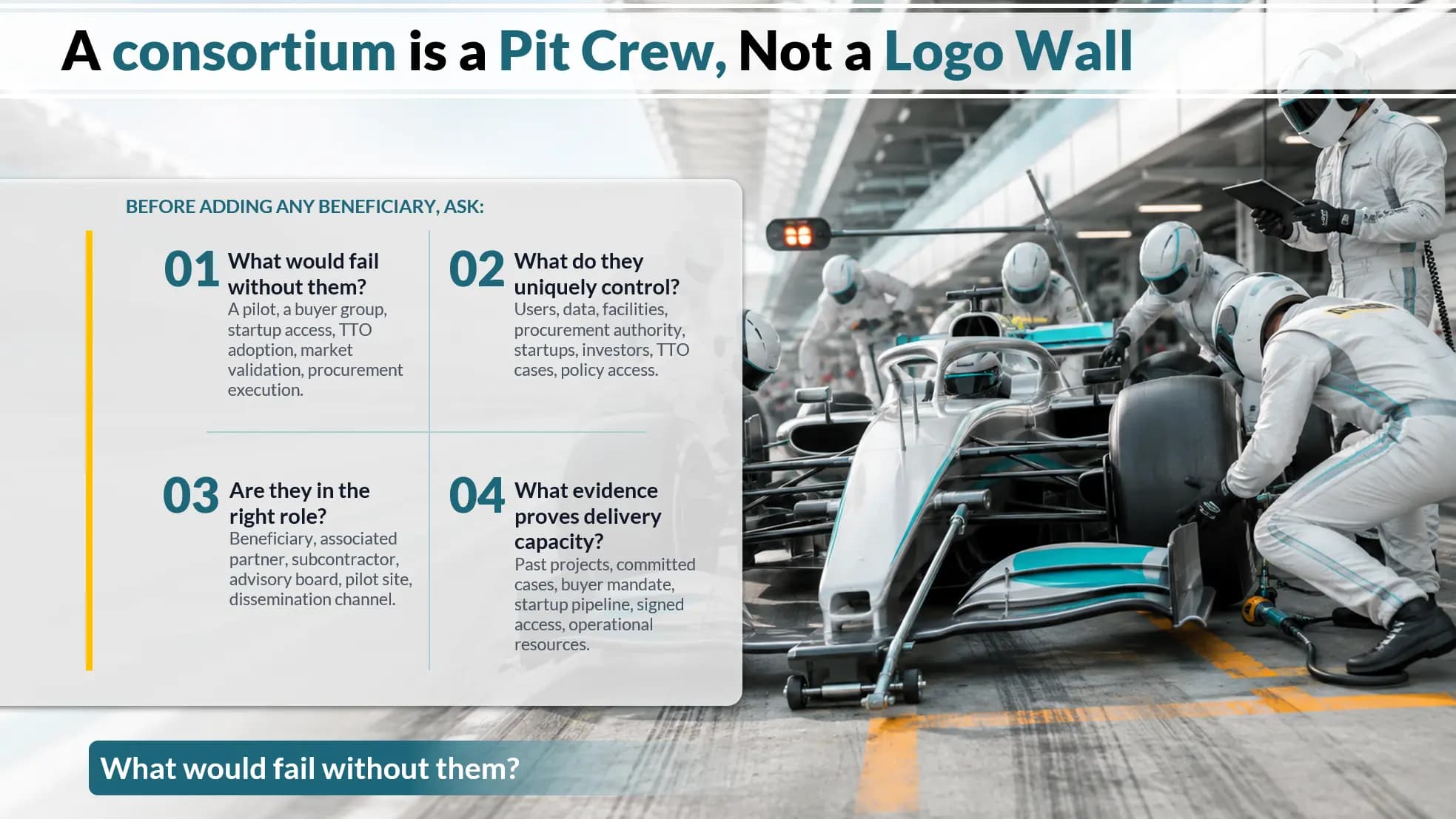
A strong Horizon Europe consortium is not built by collecting prestigious names and then searching for tasks to give them. It is built in the opposite direction: start with what the project must prove, build, validate and exploit, then identify the organisations that make those outcomes credible.
That distinction sounds simple, but it changes the entire proposal. A consortium assembled around reputation often produces vague roles, duplicated expertise and work packages that read as compromises between partners. A consortium assembled around delivery creates a much clearer story. The evaluator can see who owns each critical function, why that organisation is needed, what evidence supports its capacity and what project risk becomes smaller because it is there.
This is why the most useful analogy is a pit crew. A pit crew can include highly specialised people, but nobody is present as decoration. Every role has a purpose, every handover matters and every delay has consequences. The same principle applies to a collaborative research and innovation project.
That question is the starting point for a consortium that feels necessary rather than crowded.
The problem is not consortium size. It is consortium logic.
For many collaborative Horizon Europe calls, the formal participation rules require a minimum consortium of independent legal entities established in different eligible countries, with the exact conditions and exceptions defined by the call. That eligibility threshold matters, but eligibility is only the floor. It does not tell you what the right consortium should look like for a particular project.
A proposal can satisfy the formal rules and still present a weak delivery structure. It may include excellent organisations but fail to explain why those organisations belong together. It may cover several countries without showing why those countries matter. It may include universities, companies, public bodies and user organisations but leave the evaluator uncertain about who owns validation, exploitation, regulatory work or implementation after the funded period.
The official Horizon Europe guidance is clear that beneficiaries are the project partners named in the grant agreement and that the grant defines the activities, budget, EU contribution, rights and obligations of the action. That is why beneficiary status should not be treated as a badge. It is an implementation role with responsibilities. See the Horizon Europe 2026-2027 General Annexes and the REA guidance on who should apply for the current framework and call-specific caveats.
A good consortium therefore does more than meet the minimum participation conditions. It makes the work plan believable.
Build from the work backwards, not from the logos forwards
The fastest way to create a weak consortium is to begin with a list of organisations you would like to include. Once those names are politically or commercially committed, the proposal team often has to invent a justification for each one. Work packages become fragmented, deliverables multiply and budgets are distributed partly to preserve goodwill rather than to reflect real responsibility.
A stronger process starts with the critical functions of the project. Before discussing organisations, define what the action must be able to do from beginning to end. Depending on the topic, that may include scientific development, engineering, access to infrastructure, user recruitment, regulatory preparation, pilot deployment, manufacturing, data access, standardisation, procurement, market validation, communication, exploitation or policy uptake.
For every critical function, ask four questions:
- What exactly must be delivered?
- What capability is required to deliver it?
- What evidence would convince an evaluator that the capability exists?
- Which organisation can own the function with the least ambiguity?
Only after those questions are answered should names enter the design.
This produces a consortium map based on capabilities and dependencies rather than reputation. It also reveals gaps early. If the project needs hospital access but nobody controls a hospital environment, the gap is visible. If the project depends on public procurement but no organisation has a credible buyer or procurement role, the gap is visible. If market adoption depends on an industrial channel that nobody owns, that gap is visible too.
The result is not always a smaller consortium. Sometimes the correct project genuinely needs many organisations. The difference is that each organisation has a reason that can be explained in one or two sentences.
Use the pit crew test for every beneficiary
The core test is simple:
A strong answer is specific. For example: without this partner, the consortium cannot access the target patient population; cannot validate the prototype in the required industrial environment; cannot obtain the dataset needed for the model; cannot manufacture at the scale required for demonstration; cannot engage the public buyers that define the adoption pathway; or cannot execute the exploitation route described in the impact section.
A weak answer sounds different: the organisation is prestigious, has a strong network, has participated in many EU projects, knows the sector or could support dissemination. Those qualities may be useful, but they do not automatically justify beneficiary status.
The pit crew test becomes even stronger when you add a second question:
The answer should connect directly to the intervention logic. A testing centre may reduce technical validation risk. A hospital may reduce clinical evidence and user-access risk. A manufacturer may reduce scale-up risk. A city or public authority may reduce deployment and adoption risk. A commercial partner may reduce market-entry risk. A research organisation may reduce scientific uncertainty or provide infrastructure that cannot be replicated elsewhere.
When an organisation cannot be linked to a concrete failure mode, it is worth reconsidering the role.
Make the unique contribution visible
General expertise is rarely enough. Many organisations can claim expertise in artificial intelligence, sustainability, stakeholder engagement, communication, innovation management or exploitation. What strengthens a proposal is not the label, but the asset, access, authority or capability that is difficult to replace.
A partner may uniquely control a pilot facility, a patient cohort, a manufacturing line, a dataset, a certification environment, an established buyer network, a regulatory pathway, a regional deployment site, a protected technology, a user community or a route to market. That unique control gives the evaluator a reason to believe that the work can actually happen.
The proposal should make this visible through a simple chain:
Capability → task → evidence → output → risk reduced.
For example, instead of writing that a partner has extensive experience in industrial validation, write that the partner operates the specific pilot line on which the prototype will be tested, has completed comparable validation campaigns, will lead Task 4.2, will deliver the validation dataset and will reduce the risk that laboratory performance fails under industrial conditions.
That sentence tells the evaluator much more. It connects the organisation to the work plan and gives the role an observable purpose.
The same principle applies to exploitation. Saying that a company has market experience is generic. Explaining that it controls the distribution channel for the first target segment, has existing customers in three priority markets and owns the post-project commercial rollout task is specific.
Specificity converts reputation into credibility.
Beneficiary status is not the only way to involve a useful organisation
One of the most common causes of consortium inflation is the belief that every useful organisation must become a beneficiary. Horizon Europe provides several participation mechanisms, subject to the conditions of the call and the grant agreement. An organisation may contribute as an associated partner, subcontractor or other permitted participant rather than as a funded beneficiary.
This distinction matters because different roles carry different responsibilities. A beneficiary signs the grant agreement and is responsible for implementing action tasks. An associated partner can participate in the action without receiving EU funding under the grant. Subcontracting is used for defined action tasks under the applicable grant rules when the conditions are met. Other forms of involvement can also be appropriate for advisory, dissemination or stakeholder participation.
The strategic question is therefore not simply, “Do we want this organisation involved?” It is:
A hospital that must recruit participants, run a clinical protocol and generate core evidence may need a beneficiary role. A hospital that only provides occasional expert advice may not. A public authority that owns a pilot site and will execute procurement-related activities may require a central role. A public authority that only supports dissemination could be involved differently.
Choosing the right role can make the consortium easier to govern without losing valuable expertise or external credibility.
For a deeper look at this trade-off, see More partners, more problems: how to avoid unnecessary complexity in Horizon Europe consortia.
The work plan should reveal the consortium logic
A strong consortium does not need a long paragraph defending why every participant is present. The logic should already be visible in the work plan.
If Partner A claims to be the technical lead, it should own meaningful technical tasks and outputs. If Partner B is presented as the end-user representative, it should have a concrete role in requirements, co-design, validation or adoption. If Partner C is responsible for exploitation, the proposal should show what exploitation decisions, assets, market activities or post-project responsibilities it controls.
This is where many otherwise polished proposals become inconsistent. The narrative says one thing, the work packages say another and the budget says something else. An organisation described as strategically essential receives a very small allocation. Another partner receives a large budget but owns no obvious critical output. Several partners share the same vague task, making accountability difficult to identify.
Evaluators do not need every task to belong to one organisation, but they do need to understand who is accountable for what. Shared work is normal. Shared accountability without a clear owner is not.
A useful check is to read only the work package table and ask whether the consortium still makes sense. If the answer is no, the role descriptions are probably doing too much explanatory work.
Budget is a consortium design test
Budget allocation is not only a financial exercise. It is also a test of whether the consortium structure is credible.
If an organisation owns a major technical risk but receives almost no resources, the evaluator may question whether the role is real. If a partner receives a substantial share of the budget but owns only communication, coordination support or loosely defined stakeholder activity, the evaluator may question proportionality. If several partners receive similar allocations for overlapping responsibilities, the work plan can look negotiated rather than designed.
This does not mean that budget should be mechanically proportional to prestige, number of tasks or work package leadership. Different activities have different cost structures. Experimental work, clinical validation, pilots, manufacturing and infrastructure-intensive tasks may legitimately require more resources than desk-based analysis.
The important point is that budget, responsibility and evidence should tell the same story.
For each partner, the proposal team should be able to explain why the planned resources are necessary for the tasks, why those tasks matter to the project and why the organisation is the right one to perform them.
Three consortium patterns that often reveal the difference
Technology transfer and deep-tech projects
A famous university does not automatically make a technology-transfer consortium credible. The important question is whether the relevant team controls the research result, IP, laboratory capability or scientific knowledge needed for the project, and whether the consortium also contains the capabilities required to move beyond research.
If the project promises industrial validation, somebody must own the industrial environment. If it promises commercial exploitation, somebody must own the exploitation pathway. If it promises manufacturing scale-up, somebody must demonstrate manufacturing competence. A research-heavy consortium with no credible bridge to deployment can look incomplete even when the scientific institutions are excellent.
Health, user-validation and pilot projects
A hospital, municipality, public service or user organisation should not be included only to make the proposal look user-centred. The role must be operational. Who recruits users? Who owns ethics or local approvals where relevant? Who runs the pilot? Who collects evidence? Who decides whether the outcome is usable? Who continues adoption after the project?
The partner becomes valuable when the proposal connects access to execution.
Ecosystem and public-sector projects
Networks, clusters, accelerators and public authorities can be powerful partners, but “large network” is not a task. The proposal should explain what the network enables that the consortium cannot obtain otherwise. Is it access to buyers, startups, regions, public procurers, standards communities, investors or policy actors? What will that access produce during the action?
A network becomes credible when its reach is converted into measurable project activity and outputs.
Design for evaluator speed
Evaluators read under time pressure. A consortium that takes several pages to understand is already creating friction.
A strong proposal allows a reader to answer these questions quickly:
- Why is each beneficiary necessary?
- Which critical function does each beneficiary own?
- What evidence demonstrates the required capacity?
- Which risk becomes smaller because the beneficiary is included?
- Why is the budget proportionate to the responsibility?
- How do the partners connect from research to validation, impact and exploitation?
The clearer those answers are, the less interpretive work the evaluator has to do.
This is one reason to avoid generic role descriptions such as “supports dissemination”, “contributes to stakeholder engagement” or “provides expertise”. Those phrases can be true, but they rarely prove necessity. Replace them with named tasks, assets, audiences, environments, outputs and decisions.
If the evaluator can remove a partner mentally and nothing important changes, the proposal has a consortium-design problem.
A practical consortium check before submission
Before freezing the partner list, run a short red-team exercise. For every beneficiary, write a one-page note that answers the following questions:
Function
- What critical project function does this organisation own?
- What would fail, weaken or become materially riskier without it?
- Which work package, task and output make the role visible?
Unique contribution
- What does the organisation control that another partner does not?
- Is that contribution an asset, access right, capability, infrastructure, dataset, authority, user base or market channel?
- Could the same contribution be obtained more simply through another participation role?
Evidence
- What verifiable evidence demonstrates capacity to deliver?
- Are previous projects, facilities, customers, pilots, publications, certifications or operational results relevant to the promised role?
- Are resources and budget aligned with that responsibility?
Integration
- Which other partners depend on this organisation?
- Are the handovers between tasks clear?
- Does the role strengthen the impact and exploitation story as well as implementation?
If the answers are precise, the beneficiary probably belongs. If the answers rely on reputation, general expertise or future usefulness, redesign the role before submission.
Do not build a logo wall. Build a delivery system.
The best Horizon Europe consortia are not memorable because they contain the largest number of famous institutions. They are memorable because the project structure makes sense.
Every critical capability is covered. Every important risk has an owner. Every partner controls something useful. The budget follows the work. The work packages follow the intervention logic. Validation connects to impact. Exploitation has real owners rather than generic promises.
That is the pit crew principle in practical terms.
A consortium should feel inevitable. The evaluator should be able to see why these organisations, in these roles, with these resources, are the team required to deliver this particular action.
If you are stress-testing that logic, the Horizon Europe Proposal Evaluator is designed to review programme-specific weaknesses before submission. Ruthless Evaluator can help identify vague partner roles, weak evidence chains, unexplained implementation choices and inconsistencies between ambition, work plan, impact and delivery capacity.
The objective is not to make the consortium look bigger.
It is to make the proposal easier to trust.
Run an evaluator grade review on the draft
Upload a version, select programme context, and get structured feedback you can act on.