More partners, more problems: how to avoid unnecessary complexity in Horizon Europe consortia
Adding more beneficiaries does not automatically make a Horizon Europe consortium stronger. A new partner should reduce a specific project risk, not add coordination noise, unclear responsibility or unexplained complexity.
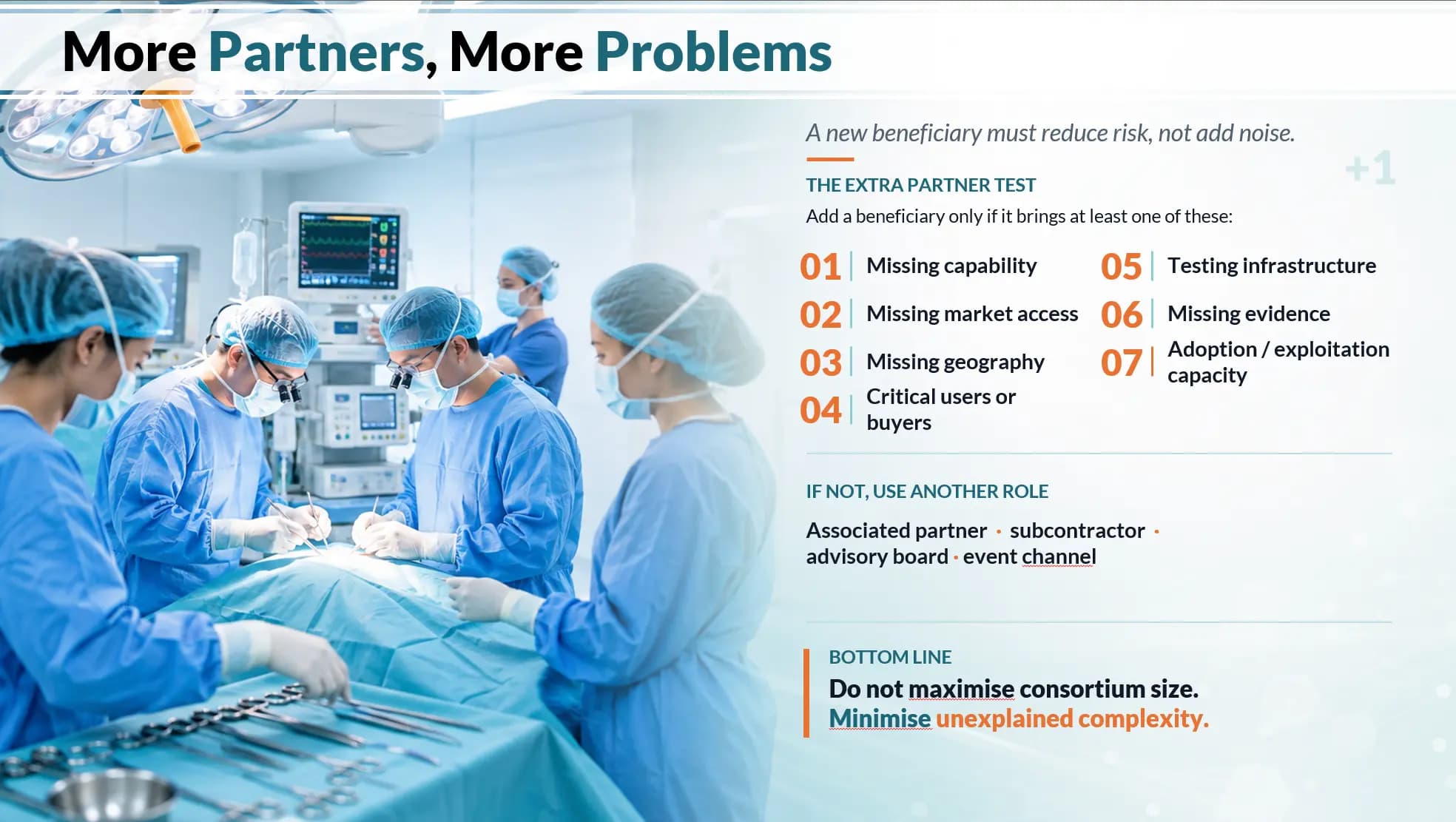
A new partner often feels like an easy way to make a Horizon Europe proposal stronger. Add a university and the scientific profile looks deeper. Add a company and the exploitation story looks more commercial. Add a city, hospital, cluster or user organisation and the proposal appears closer to implementation.
The problem is that every new beneficiary creates both capability and complexity. If the capability is specific and necessary, that trade can be excellent. If the role is vague, the proposal gains another interface, another budget allocation, another set of dependencies and another explanation that the evaluator must understand, without gaining enough delivery value in return.
This is why consortium design should not be treated as a collection exercise. The right objective is not to maximise the number of useful organisations. It is to build the smallest consortium that can credibly deliver the full ambition of the project, while adding partners whenever additional capability, geography, user access or implementation capacity is genuinely required.
That is the standard every additional partner should meet.
Complexity has a real cost
The cost of an additional beneficiary is not limited to the budget assigned to that organisation. A new beneficiary creates coordination relationships with the coordinator, work package leaders and other partners. It creates reporting responsibilities, governance participation, data and IP questions, dependencies between tasks and additional opportunities for delay or misunderstanding.
In a small consortium, responsibilities are often visible almost immediately. In a larger consortium, the number of interfaces grows quickly. Partner A may depend on Partner B for data, Partner C for a prototype, Partner D for access to users and Partner E for validation. If any handover is vague, the work plan can become fragile.
This does not mean that large consortia are bad. Many Horizon Europe topics genuinely require broad geographic coverage, multiple disciplines, different parts of a value chain, several pilot environments or a multi-actor approach. The official REA guidance on Horizon Europe participation explicitly notes that some calls require diverse stakeholder involvement, particularly end-users and users of project results.
The issue is unexplained complexity. When the ambition requires many partners, explain why. When it does not, do not assume that extra names improve the score.
Every partner should reduce a specific risk
A useful way to decide whether a new beneficiary belongs is to stop thinking about expertise and start thinking about risk.
A testing organisation may reduce validation risk. A manufacturer may reduce scale-up risk. A hospital may reduce clinical evidence and user-access risk. A city may reduce deployment risk. A public buyer may reduce procurement and adoption risk. A market-facing company may reduce commercialisation risk. A standards organisation may reduce interoperability or standardisation risk.
Those are credible reasons because the role changes the probability that the project can deliver.
The logic becomes weaker when the justification is generic: the partner is well known, has a large network, knows the sector, has participated in many EU projects or can support dissemination. These statements may be true, but they do not necessarily explain why the organisation needs beneficiary status.
Use this test:
If the answer is clear, continue. If the answer is vague, ask whether the contribution can be achieved through a different role or through an existing partner.
This is also the central idea in How to build a strong Horizon Europe consortium: a pit crew, not a logo wall. That article focuses on building the consortium from critical functions. Here the focus is different: controlling the complexity created by every additional beneficiary.
Useful is not the same as necessary
Almost any credible organisation can be useful to a European project. A university can provide expertise. A cluster can provide contacts. A consultancy can support analysis. A city can provide visibility. A large company can provide market credibility. An association can disseminate results.
But beneficiary status is not a general label for useful participants. Beneficiaries are parties to the grant agreement and are responsible for implementing project tasks. The Horizon Europe 2026-2027 General Annexes and the applicable call conditions should always be checked for current participation rules and exceptions.
The strategic question is therefore:
That distinction can lead to a cleaner design. Depending on the grant conditions, an organisation may be better placed as an associated partner, subcontractor, advisory participant, pilot stakeholder, external expert or other permitted participant. These roles are not interchangeable, and the legal and financial conditions must be checked, but the principle is valuable: use beneficiary status when the project needs beneficiary-level responsibility.
A consortium becomes easier to defend when every funded partner owns something that matters.
Look for role overlap before adding anyone
Partner inflation often begins with duplicated capability. Two organisations both “support stakeholder engagement”. Three partners contribute to exploitation without a clear commercial owner. Several universities provide similar technical expertise. Multiple networks promise access to overlapping communities.
Overlap is not automatically wrong. Redundancy can be valuable when the project needs independent validation, multiple geographic settings or complementary methods. The problem appears when the proposal cannot explain why the overlap is necessary.
Before adding a new partner, compare the proposed role with the existing consortium:
- Does another beneficiary already have the same capability?
- Does another beneficiary already control access to the same user group or market?
- Will the new partner own a distinct task or only contribute small pieces across many tasks?
- Does the new partner bring a different validation environment, geography, methodology or asset?
- Is the overlap deliberate risk mitigation or accidental duplication?
If two partners look interchangeable in the implementation section, the evaluator may wonder why both are funded.
A strong consortium uses complementarity deliberately. Each partner should fill a gap, create a needed form of independence or extend the project into a genuinely different environment.
Small contributions can create disproportionate coordination
One of the most common warning signs is the beneficiary that appears in many work packages but owns almost nothing. The organisation contributes a few person-months here, attends a workshop there, reviews a deliverable somewhere else and has a small dissemination responsibility at the end.
This can look collaborative, but it often creates a poor ratio between coordination cost and delivery value.
The problem becomes especially visible when several partners have this pattern. The proposal starts to contain large participant tables, complex governance diagrams and long task descriptions, yet the actual core work is still performed by a much smaller subset of organisations.
A better design gives each beneficiary a clear centre of gravity. A partner can contribute across the project, but the evaluator should still know what that partner fundamentally owns. That ownership might be a technical subsystem, a pilot, a dataset, a validation campaign, a user group, a regulatory pathway, exploitation for a market segment or project coordination.
When the centre of gravity cannot be identified, the role may need to be consolidated.
Governance should become clearer as the consortium becomes larger
Large consortia need more structure, not more meetings.
A common response to complexity is to add committees: executive board, technical board, innovation board, ethics board, exploitation board, stakeholder board, pilot board and work package leader group. Each structure can be justified in the right project, but committees are not a substitute for accountability.
The governance model should answer three practical questions:
- Who decides? Which decisions belong to the coordinator, work package leads, consortium body or specialist group?
- Who owns delivery? Which organisation is accountable when a critical task slips?
- How are conflicts resolved? What happens when technical, budget, IP, pilot or exploitation priorities collide?
If the proposal needs a diagram to explain governance, the diagram should reduce cognitive load rather than display organisational sophistication.
The best governance descriptions are often surprisingly simple. They connect decision rights to the risks of the project and avoid creating bodies with overlapping mandates.
Budget fragmentation can expose weak consortium logic
An inflated consortium often leaves fingerprints in the budget. Many small allocations can indicate that organisations were added first and tasks were distributed later. Conversely, a partner described as essential may receive too little resource to make the promised contribution believable.
Budget should not be judged only by size. Different tasks have different cost profiles, and a small specialist role can be critical. The important test is whether resource, responsibility and output are consistent.
For every partner, ask:
- What is the main result this budget buys?
- Which staff, facilities, travel, equipment or other eligible resources are necessary for that result?
- Is the allocation proportionate to the responsibility?
- Is there another partner funding essentially the same capability?
- Would combining responsibility create a clearer and more efficient work plan?
In lump-sum actions, this logic remains important even though the financial mechanics differ from actual-cost grants. The proposal still needs a credible distribution of work and resources across participants and work packages.
An evaluator should not get the impression that budget was distributed to keep every partner satisfied.
When more partners are genuinely the right answer
There are many cases where a larger consortium is exactly what the project needs. The goal is not minimalism for its own sake.
Multi-country validation
If the expected impact depends on demonstrating that a solution works across different regulatory, climatic, industrial, cultural or healthcare contexts, several sites may be necessary. The partners are justified because each environment provides evidence that cannot be generated by one site alone.
Full value-chain projects
A technology may require research, component production, system integration, manufacturing, certification, deployment and market access. If those capabilities sit in different organisations, a broader consortium can be more credible than forcing one partner to claim capabilities it does not have.
Multi-actor or end-user intensive actions
Some topics explicitly require or strongly depend on the involvement of end-users, practitioners, public authorities, civil society, farmers, patients, regions or other stakeholder groups. In those cases, diversity is part of the intervention, not decoration.
Independent validation and replication
Sometimes the project needs independent test environments or replication sites to prove robustness. Two partners may appear to have similar roles but actually provide the independence that makes the evidence credible.
The common feature is that each additional partner produces distinct evidence or delivery capacity.
Warning signs that a consortium is becoming inflated
Consortium inflation is easier to detect when you know what to look for. Several signals should trigger a review:
- multiple partners have nearly identical role descriptions;
- a beneficiary appears in many tasks but owns no important output;
- the work plan uses vague verbs such as support, contribute and participate without naming responsibility;
- the same user group or network is accessed through several partners without a clear reason;
- several partners have very small budgets and no critical dependency;
- governance requires many committees because responsibilities are unclear;
- exploitation is distributed across many organisations without a clear owner for each route;
- removing a partner does not change any milestone, deliverable, pilot, dataset or adoption pathway;
- the proposal needs long narrative explanations to justify why particular organisations are present.
None of these signals proves that a partner should be removed. They indicate where the proposal team should test the logic more aggressively.
Run a removal test before submission
A powerful red-team exercise is to design the consortium backwards. Instead of asking who else to add, ask who can be removed without damaging the project.
For each beneficiary, temporarily delete the organisation from the consortium map and answer four questions:
Delivery
What task, deliverable, milestone or pilot becomes impossible or materially weaker?
Evidence
What data, validation environment, user access, infrastructure or proof disappears?
Impact
What exploitation, adoption, policy, market or dissemination route becomes less credible?
Risk
What specific project risk becomes larger?
If the team cannot identify a meaningful consequence, the role needs examination. The answer may be to remove the partner, merge tasks, change participation status or make the responsibility much more specific.
This exercise is useful because consortium discussions are often influenced by relationships and history. A removal test forces the team to look at the structure from the evaluator perspective.
Example: a twelve-partner consortium that only needs eight core beneficiaries
Imagine a project developing an industrial monitoring technology. The consortium contains three research organisations, two software companies, two manufacturers, a cluster, a consultancy, two pilot sites and a regional authority.
At first glance, the breadth looks strong. But after mapping functions, the team discovers that two research organisations perform nearly identical algorithm work, the cluster and consultancy both lead stakeholder engagement, and the regional authority has no task beyond dissemination.
A stronger design might keep the research organisation with the required dataset and facilities, give the second one an independent validation role only if that independence is genuinely needed, consolidate stakeholder work under one owner and involve the regional authority through a lighter participation mechanism if permitted and appropriate.
The point is not that eight is better than twelve. The point is that every remaining beneficiary has a distinct function that changes delivery.
The resulting proposal is easier to read, easier to govern and easier to defend.
Example: a large consortium that is fully justified
Now imagine a climate adaptation action testing an intervention across coastal, rural and urban environments in several countries. The project needs different local authorities, scientific teams, infrastructure operators and user communities because the whole purpose is to test transferability across contexts.
Here, reducing the consortium aggressively could damage the intervention logic. Each site may generate different evidence, face different constraints and support a different replication pathway.
The proposal should therefore explain why the breadth is necessary. It can show which variable each site tests, which user group each partner represents, how methods remain comparable and how the combined evidence supports European-level impact.
In this case, size is not the weakness. Unexplained size would be the weakness.
Make the consortium easy to understand in five minutes
An evaluator should be able to read the partner descriptions, work package structure and budget overview and understand the operating model quickly.
A useful five-minute test is to ask someone who did not build the consortium to identify:
- the coordinator and why that organisation is credible;
- the owner of each major technical or scientific function;
- the owner of each pilot or validation environment;
- the owner of exploitation and adoption routes;
- the main dependency between partners;
- the reason every beneficiary is necessary.
If those answers are difficult to extract, the consortium may be structurally sound but poorly communicated. Fixing the presentation can be enough. If the answers do not exist, the underlying design needs work.
This is where specificity matters. “Partner X contributes to impact” is weak. “Partner X leads the public-buyer validation campaign in three municipalities and owns the procurement replication package” is much easier to evaluate.
The bottom line: minimise unexplained complexity
The right Horizon Europe consortium is not necessarily small, and it is not necessarily large. It is proportionate to the work.
Add a beneficiary when the project needs a capability, asset, geography, user group, validation environment or implementation responsibility that the existing team cannot credibly provide. Keep the partner when the role reduces a specific risk and has evidence behind it. Reconsider the structure when the contribution is generic, duplicated or easier to obtain through another mechanism.
The final consortium should feel deliberate. The work packages should explain why the partners are there. The budget should confirm the responsibilities. Governance should clarify decisions rather than compensate for ambiguity. Exploitation should have real owners. Every important handover should be visible.
Do not optimise for the number of logos on the first slide. Optimise for credible execution.
If you want to stress-test the structure against programme-specific expectations, the Horizon Europe Proposal Evaluator can help identify unclear roles, weak implementation logic, insufficient evidence and avoidable complexity before submission. Ruthless Evaluator is built to surface the weaknesses that make an evaluator hesitate even when the underlying idea is strong.
A consortium earns credibility when every partner makes the project easier to deliver and easier to trust.
Run an evaluator grade review on the draft
Upload a version, select programme context, and get structured feedback you can act on.