Why Your EU Funding Proposals Need a QA/QC System, Not Just a Final Review
An EU proposal can be polished, compliant and still unconvincing. Learn how an end-to-end QA/QC cycle helps teams choose better topics, challenge evidence, prioritise revisions and improve how they write over time.
A European funding proposal can be beautifully written, submitted on time and still be a weak application. The problem may not be the prose. It may be the topic chosen six months earlier, an impact claim without buyer evidence, a work plan that cannot deliver its own milestones, or a weakness that the same team has carried from one proposal to the next. None of those problems is necessarily solved by proofreading the final PDF.
Most organisations already have a proposal review process. Someone checks the template. A colleague reviews the science. The finance team looks at the numbers. A senior person reads the almost-final version. Those checks are valuable, but they are often disconnected and arrive when important decisions have already become difficult to change. Reviewing a document once is not the same as assuring the quality of the decisions behind it.
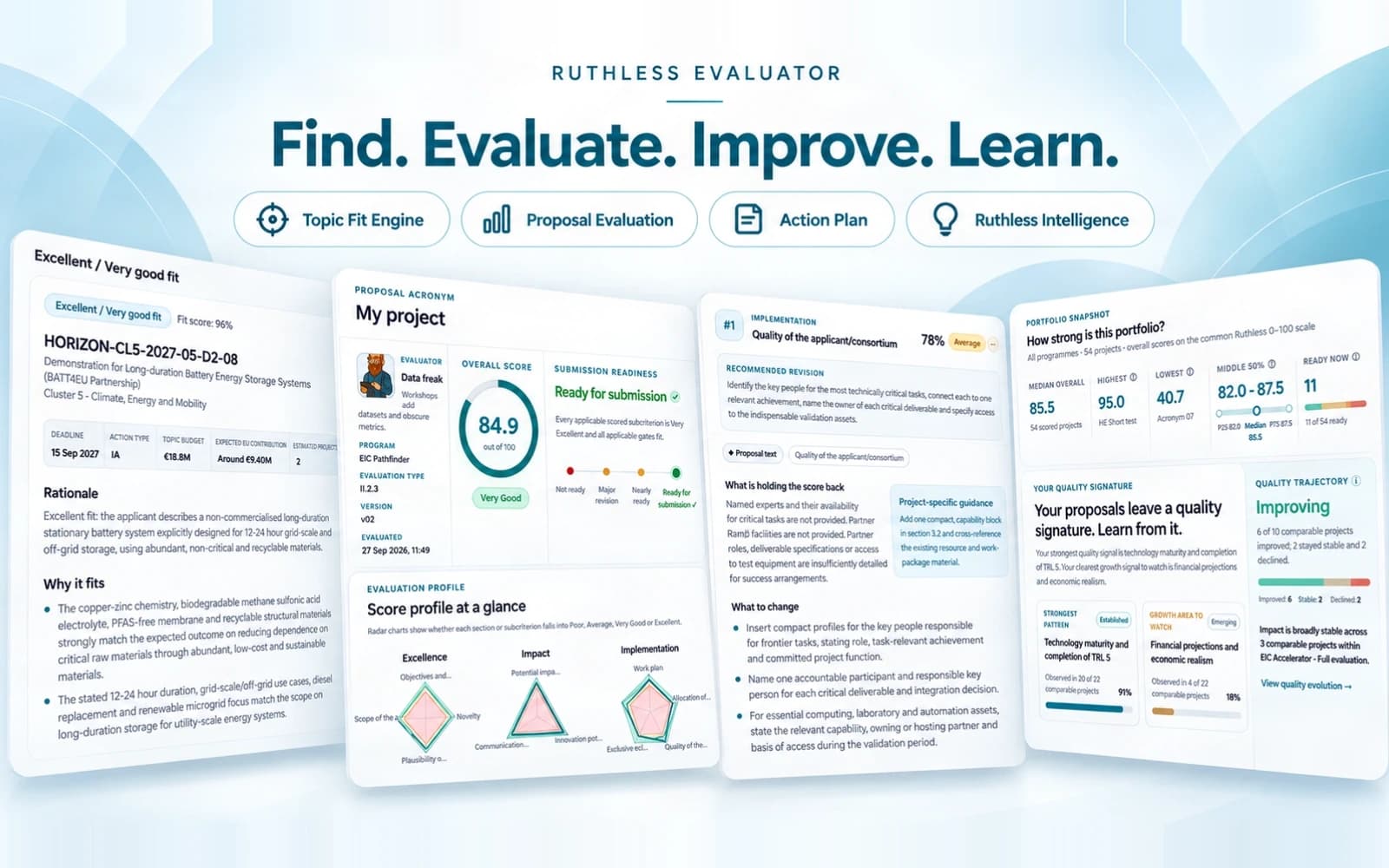
That distinction explains why Ruthless Evaluator has evolved. It began as a way to stress-test a proposal before the real evaluators see it. Today, it supports a broader EU funding quality-assurance and quality-control cycle: Find. Evaluate. Improve. Learn. The value is not four features placed on a homepage. It is four connected questions that a serious proposal team should be able to answer, with evidence, before submitting and again before starting its next bid.
First, distinguish quality assurance from quality control
In everyday conversation, QA and QC are often treated as interchangeable. For proposal work, separating them is useful. Quality assurance (QA) concerns the process: whether the team is using the right sources, appropriate review gates, clear responsibilities and repeatable methods to prevent avoidable defects. Quality control (QC) concerns the output: whether this particular proposal, at this particular stage, contains the evidence, consistency and reasoning it needs.
A template-compliance checklist is one form of QC. A defined process that checks programme fit before drafting, reviews evidence before making commitments, assesses revisions against a stable framework and learns from recurring errors is QA. Both matter. An elegant process can still produce a weak proposal; a brilliant draft can still be submitted through an unreliable process.
Consider an applicant targeting a Horizon Europe Innovation Action. The current Horizon Europe 2026–2027 General Annexes describe award criteria covering Excellence, Impact and the Quality and efficiency of implementation. Those are related but distinct questions. Clear objectives do not compensate for an unexplained impact pathway; an ambitious impact claim does not make a thin work plan credible. A QA/QC system must therefore test not only each answer, but the links between them.
The framework also changes by programme and call. ERC assessments centre on scientific excellence and the applicant's capacity to deliver frontier research, while an EIC Accelerator application requires a coherent case spanning innovation, market, risk and execution. The ERC's explanation of its evaluation approach and the EIC Accelerator guidance for applicants make that difference clear. A single generic “good proposal” checklist is not enough.
The hidden cost of treating quality as a final-stage activity
Late-stage review feels efficient because it leaves researchers and business developers free to write. In practice, it can make correction expensive. Once objectives, partners, technical milestones and budgets have been agreed, finding a fundamental misalignment may require rewriting several sections and renegotiating commitments. The document is now polished, but its assumptions are locked in.
Take a plausible battery technology proposal. The team describes a convincing low-cost storage chemistry and strong early test results. Yet the targeted topic expects demonstration at a maturity level the project cannot reach within the proposed timeframe. The defect is not a sentence to improve; it is a fit decision that should have been challenged before the work packages were designed.
Or take an EIC Accelerator applicant that forecasts rapid growth from a new industrial process. Revenue is calculated correctly, but manufacturing qualification is scheduled after commercial deliveries begin, and the cash forecast treats an uncommitted investment round as if it were available liquidity. Each section may read well in isolation. Together they describe an execution gap. This is why proposal consistency matters even when individual sections look strong.
Good QA/QC moves difficult questions earlier and keeps them visible throughout revision. It does not eliminate uncertainty. It makes assumptions, missing evidence and unresolved decisions harder to overlook.
Find: are you applying to the right opportunity?
The first quality decision is not how to write the proposal. It is whether the project belongs in the call at all. A topic can appear attractive because its title contains familiar technical keywords. That does not establish alignment with the expected outcomes, action type, demonstration requirements, beneficiary profile or scope exclusions.
Ruthless Evaluator's Topic Fit Engine helps users identify relevant Horizon Europe opportunities from a project description and, where available, information about maturity, applicant profile and the technological area. The output is intended to show not only potentially suitable topics but also why they fit and what needs verification. It is a decision aid, not a replacement for the latest official Work Programme and call conditions.
A useful fit check should answer three questions. Does the proposed problem match what the funder is trying to address? Can the team deliver the expected outcomes with its actual maturity, resources and partners? And which decisive mismatch would force a different project design? A high thematic similarity score is not enough if the delivery requirements are wrong.
Imagine two topics using the language of sustainable energy storage. One may be oriented towards basic materials discovery; another may require field-scale demonstration and an industrial value chain. The same technology could be promising for both, but the proposal, consortium, evidence requirements and timeline would be very different. Find is the preventive QA step: it reduces the risk of spending months perfecting the wrong application.
For the practical workflow, see our Topic Fit Engine walkthrough. The final decision should always be checked against the official call documentation and its current version.
Evaluate: can an independent reader verify the case you are making?
After selecting a credible opportunity, the next task is to challenge the draft as it stands. Not as the author intended it. Not with the additional explanation a friendly colleague can provide over coffee. As an external reader who has only the submitted evidence.
Ruthless Evaluator's proposal evaluation provides structured, programme-specific feedback on the strengths, weaknesses and missing justifications in the application. It can help users examine subcriteria, see where confidence is being lost and understand the gap between a plausible assertion and a substantiated argument. The numerical scores are Ruthless's proprietary diagnostic scale, not predictions of official panel scores or funding outcomes.
That distinction matters. The most valuable result is rarely a number in isolation. It is a sentence such as: “The proposed 2029 supply volume is not reconciled with the capacity that will actually be qualified for sale,” or “The claimed energy saving is not supported by a comparison under equivalent operating conditions.” Those observations can be checked, challenged and acted on. A generic comment to “strengthen impact” cannot.
Different funding schemes require different forms of scrutiny. For collaborative projects, the link between objectives, work packages, deliverables, effort and expected outcomes may be decisive. For EIC applicants, a commercially convincing story needs evidence on customers, technical readiness, intellectual property, costs and risk. For ERC projects, the originality and ambition of the science and the capabilities of the principal investigators demand particular attention. The evaluation must reflect the relevant framework, not force every proposal into the same language.
An effective evaluation should also surface what is already working. The point is not to generate criticism for its own sake. It is to preserve strong evidence while exposing the claims that still depend on the reader's goodwill.
Improve: turn feedback into a controlled revision plan
A report listing twenty weaknesses may be accurate and still be unusable. A proposal team has limited time. Some improvements depend on others; some require fresh evidence from customers or partners; some can be resolved by clarifying material that already exists. Treating every comment as equally urgent wastes that time.
Ruthless Evaluator's Action Plan converts diagnostic findings into ranked, project-specific revisions. Its purpose is to answer what to change, in what order and how to support the change. For each priority, the user can examine the problem, the recommended revision, the evidence required and guidance about where to incorporate it. The plan focuses on up to ten high-impact improvements, rather than generating tasks simply to fill a quota; already Excellent subcriteria do not need an artificial improvement item.
Imagine that a proposal has three linked weaknesses: its projected sales are not backed by customer purchasing assumptions, its manufacturing plan does not demonstrate enough qualified capacity, and its cash forecast does not account for a delay in qualification. Editing the market paragraph first may not solve anything. The more effective sequence is to establish credible customer demand, reconcile deliverable capacity and then update the financial scenario and risk response. The order matters because the evidence is connected.
The Action Plan is not a promise that every recommendation can be implemented immediately. Some actions require laboratory data, legal advice or a customer's confirmation. A useful revision process records ownership and realistic dependencies, distinguishes evidence that exists from evidence still to be obtained, and leaves unresolved uncertainty visible rather than covering it with confident wording.
Teams can use the plan as a short working agenda: assign the priority, specify the evidence owner, update the relevant proposal section and re-evaluate the revised version. Then compare what has genuinely changed. Rewriting a paragraph is activity; resolving an evidential gap is progress.
Learn: stop repeating the same weaknesses across proposals
Fixing one application is necessary. It is not sufficient if the same mistakes return in the next call. An individual researcher may consistently under-explain the significance of their own contribution. A company may repeatedly present forecast revenue before validating the assumptions behind demand. A consultancy may write strong impact sections but keep producing thin risk and implementation logic. A one-off review rarely reveals those patterns.
Ruthless Intelligence extends quality assurance beyond a single document. It can analyse a selected body of evaluation evidence—individual projects, revision histories or a wider portfolio—to show supported strengths, recurring growth areas and quality evolution. It distinguishes patterns supported by comparable evidence from signals that are still emerging or too isolated for confident conclusions. This prevents a small or mixed sample from being treated as definitive proof of someone's writing ability.
The quantitative analysis is grounded in recorded evaluation data; the interpretation should remain tied to those observations rather than invent statistics or manufacture certainty. That makes the output useful to an individual grant writer, a PI, a research office or a team leader who needs to decide where improvement effort should go.
A particularly practical result is the three-week personal development sprint, available in the relevant Ruthless Intelligence analysis workflow. Instead of merely labelling a person “weak at impact”, a supported finding can become a learning priority, specific practice and evidence to revisit in later proposals. The plan is a development aid, not an objective measurement of professional competence. When evidence is insufficient, the right conclusion is that the pattern cannot yet be established.
Our more detailed article on how Ruthless Intelligence turns evaluation history into quality assurance explains why these distinctions matter. Learn is the part of the loop that turns repeated proposal work into accumulated professional knowledge.
A practical QA/QC cycle for your next EU funding proposal
The four stages are most valuable when used as a continuous workflow rather than four disconnected screens. The following example is a simple working sequence that a researcher, innovation manager or proposal consultant can adapt without introducing a heavy governance bureaucracy.
Before committing to a call, write a short statement of the project problem, present maturity, intended outcome and non-negotiable constraints. Use Find to identify relevant options, then verify the official topic text, required outcomes and scheme rules. Record the decisive fit assumptions and who will verify them.
At the first coherent draft, use Evaluate to stress-test the logic, not merely grammar. Look for high-impact weaknesses: claims without evidence, unexplained risks, numbers that cannot be reconciled, or missing links between objectives and delivery. Discuss disagreements with the relevant technical, commercial or scientific owner rather than accepting either the author's confidence or an AI-generated comment automatically.
Before the revision freeze, use Improve to assign the highest-value actions. Separate changes requiring new evidence from those requiring better explanation of existing evidence. Check that resolving one priority does not introduce contradictions elsewhere. Re-evaluate where appropriate, comparing the actual findings rather than optimising for a cosmetically higher diagnostic score.
After submission or after several comparable proposals, use Learn to examine patterns. Which weaknesses repeatedly survive internal review? Which strengths are worth standardising? What should an individual or team practise during the next three weeks? Carry the answer into the next project's opening checklist so the same problem does not need to be rediscovered every time.
This cycle can coexist with internal peer review, consultants, administrative compliance checks and formal approval gates. Ruthless does not replace those people or processes; it provides another structured layer of scrutiny and memory around them. It also respects a fundamental boundary: the authorised call documents and the submission portal remain the official sources of programme requirements.
Five questions to ask before you call your proposal submission-ready
A final review should ask more than “Has everyone approved their section?” A more revealing QA/QC conversation covers five decisions:
- Fit: Can we point to the exact call requirements and explain why the project's maturity and intended outcomes meet them?
- Evidence: Which three claims would be hardest for an external evaluator to verify from the submitted material alone?
- Consistency: Do the work plan, resources, risks, impact assumptions and financial logic describe the same project and timetable?
- Revision: What are the highest-value unresolved weaknesses, who owns them, and what proof—not just text—would close them?
- Learning: If this proposal were reviewed again six months from now, what recurring team weakness should already have been addressed?
If the team cannot answer one of these questions, a final proofreading round will probably not provide the answer. A mature QA/QC process makes such gaps visible while there is still time to do something about them.
From stress-testing one draft to improving an organisation's proposal capability
Ruthless Evaluator's original mission has not disappeared. A rigorous stress-test remains one of the most useful things a team can do before submitting a competitive EU funding application. What has changed is the scope of the problem we are helping users solve. A single better proposal is valuable; a repeatable ability to choose, test, revise and learn is more valuable still.
That is what Find. Evaluate. Improve. Learn. is designed to support. Find helps challenge the initial opportunity decision. Evaluate makes evidence and weaknesses visible before submission. Improve translates that diagnosis into an ordered set of practical revisions. Learn uses accumulated evaluations to identify patterns worth preserving or correcting over time.
No platform can guarantee funding, remove scientific uncertainty or substitute for the judgement of experienced applicants and official evaluators. But a team can demand better traceability, fewer avoidable contradictions and a more useful way to learn from its own work. EU proposal quality should be a process you can repeat, not a final-hour hope.
Explore the Topic Fit Engine, proposal evaluation workflow and Ruthless Intelligence to see how the four-stage approach fits into your next proposal cycle.
Run an evaluator grade review on the draft
Upload a version, select programme context, and get structured feedback you can act on.